Grade 2 Daily Routines Lesson Plan: My Day
Members Only ESL Lesson Plan Grade 2
No ratings yet

Grade 2 Daily Routines Lesson Plan: My Day

About This Resource

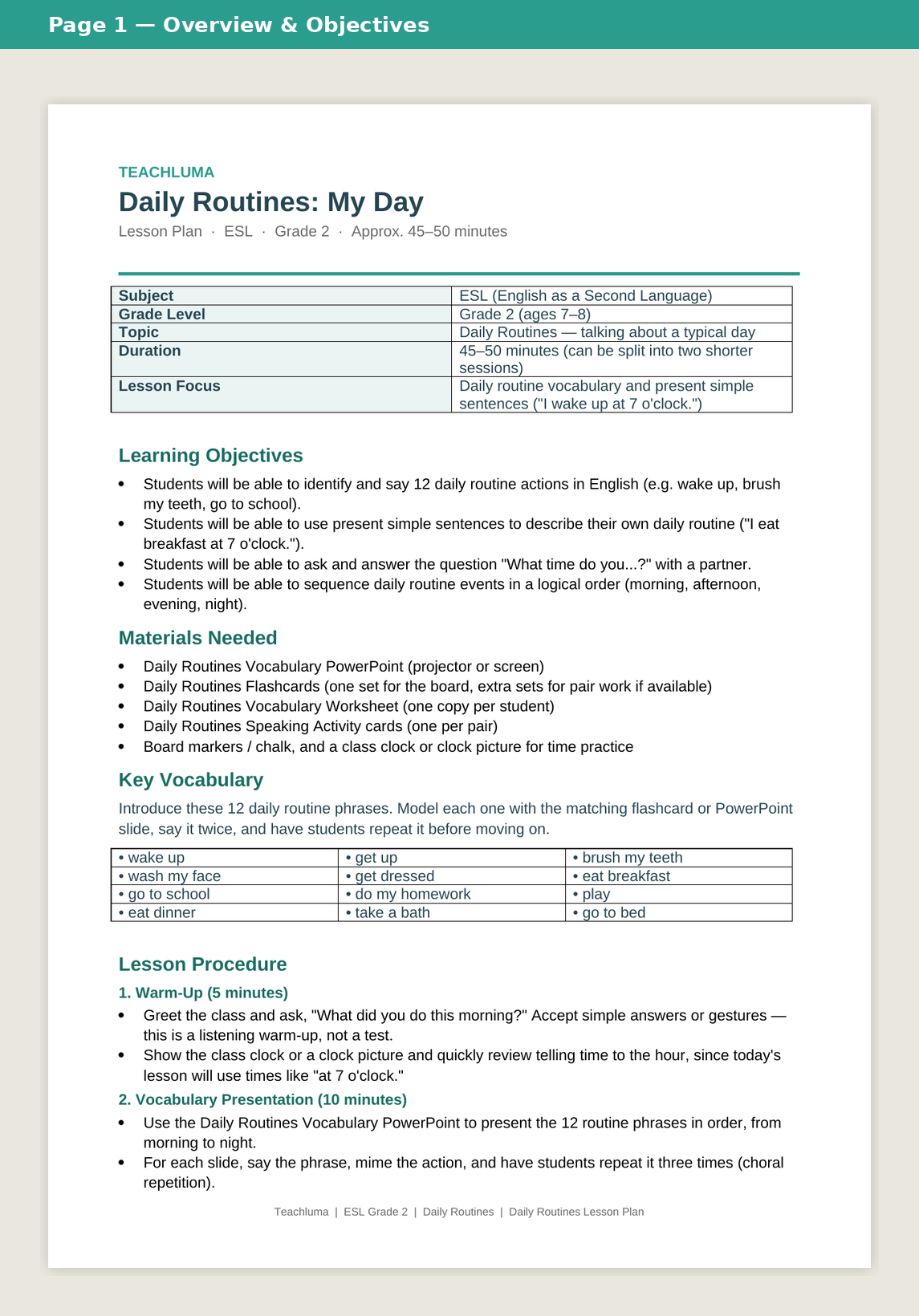
A complete 45–50 minute lesson plan for introducing daily routine vocabulary and present simple sentences to Grade 2 English learners. It walks a teacher step by step from warm-up through vocabulary presentation, guided practice, a paired speaking task, and a wrap-up review, and it is written for classrooms where English is a second or foreign language, so every step includes exactly what to say and do.

Overview

This lesson plan brings together the other Daily Routines resources (the Vocabulary PowerPoint, Flashcards, Vocabulary Worksheet, and Speaking Activity) into a single, ready-to-teach sequence. It is built around 12 core daily routine phrases — from "wake up" to "go to bed" — and the present simple sentence pattern students need to talk about their own day ("I eat breakfast at 7 o'clock."). Each stage of the lesson has a clear time allocation, a short list of teacher actions, and built-in checks for understanding, so a teacher can pick it up and teach directly from the page. A differentiation table and an assessment section are included, along with a short teacher's tip and an optional homework extension. A blank reflection-notes section at the end gives the teacher space to jot down what worked after the lesson is taught.

Resource Details

Subject
ESL
Topic
Daily Routine - Lesson Plan
Category
Lesson Plans
File Type
PDF
File Size
77.5 KB
Published
03 Sep 2026
Downloads
0

Members Only

Upgrade to Teacher Pro (from ฿199/month) to download this resource.

Share:

Grade 2 Daily Routine Lesson Plan

Learning Objectives

  • Students will be able to identify and say 12 daily routine actions in English.
  • Students will be able to use present simple sentences to describe their own daily routine.
  • Students will be able to ask and answer the question "What time do you...?" with a partner.
  • Students will be able to sequence daily routine events in a logical order (morning, afternoon, evening, night).

Lesson Procedure

  • Read through the lesson plan once before class and gather the materials listed (the Vocabulary PowerPoint, a set of Flashcards, copies of the Vocabulary Worksheet, and Speaking Activity cards — all sold separately as part of this Daily Routines collection). Teach the five stages in order: Warm-Up, Vocabulary Presentation, Guided Practice, Main Activity, and Wrap-Up/Review. The lesson is designed for a single 45–50 minute class period but can be split across two shorter sessions if your school's timetable requires it — the natural break point is right after Guided Practice. Use the differentiation table to adjust support for English learners who need extra scaffolding and for students ready for an extra challenge. Fill in the Teacher Reflection Notes section after teaching to help plan your next lesson on this topic.

Assessment

Assessment is built into the lesson through teacher observation during guided practice and the paired speaking activity, plus the completed Vocabulary Worksheet as an informal written check. For a more formal record of student performance on this topic, use the companion Daily Routines Grading Rubric.

Differentiation

SUPPORT: Pair English learners with a supportive partner and keep the flashcards visible on the board throughout the lesson as a picture word bank, so students can point to a card if they cannot recall a word.

ON-LEVEL: Students complete the worksheet and speaking activity as planned, using the sentence frame "I ___ at ___ o'clock."

CHALLENGE: Ask students to add a second detail to each sentence ("I eat breakfast with my family at 7 o'clock.") or to interview two classmates instead of one.

Classroom Activity Ideas

  • After the wrap-up mime review, play a quick "Freeze Frame" game: call out a routine phrase and students must freeze in the matching pose. The last student to freeze (or anyone frozen in the wrong pose) sits out for one round. It is a fast, low-prep way to end the lesson with energy while reinforcing the vocabulary one more time.

Teacher Tips

Mime every action as you say it, even after students seem to know the words. Grade 2 English learners hold onto vocabulary far better when a word is tied to a physical movement, and the mime also gives quieter students a way to show understanding before they are ready to speak.

What's Included

  • 3-page lesson plan (editable and print-ready)
  • Editable DOCX version
  • Print-ready PDF version

Additional Files

  • Daily Routines Lesson Plan Grade 2 (DOCX)

Teacher Reviews

No ratings yet

Be the first teacher to review this resource.

Sign in to review this resource.

Related Resources

Free Grade 1

Phonics — Unit Teacher's Guide

Lesson Plan · Phonics Lesson Plan

A four-page planning guide that maps all nine companion Phonics resources into a suggested...

View Resource
Free Grade 6

Lesson Plan | ESL | Grade 6 | Unit 2: School Life & Learning Skills

Lesson Plan · School Life & Learning Skills

A five-lesson teaching sequence mapping all eleven other Unit 2 resources into approximate...

View Resource
Free Grade 6

Unit 1 Lesson Plan — Personal Identity & Communication

Lesson Plan · Personal Identity & Communication - Lesson Plan

A five-lesson teaching sequence mapping all eleven other Unit 1 resources into approximate...

View Resource
Free Grade 1

Numbers — Unit Teacher's Guide

Teacher Resource · Numbers - Teacher's Guide

A three-page planning guide that maps all nine companion Numbers resources into a suggeste...

View Resource
Free Grade 1

Greetings and Introductions — Unit Teacher's Guide

Teacher Resource · Teacher's Guide

A three-page planning guide that maps all nine companion Greetings and Introductions resou...

View Resource
Free Grade 1

Classroom Objects — Unit Teacher's Guide

Teacher Resource · Teacher's Guide - Classroom Objects

A three-page planning guide that maps out all nine companion Classroom Objects resources i...

View Resource