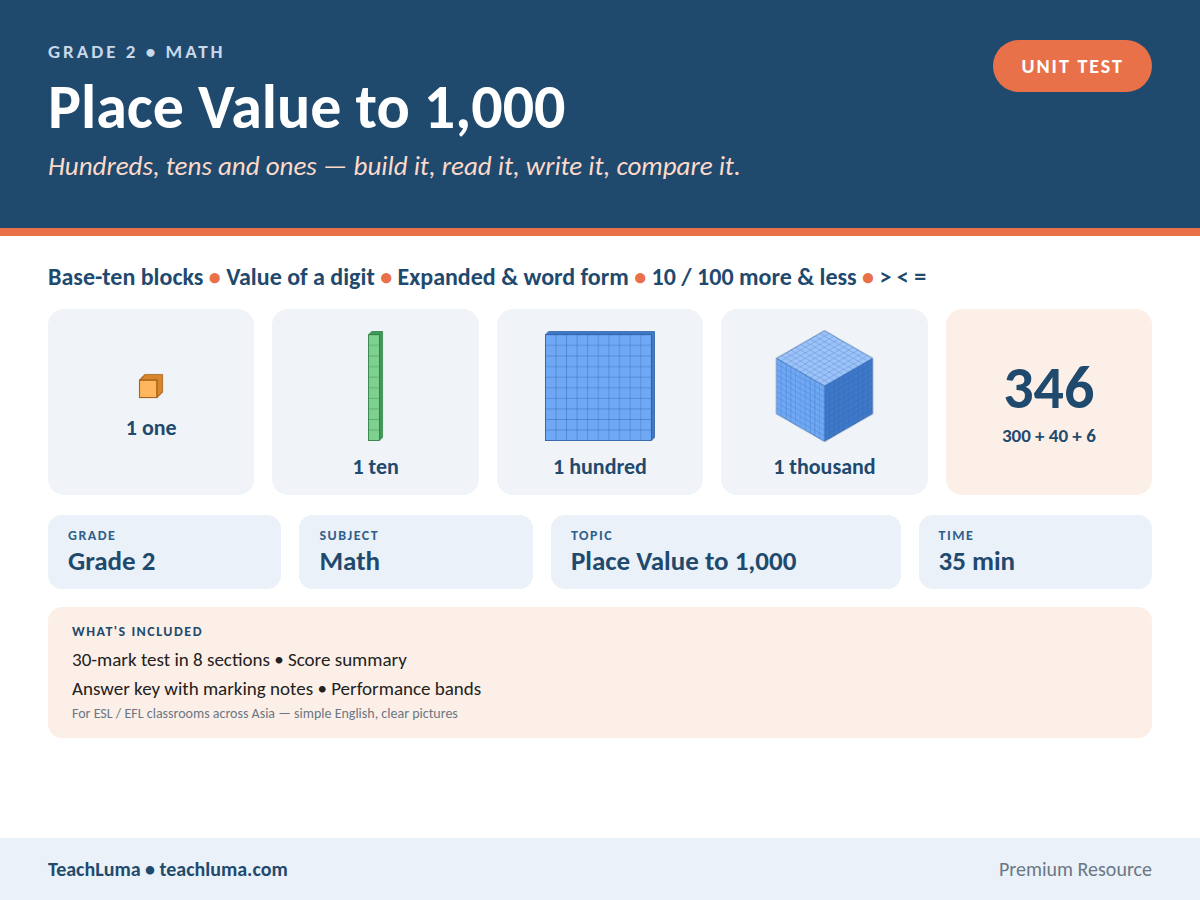
Grade 2 Math Unit Test: Place Value to 1,000 (30 Marks)
A 2-page, 30-mark unit test in 8 sections — blocks, value of a digit, three forms, skip co...
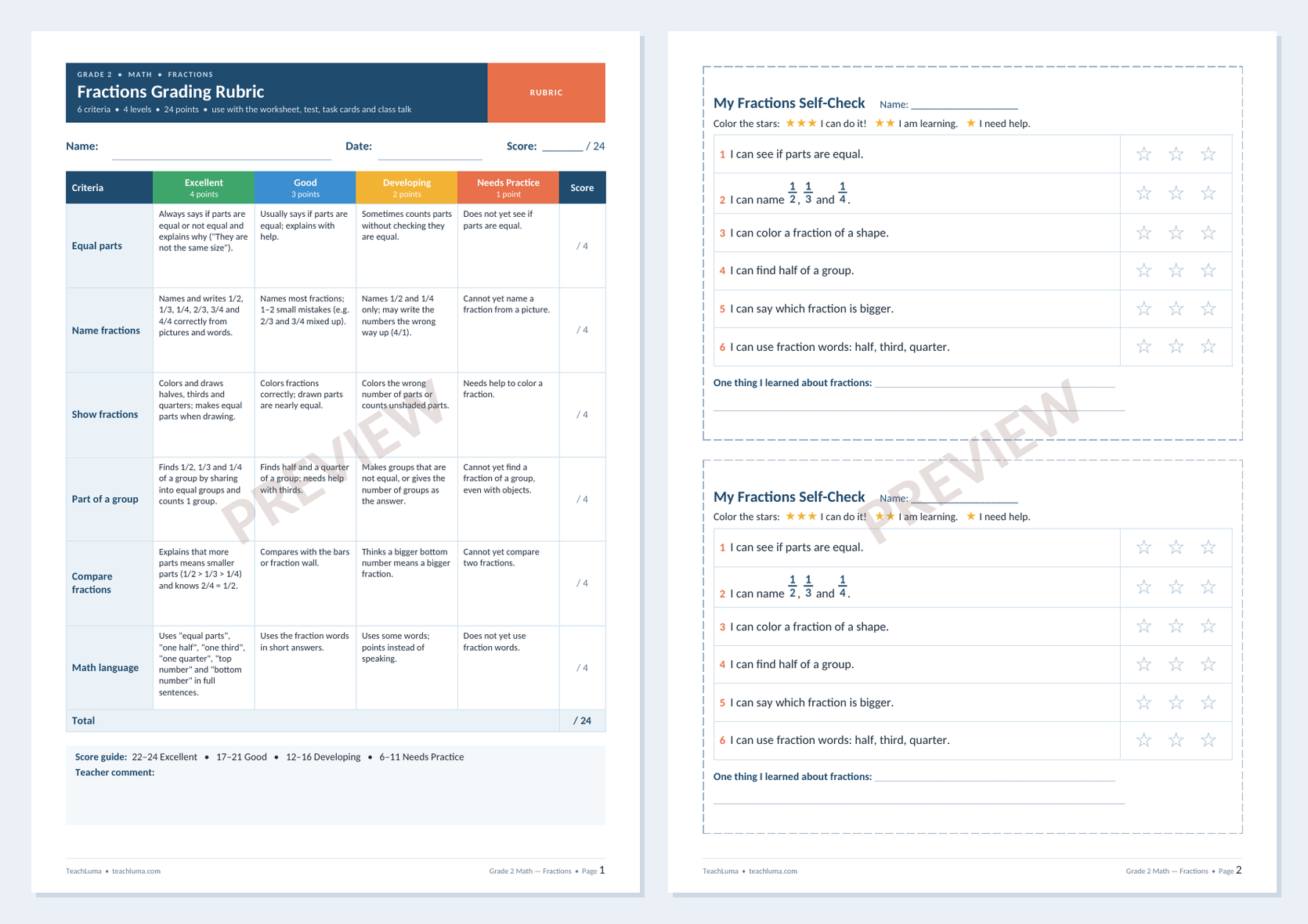
View Resource : Grade 2 Math Unit Test: Place Value to 1,000 (30 Marks)A 6-criteria, 4-level rubric (24 points) for Grade 2 fractions — equal parts, naming fractions, showing fractions, part of a group, comparing and math language — with a score guide and a child-friendly "I can" self-check with stars (2 per page).
This pack teaches Grade 2 children their first fractions. Children start with fair sharing ("Mai and Nam share 1 roti — is it fair?") and learn that a fraction is a part of a whole with equal parts. They fold paper to make halves, quarters and thirds, then name, write and color 1/2, 1/3, 1/4, 2/3, 3/4 and one whole, using the simple rule "top number = parts we count, bottom number = equal parts in all". They find half, a third and a quarter of a small group by sharing into equal groups, compare fractions on a fraction wall (1/2 > 1/3 > 1/4, 2/4 = 1/2) and solve short stories about sharing food. Every shape is drawn with exact equal parts, and "not equal" shapes are included on purpose so children learn to check. The English is short and the same every time, for ESL / EFL learners. This listing covers the Grading Rubric only.
Free download — no account required.
Teaching this in class? Try our free Random Name Picker & Timer.
Looking for something different? Request a Resource.
Support: Let children fold real paper shapes for every question and keep the fraction wall on the desk. Start with halves and quarters only, then add thirds. Use counters and cups for part of a group. Give sentence frames ("The shape has __ equal parts. __ part is shaded.") and pair a child who is new to English with a partner who models the sentences.
Extension: Show 1/4 of a square in three different ways, find 1/6 and 1/8 on the fraction wall, find 2/3 of 9 or 3/4 of 8, and write a sharing story for 1/3. Fast finishers can play Fraction Fun! in Mix mode.
Add the six scores (6–24). The score guide is printed under the rubric.
The most common mistake is counting parts that are not equal: a child sees 3 parts and says "one third" even when the parts are different sizes. Make one question a habit before every fraction: "Are the parts equal?" Cut a paper shape and lay the parts on top of each other so children can see it. The second big mistake is thinking 1/4 is bigger than 1/2 "because 4 is bigger than 2" — cut the same roti or paper strip into 2 and into 4 and let children hold the pieces. Many Asian textbooks say "quarter" and US books say "fourth"; teach "quarter" and accept both.
No ratings yet
Be the first teacher to review this resource.
A 2-page, 30-mark unit test in 8 sections — blocks, value of a digit, three forms, skip co...
View Resource : Grade 2 Math Unit Test: Place Value to 1,000 (30 Marks)A one-page, 22-point cumulative assessment covering every Place Value resource — matching ...
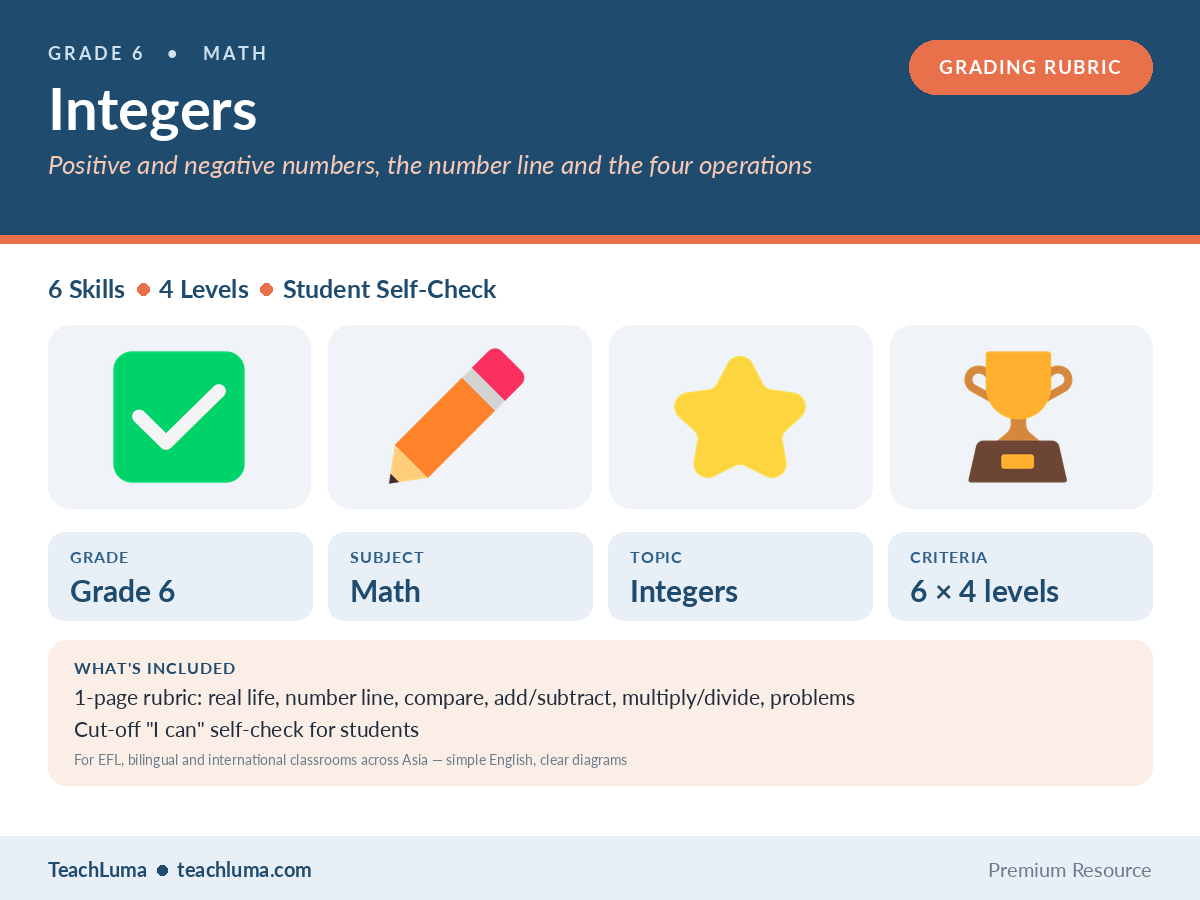
View Resource : Grade 2 Place Value Review QuizA 1-page rubric that scores 6 integer skills on a 4-level scale — real life, number line a...
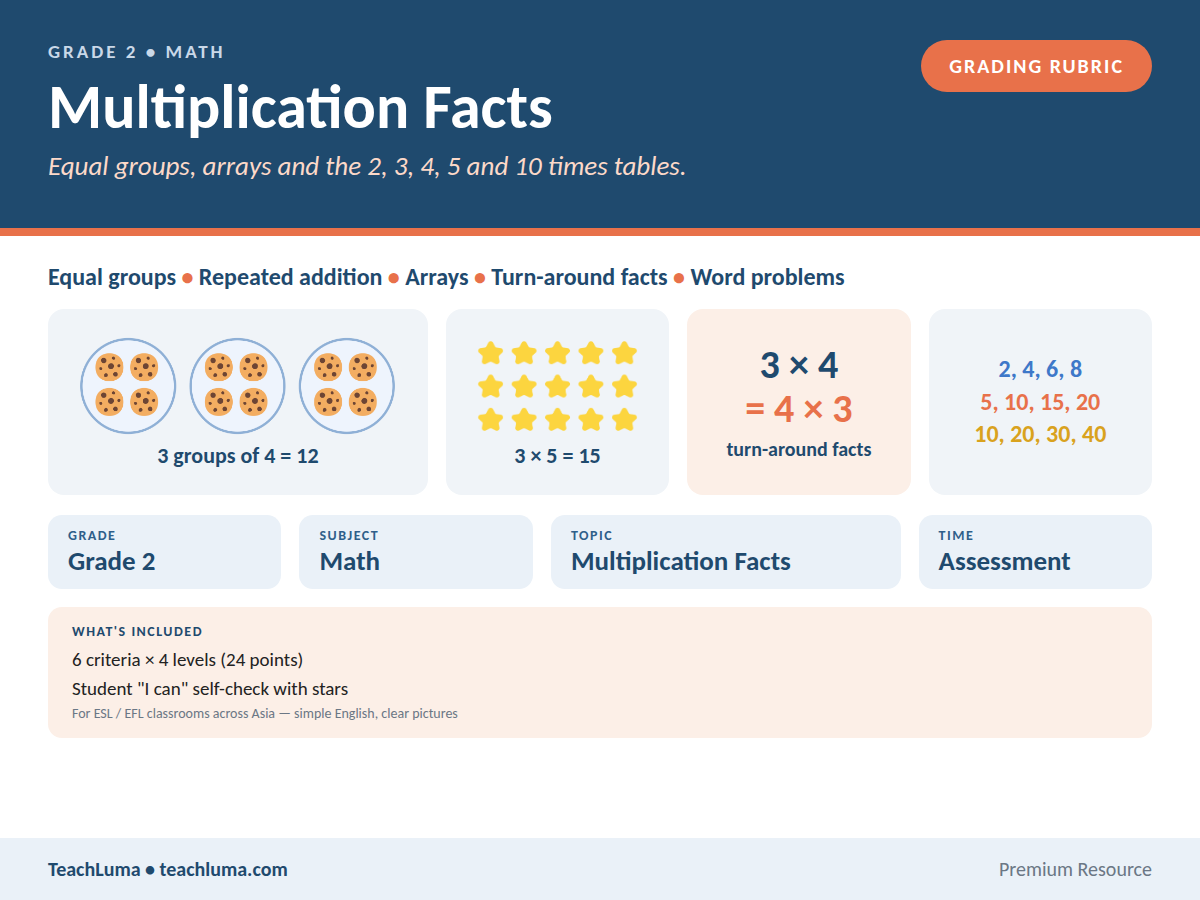
View Resource : Grade 6 Math Grading Rubric: Integers — 6 Skills, 4 Levels and a Student Self-CheckA 6-criteria, 4-level rubric (24 points) for multiplication — equal groups, arrays, 2s/5s/...
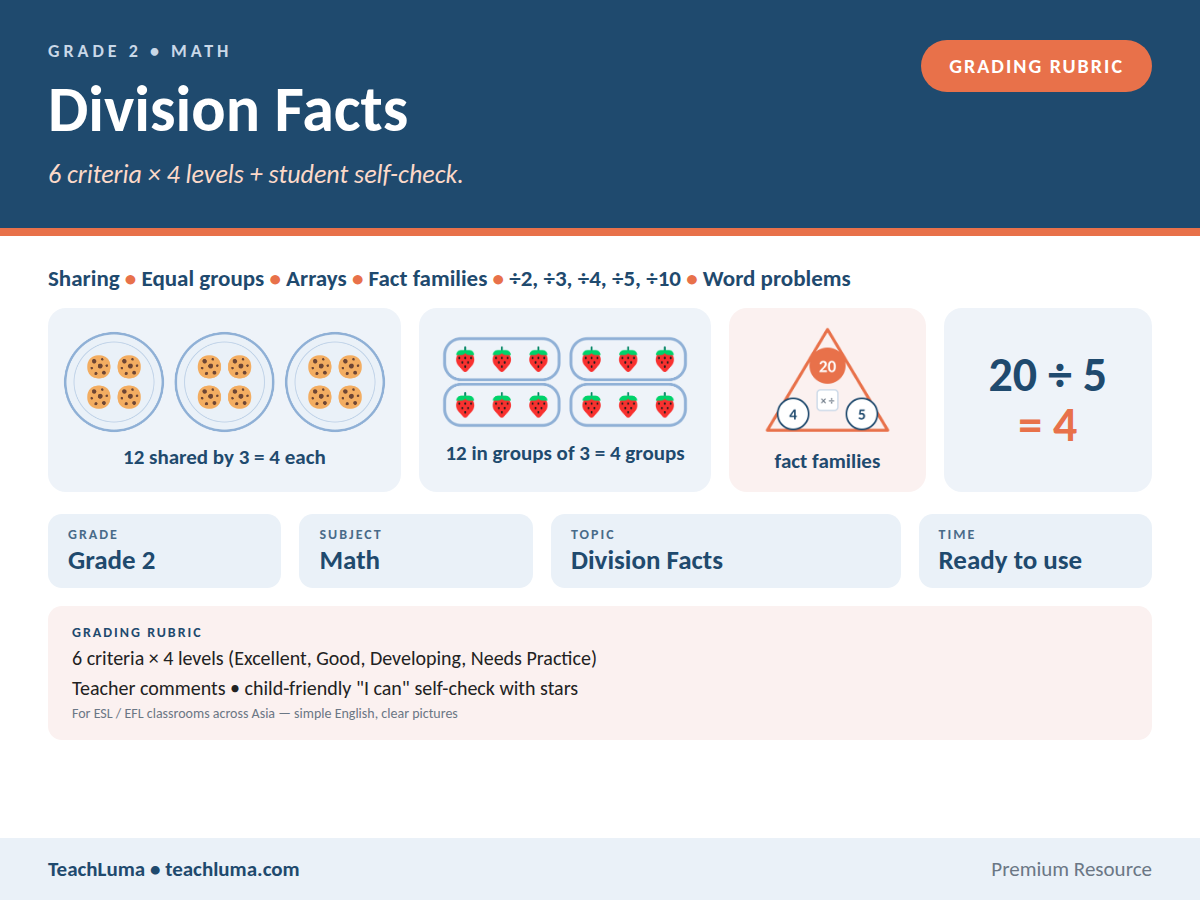
View Resource : Grade 2 Math Grading Rubric: Multiplication Facts + Student Self-CheckA 6-criterion, 4-level grading rubric for Grade 2 division (sharing, groups, writing facts...
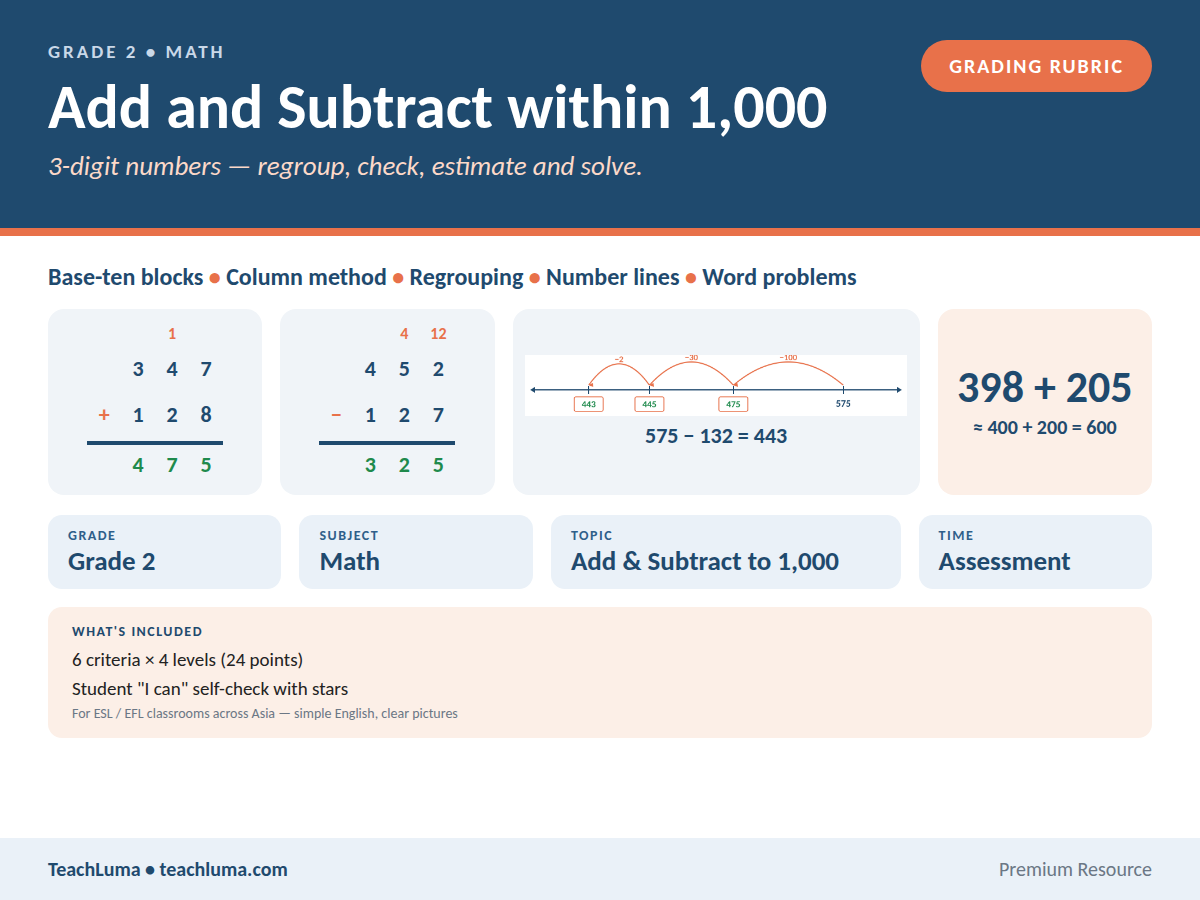
View Resource : Grade 2 Math Grading Rubric: Division Facts — with Student Self-CheckA 6-criteria, 4-level rubric (24 points) for 3-digit addition and subtraction, with a teac...
View Resource : Grade 2 Math Grading Rubric: Add and Subtract within 1,000 + Student Self-CheckAdvertisement