Grade 2 Math Unit Test: Telling Time (30 Marks)
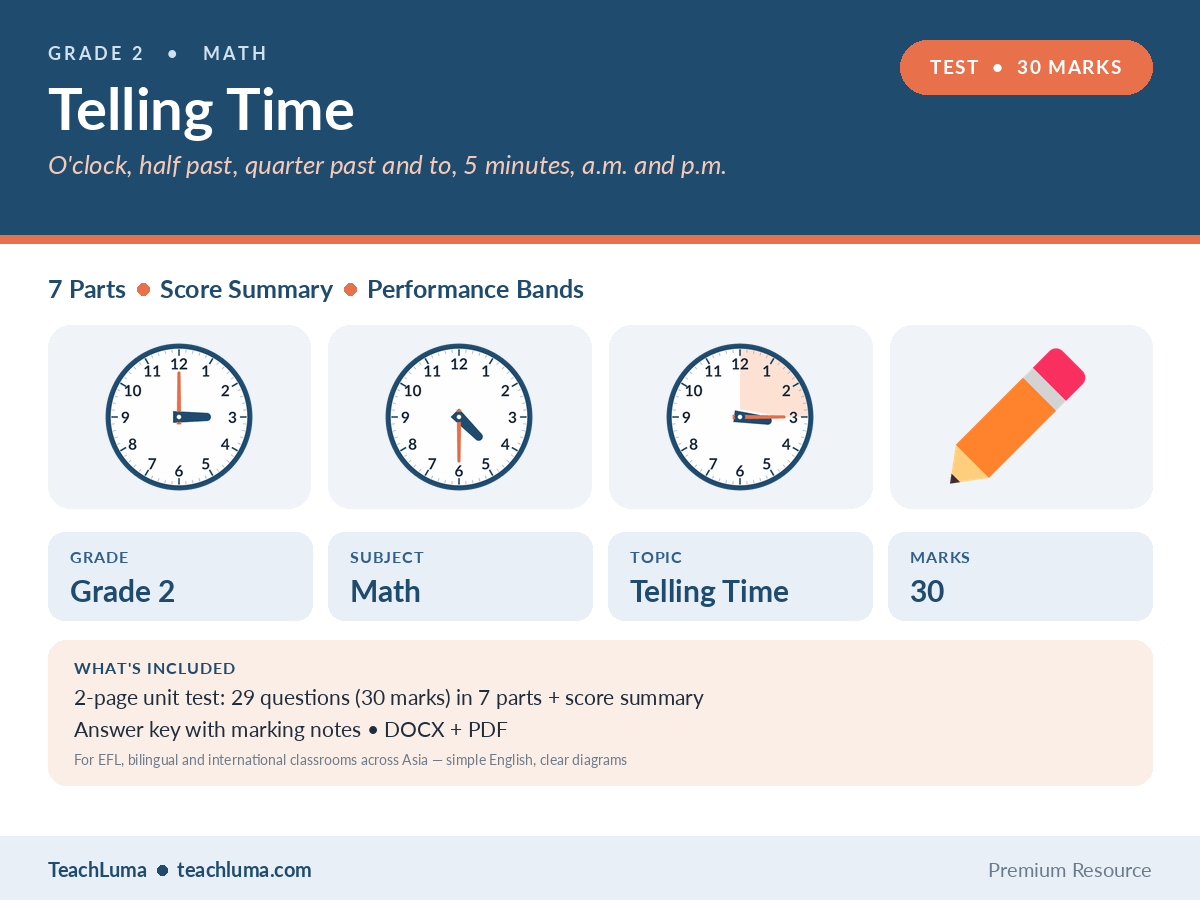
A 2-page, 30-mark unit test in 7 parts — o'clock and half past, quarter past and quarter t...
View Resource : Grade 2 Math Unit Test: Telling Time (30 Marks)A 2-page, 30-mark unit test in 8 parts — coins and notes, count the same coins, count mixed coins, count the dollars, which is more?, add prices, find the change and Check it! — with a score strip, performance bands and a full answer key.
This pack teaches Grade 2 children to recognise, count and use money in dollars and cents. Children learn the coins (5¢, 10¢, 20¢, 50¢, $1) and notes ($2, $5, $10), write amounts with ¢ and $, and learn that 100¢ = $1. They skip count the same coins by 5s, 10s, 20s and 50s, then count mixed coins and notes by starting with the biggest and counting on. They compare amounts (more coins is not always more money), make an amount in different ways, add two prices at a school canteen and a toy shop, find the change from 50¢, $1 and $10 by counting up, decide if they have enough money, and read amounts like $2.50. The coins and notes are a simple, generic dollars-and-cents set drawn for TeachLuma (like the systems used in Singapore, Hong Kong and Australia), so the pack works in any international or bilingual school. The English is short and repeated, for ESL / EFL learners. This listing covers the Assessment only.
Target Grade: Grade 2 (ages 7–8)
Members Only
Upgrade to Teacher Pro (from ฿199/month) to download this resource.
Looking for something different? Request a Resource.
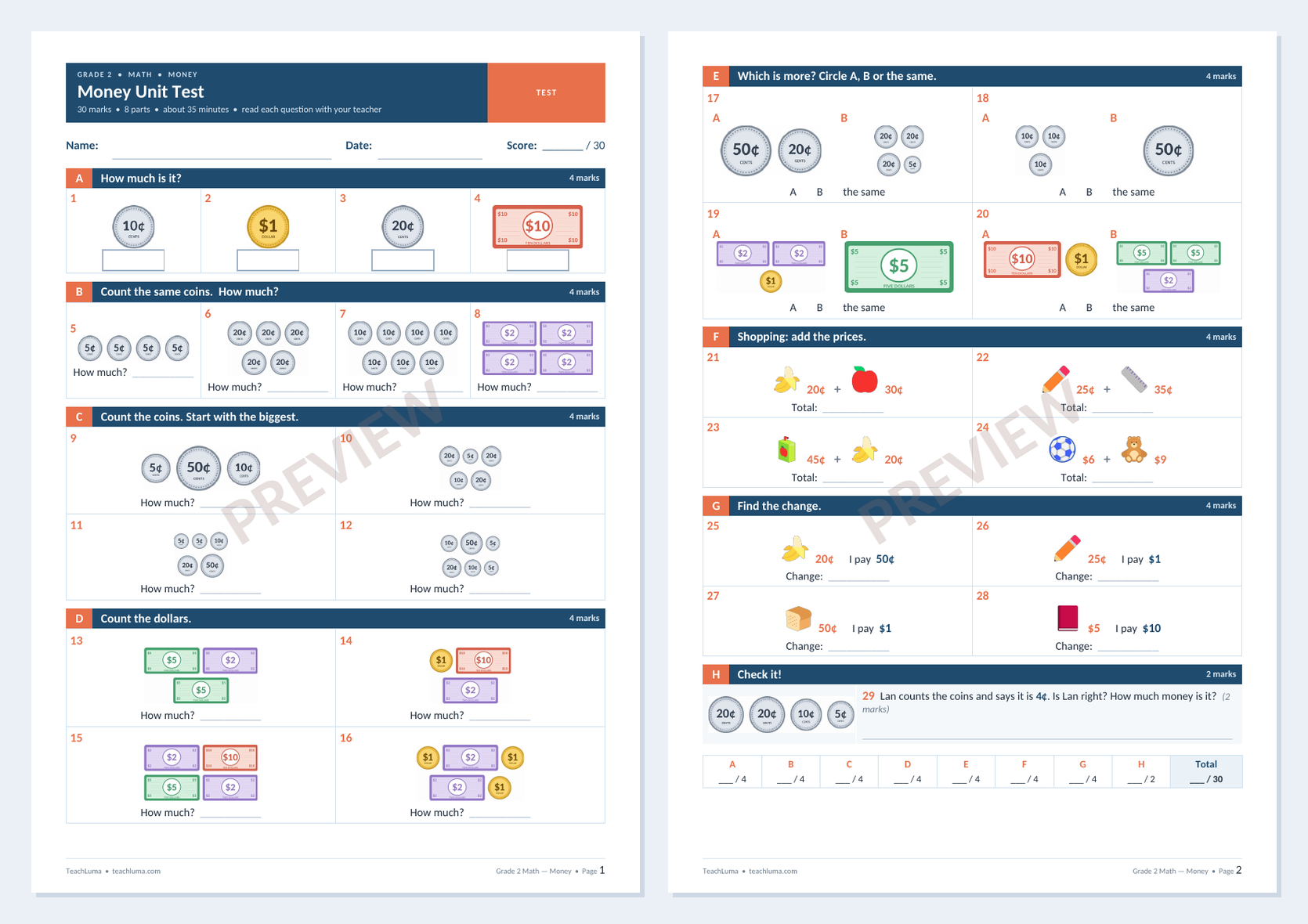
30 marks in 8 parts (29 questions; question 29 is worth 2 marks), with a score strip, performance bands and a complete, numbering-matched answer key.
Support: Let children use the play money for every question and sort the coins before they count. Work in cents only (up to 50¢) before moving to dollars. Give a 100-chart for counting on, and sentence frames ("It is ___ cents." "It costs ___." "My change is ___."). Pair a child who is new to English with a partner who models the sentences.
Extension: Make $1 in as many ways as possible, buy three things and find the change, work with amounts like $3.75, or plan a class party with a $20 budget. Fast finishers can play Money Market (Change mode) or run the Class Shop.
The biggest mistake in this unit is counting the coins instead of the money: a child sees 5 coins and says "5 cents". Make one question a habit: "How much is THIS coin worth?" and have children touch each coin and say its value as they count on. Always sort first — biggest on the left — then count on: "50 … 70 … 75." For change, never teach it as a hard subtraction at this age: count UP from the price to the money paid with play coins (45¢ … 50¢ … $1 = 55¢), just like a shopkeeper. If your country uses different coins, show your real coins next to the pack coins on Day 1 and ask "Which one is like 10¢?" — the maths is exactly the same.
No ratings yet
Be the first teacher to review this resource.
A 2-page, 30-mark unit test in 7 parts — o'clock and half past, quarter past and quarter t...
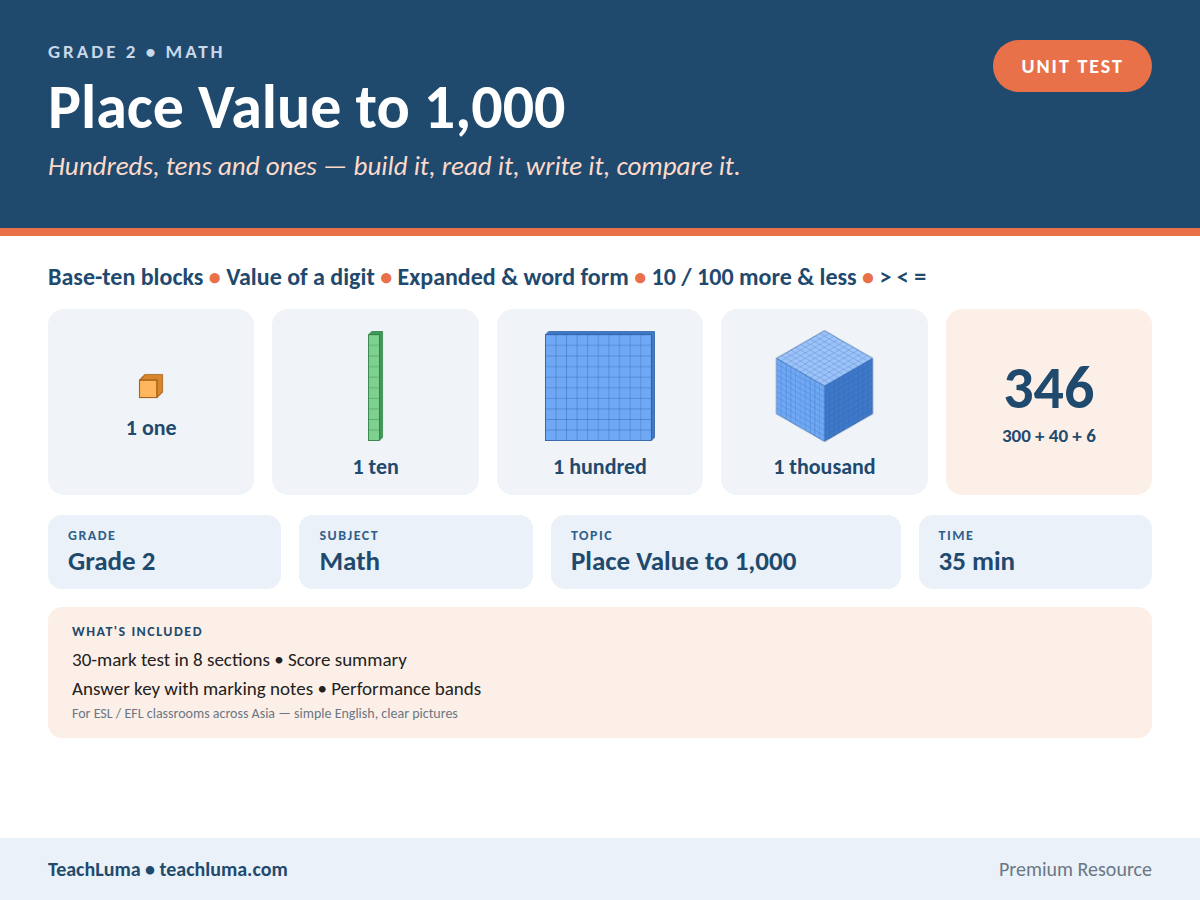
View Resource : Grade 2 Math Unit Test: Telling Time (30 Marks)A 2-page, 30-mark unit test in 8 sections — blocks, value of a digit, three forms, skip co...
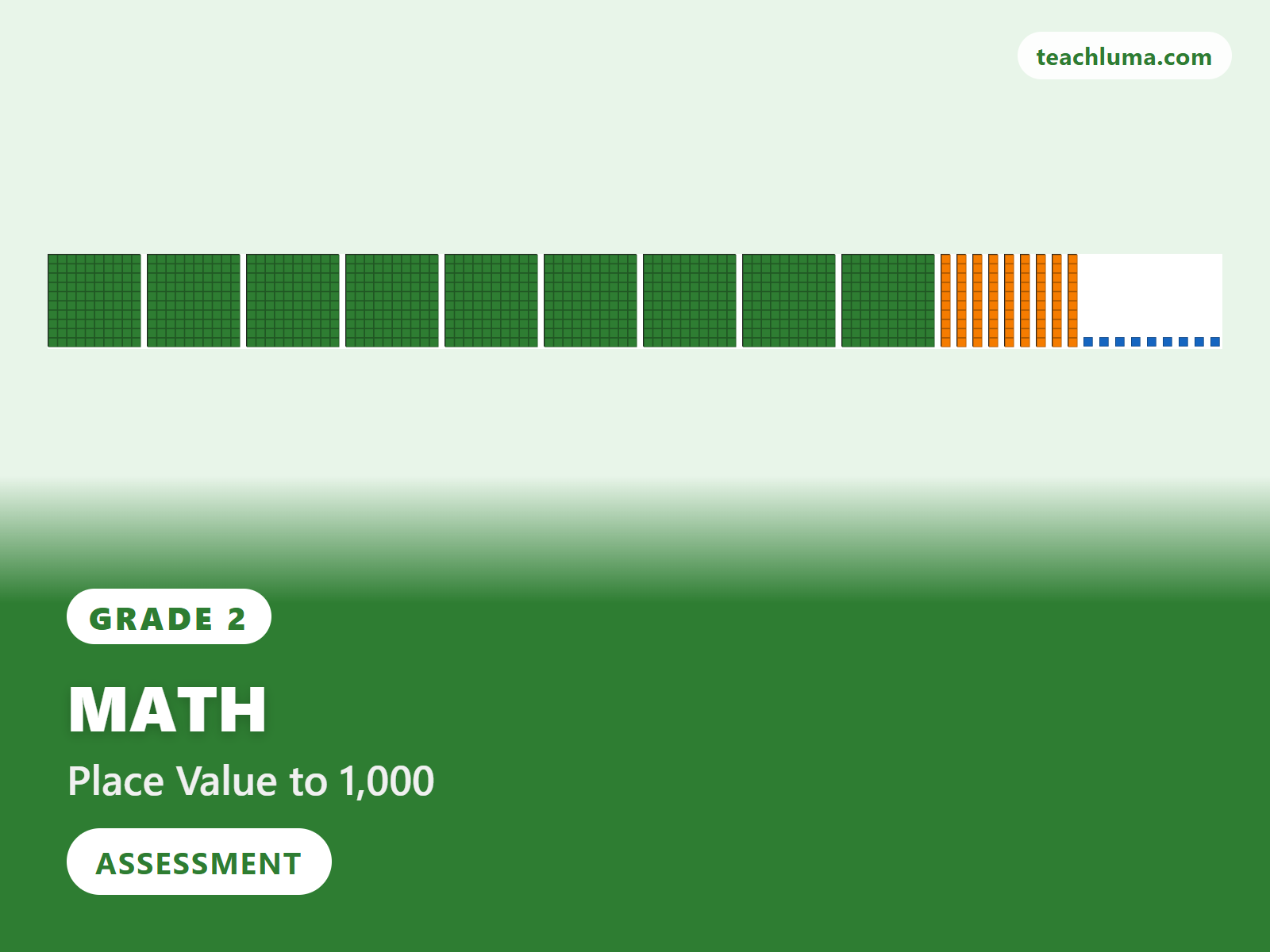
View Resource : Grade 2 Math Unit Test: Place Value to 1,000 (30 Marks)A one-page, 22-point cumulative assessment covering every Place Value resource — matching ...
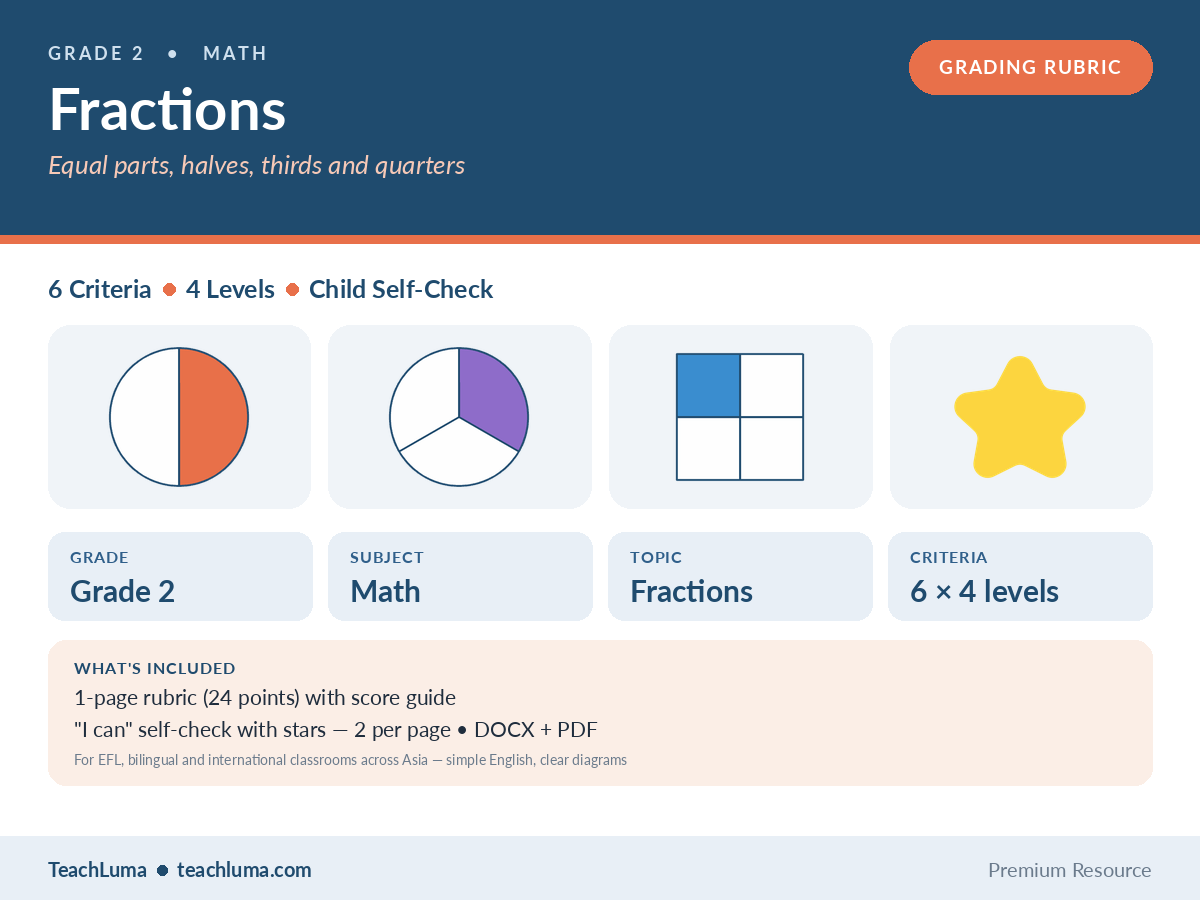
View Resource : Grade 2 Place Value Review QuizA 6-criteria, 4-level rubric (24 points) for Grade 2 fractions — equal parts, naming fract...
View Resource : Grade 2 Math Grading Rubric: Fractions + Student Self-CheckA 30-point summative quiz covering the full Percentages in Real Life topic: vocabulary and...
View Resource : Grade 6 Percentages in Real Life QuizA short, 30-point formal quiz covering everything in this Area and Perimeter unit: key voc...
View Resource : Grade 5 Area and Perimeter QuizAdvertisement