Skip to content
Preview
Members Only Science Complete Lesson Pack Grade 3 (Year 4)
No ratings yet

On the Move: How Seeds Travel

About This Resource

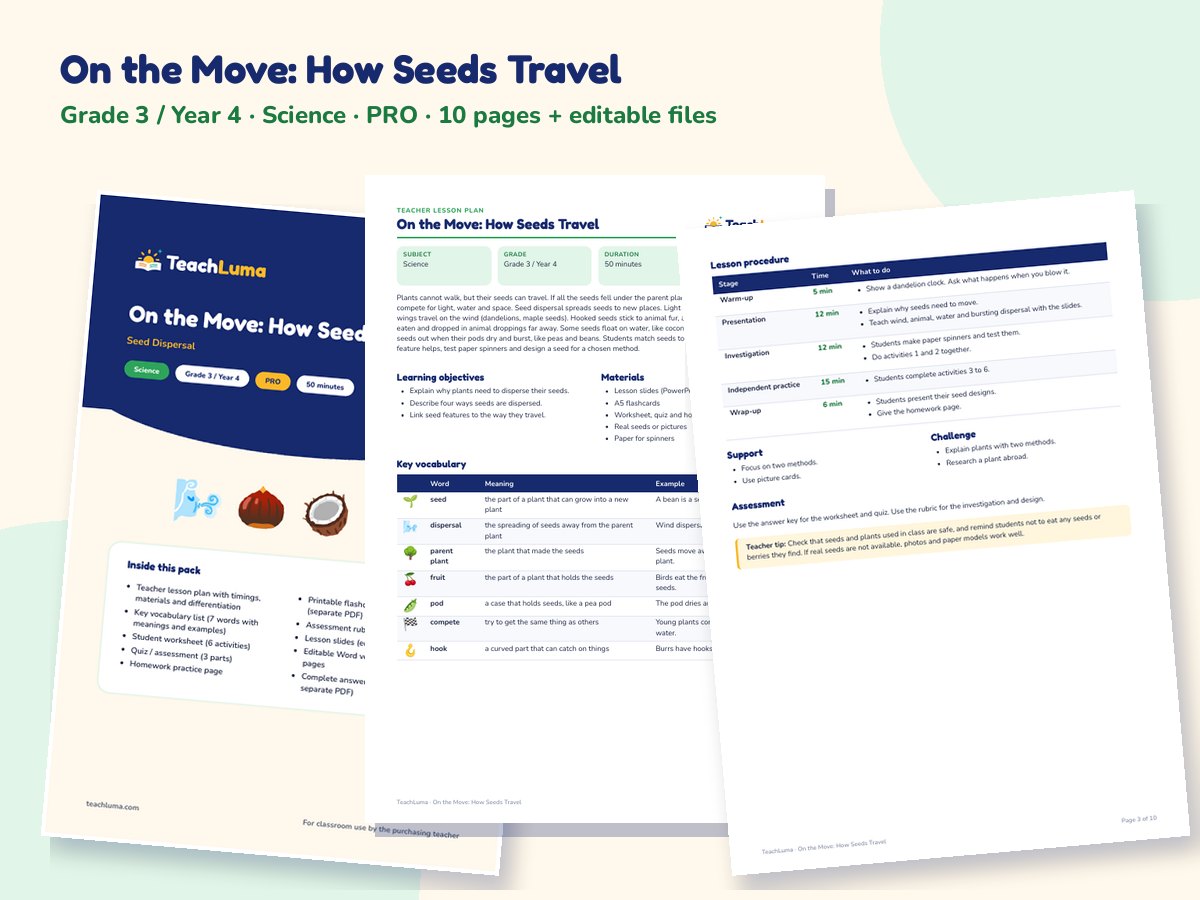
A complete Grade 3 science pack on seed dispersal. Students learn why seeds need to move away from the parent plant and how they travel by wind (dandelion, maple), animals (burrs and berries), water (coconut) and bursting pods (peas). They examine seed features, sort seeds by dispersal method, test spinning seeds and design a seed. Includes slides, a lesson plan, worksheet, quiz, homework, flashcards, a rubric and answer keys.

Overview

Plants cannot walk, but their seeds can travel. If all the seeds fell under the parent plant, the young plants would compete for light, water and space. Seed dispersal spreads seeds to new places. Light seeds with fluffy parachutes or wings travel on the wind (dandelions, maple seeds). Hooked seeds stick to animal fur, and seeds inside juicy fruit are eaten and dropped in animal droppings far away. Some seeds float on water, like coconuts, and some plants shoot their seeds out when their pods dry and burst, like peas and beans. Students match seeds to methods, explain how each feature helps, test paper spinners and design a seed for a chosen method.

Resource Details

Subject
Science
Topic
Seed Dispersal
Category
Plants
File Type
PDF
File Size
299.4 KB
Published
13 Nov 2026
Downloads
0

Members Only

Create a free account to download this resource with one of your 3 Free Pro Previews, or upgrade to Teacher Pro (from ฿199/month) for the whole library.

Share:

Looking for something different? Request a Resource.

Grade 3 science (ages 8–9) 50 minutes Life science observing classifying investigating designing

Learning Objectives

  • Explain why plants need to disperse their seeds.
  • Describe four ways seeds are dispersed.
  • Link seed features to the way they travel.

How to Use This Resource

  • Show the slides: a dandelion clock. Ask: "What happens when you blow it? Why is that useful for the plant?"
  • Teach the four methods with real seeds or pictures, then do worksheet activities 1 and 2 together.
  • Students complete activities 3 to 6, then use the quiz and send the homework page home.

Classroom Activity Ideas

  • Seed hunt: students collect seeds outside (with permission) and sort them by method.
  • Spinner test: students drop paper spinners from a height and compare fall times.
  • Sock walk: students wear an old sock over their shoe on a grassy walk and see which seeds stick.

Differentiation

Support: focus on wind and animal dispersal with picture cards. Challenge: students explain why a plant might use more than one method and research a plant from another continent.

Assessment

Use the worksheet and quiz to check methods and features. Use the rubric for the spinner investigation and seed design.

Teacher Tips

Check that seeds and plants used in class are safe, and remind students not to eat any seeds or berries they find. If real seeds are not available, photos and paper models work well.

What's Included

  • 10-page printable PDF lesson pack: teacher lesson plan with timings, materials and differentiation
  • Key vocabulary list (7 words with meanings and examples)
  • Student worksheet (6 activities)
  • Quiz / assessment (3 parts)
  • Homework practice page
  • Printable flashcards: 7 A5 picture cards (separate PDF)
  • Assessment rubric (4 levels)
  • Lesson slides (editable PowerPoint)
  • Editable Word version of all student pages
  • Complete answer key (also as a separate PDF)

Additional Files

  • Lesson Slides (PPTX)
  • Editable Student Pages and Lesson Plan (DOCX)
  • A5 Flashcards (PDF)
  • Answer Key (PDF)

Teacher Reviews

No ratings yet

Be the first teacher to review this resource.

Sign in to review this resource.

Related Resources

Advertisement