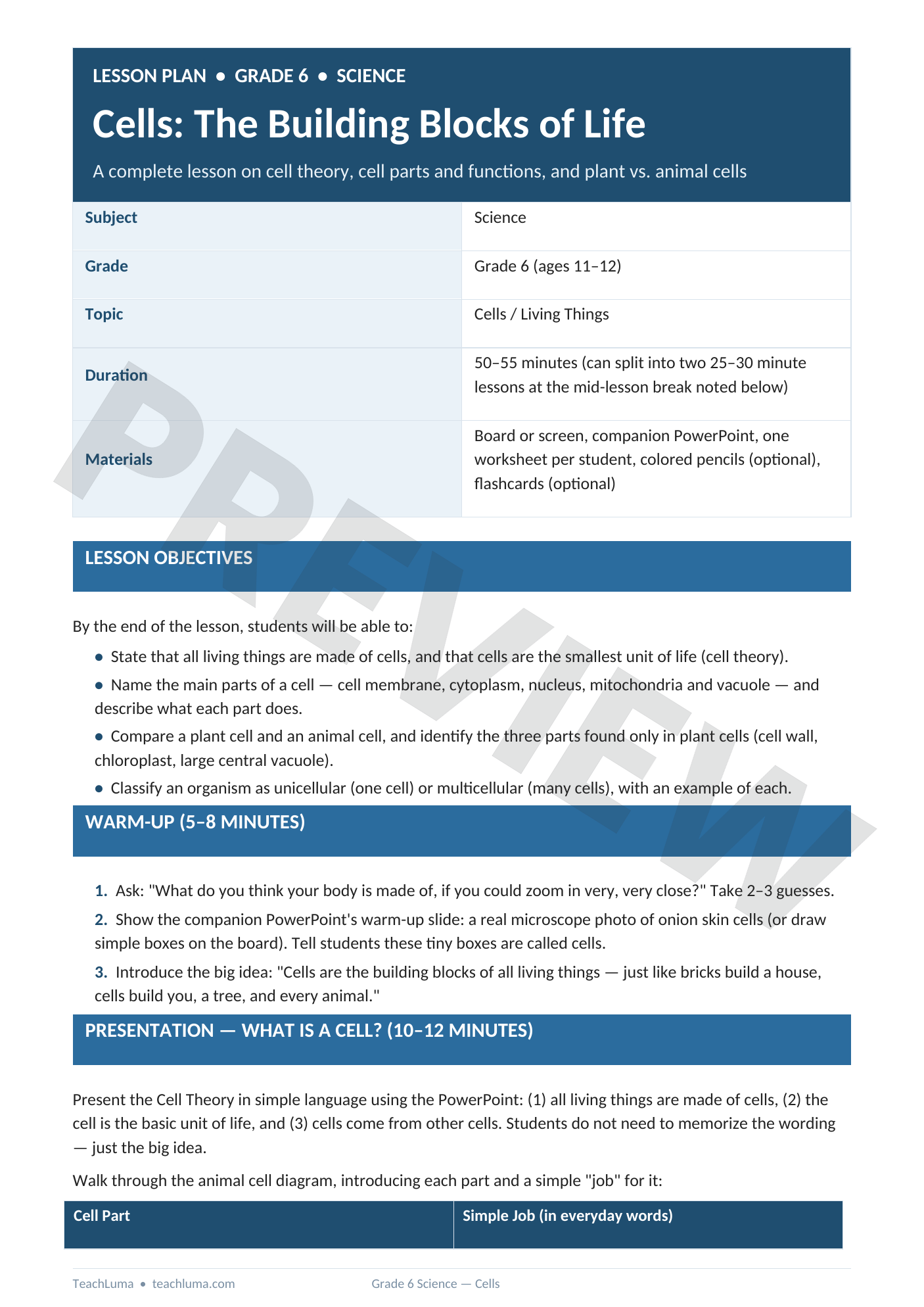
Grade 6 Science Lesson Plan: Cells — The Building Blocks of Life
About This Resource
A complete 50–55 minute lesson plan teaching cell theory, the job of each cell part, and plant vs. animal cells — with full minute-by-minute staging, pair-work, and differentiation notes.
Resource Details
- Subject
- Science
- Topic
- Cells
- Category
- Life Science
- File Type
- File Size
- 70.6 KB
- Published
- 24 Sep 2026
- Downloads
- 0
Free download — no account required.
Teaching this in class? Try our free Random Name Picker & Timer.
Looking for something different? Request a Resource.
Learning Objectives
- State that all living things are made of cells, and that the cell is the smallest unit of life (cell theory).
- Name the main parts of a cell — cell membrane, cytoplasm, nucleus, mitochondria and vacuole — and describe what each part does.
- Compare a plant cell and an animal cell, and identify the three parts found only in plant cells (cell wall, chloroplast, large central vacuole).
- Classify a living thing as unicellular (one cell) or multicellular (many cells), with an example of each.
Lesson Procedure
- Follow the staged sequence in the plan: warm-up, presentation of cell theory and the animal cell diagram, guided practice with the plant cell diagram, pair/group practice sorting plant-vs-animal parts, independent practice, review, and assessment guidance. Pairs naturally with the companion PowerPoint and Worksheet, sold separately or as part of the Complete Lesson Pack bundle.
Assessment
Use the companion Quiz for a quick formative check and the companion Assessment for a formal grade (both sold separately or included in the Complete Lesson Pack). The companion Grading Rubric scores the diagram-labeling and short-answer tasks.
Differentiation
Support: Use the blank (unlabeled) diagram versions with a shortened word bank of 3–4 terms instead of all 5–7; let students work in pairs; provide the Flashcards as a matching aid; accept short-phrase answers on open-ended questions.
Extension: Ask students to explain why red blood cells (which lose their nucleus as they mature) can still be called cells; have students research one unicellular organism not covered in class; challenge students to label a cell diagram from memory with no word bank at all.
Classroom Activity Ideas
- Cell City poster: students design a poster matching each organelle to a city role.
- Build-a-cell: small groups build a model cell using classroom objects.
- Plant or animal? Sort: call out an organelle and have students move to the matching side of the room.
Teacher Tips
The word "cell" can confuse EFL/ESL learners because in many languages a similar-sounding word means a prison cell or a mobile phone. Before starting, quickly clarify that today's "cell" is a science word for a living building block — not a room or a device. This one clarification prevents confusion for the rest of the lesson.
What's Included
- Full lesson plan (editable DOCX, print-ready PDF) — 3 pages
Additional Files
Teacher Reviews
No ratings yet
Be the first teacher to review this resource.
Related Resources
Grade 6 Science Worksheet: Cells — The Building Blocks of Life
Worksheet · Cells
A 3-page worksheet with 5 parts: label the animal cell, label the plant cell, match cell p...
View Resource
Grade 6 Science Quiz: Cells — The Building Blocks of Life
Quiz · Cells
An 8-question, 10-minute formative quiz covering cell part functions, plant-vs-animal diff...
View Resource
Grade 6 Science PowerPoint: Cells — The Building Blocks of Life
PowerPoint · Cells
A 14-slide, classroom-ready presentation introducing cell theory, labeled animal and plant...
View Resource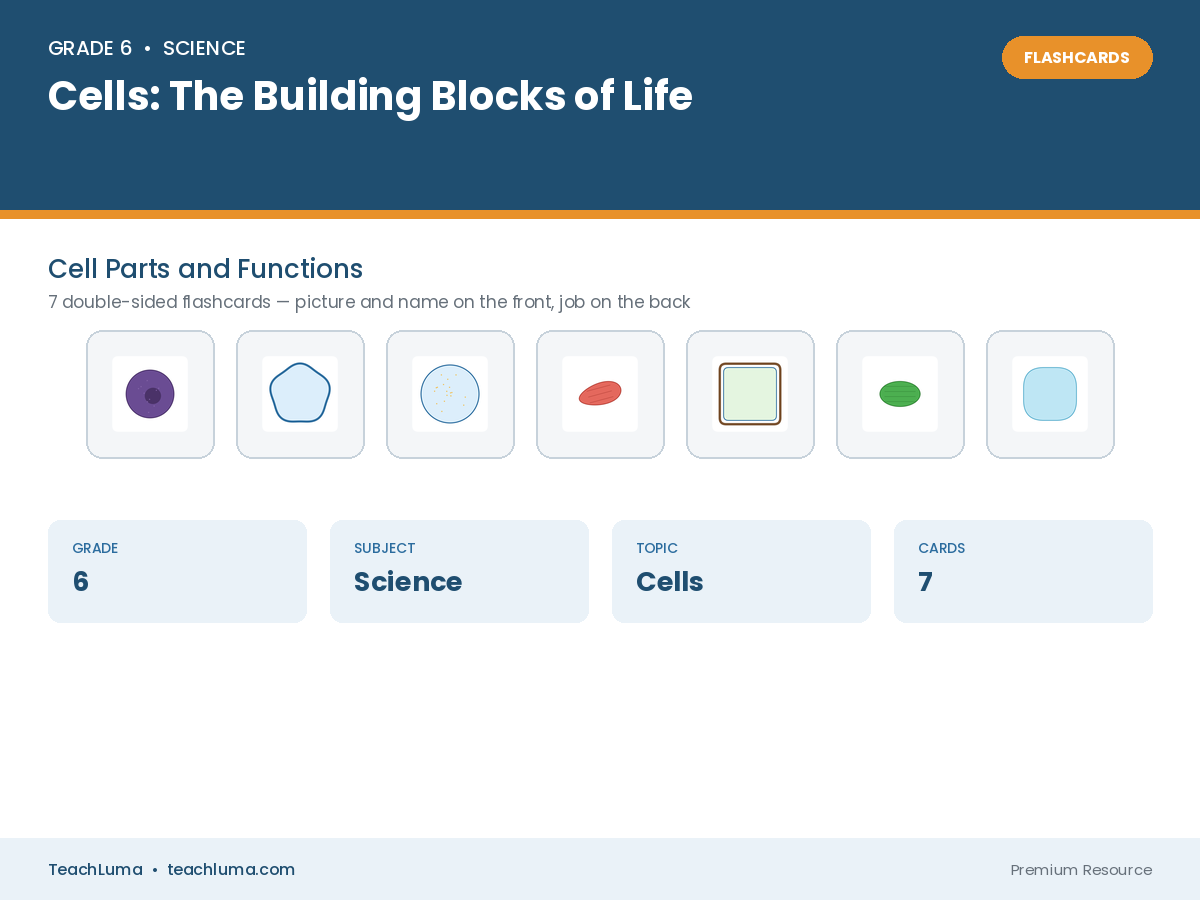
Grade 6 Science Flashcards: Cell Parts and Functions
Flashcards · Cell Parts and Functions
7 double-sided flashcards (picture + name on the front, job on the back) covering the nucl...
View Resource
Grade 10 Science Lesson Plan: Genetics & Punnett Squares
Lesson Plan · Genetics & Punnett Squares
A detailed, immediately-usable 10-lesson unit plan covering inheritance, Punnett squares, ...
View Resource
Grade 5 Ecosystems and Habitats Lesson Plan
Lesson Plan · Ecosystems and Habitats
A complete three-lesson plan that introduces Grade 5 students to ecosystems and habitats, ...
View ResourceAdvertisement