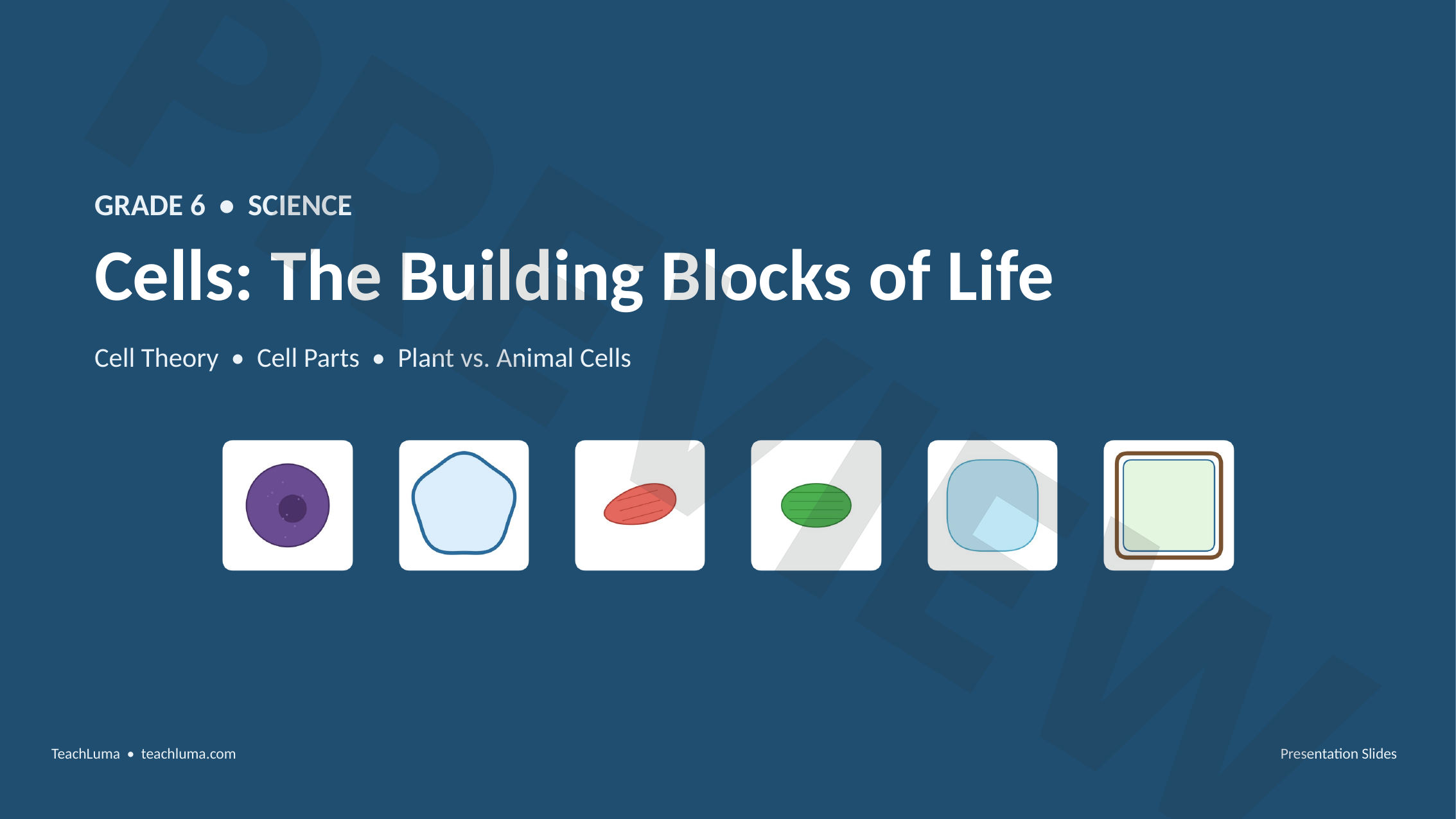
Grade 6 Science PowerPoint: Cells — The Building Blocks of Life
About This Resource
A 14-slide, classroom-ready presentation introducing cell theory, labeled animal and plant cell diagrams, and two built-in Quick Check discussion slides.
Resource Details
- Subject
- Science
- Topic
- Cells
- Category
- Life Science
- File Type
- PPTX
- File Size
- 706 KB
- Published
- 24 Sep 2026
- Downloads
- 0
Members Only
Upgrade to Teacher Pro (from ฿199/month) to download this resource.
Looking for something different? Request a Resource.
Lesson Sequence
- Project the slides in order during the presentation and guided-practice stages of the lesson. Use the two 'Quick Check' slides to pause for whole-class oral review before moving on. Works as a stand-alone teaching tool or alongside the companion Lesson Plan.
Classroom Activities
- Pause on the labeled diagram slides and cover the labels, asking students to recall each part from memory before revealing them.
- Use the closing slide's three follow-up tasks (Worksheet, Game, Quiz/Assessment) as a menu of next steps for different groups.
Teacher Tips
The word "cell" can confuse EFL/ESL learners because in many languages a similar-sounding word means a prison cell or a mobile phone. Before starting, quickly clarify that today's "cell" is a science word for a living building block — not a room or a device. This one clarification prevents confusion for the rest of the lesson.
Learning Objectives
- State that all living things are made of cells, and that the cell is the smallest unit of life (cell theory).
- Name the main parts of a cell — cell membrane, cytoplasm, nucleus, mitochondria and vacuole — and describe what each part does.
- Compare a plant cell and an animal cell, and identify the three parts found only in plant cells (cell wall, chloroplast, large central vacuole).
- Classify a living thing as unicellular (one cell) or multicellular (many cells), with an example of each.
Differentiation
Support: Use the blank (unlabeled) diagram versions with a shortened word bank of 3–4 terms instead of all 5–7; let students work in pairs; provide the Flashcards as a matching aid; accept short-phrase answers on open-ended questions.
Extension: Ask students to explain why red blood cells (which lose their nucleus as they mature) can still be called cells; have students research one unicellular organism not covered in class; challenge students to label a cell diagram from memory with no word bank at all.
Assessment
The two Quick Check slides function as an informal, whole-class formative check during the lesson. For a graded check, use the companion Quiz or Assessment.
What's Included
- 14-slide presentation (PPTX, print-ready PDF)
Additional Files
- Grade 6 Science PowerPoint: Cells — The Building Blocks of Life (PDF)
Teacher Reviews
No ratings yet
Be the first teacher to review this resource.
Related Resources
Grade 6 Science Worksheet: Cells — The Building Blocks of Life
Worksheet · Cells
A 3-page worksheet with 5 parts: label the animal cell, label the plant cell, match cell p...
View Resource
Grade 6 Science Quiz: Cells — The Building Blocks of Life
Quiz · Cells
An 8-question, 10-minute formative quiz covering cell part functions, plant-vs-animal diff...
View Resource
Grade 6 Science Lesson Plan: Cells — The Building Blocks of Life
Lesson Plan · Cells
A complete 50–55 minute lesson plan teaching cell theory, the job of each cell part, and p...
View Resource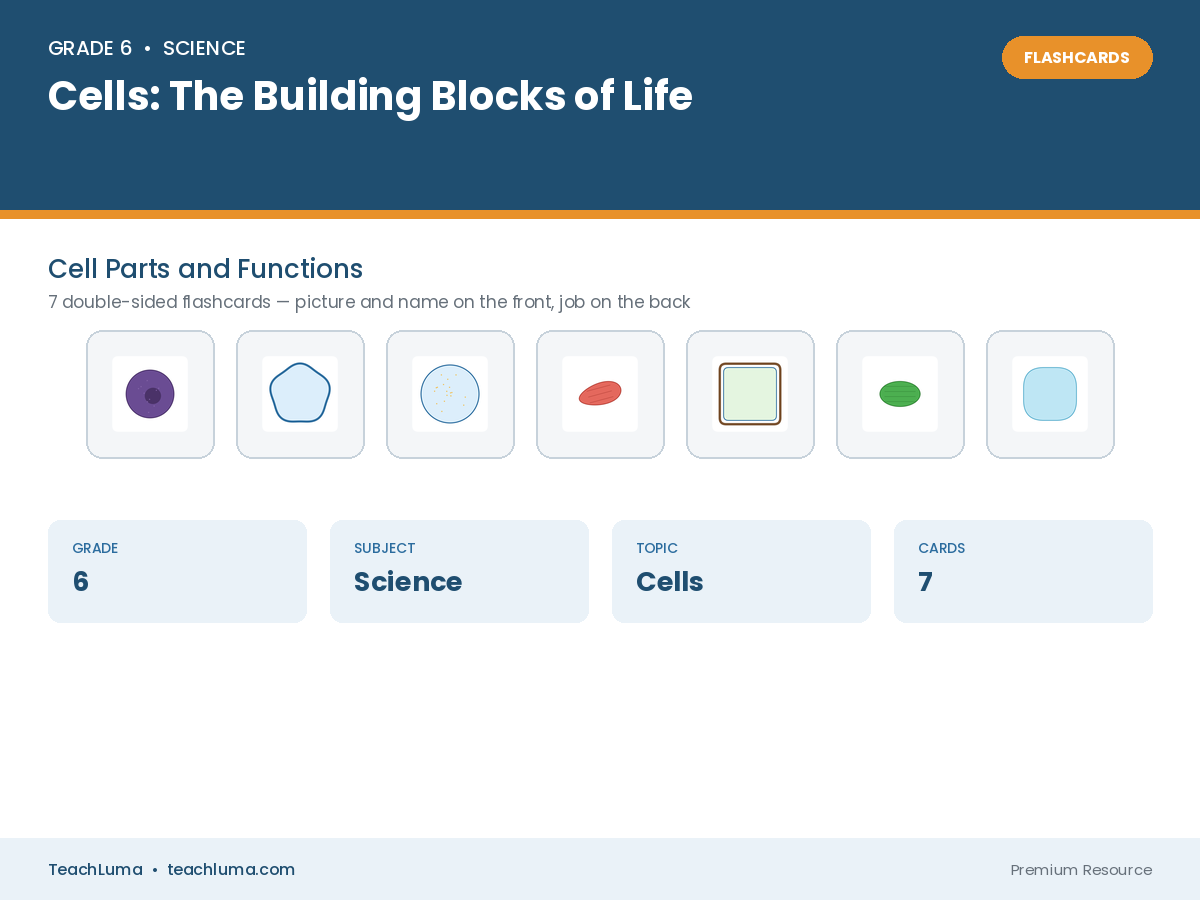
Grade 6 Science Flashcards: Cell Parts and Functions
Flashcards · Cell Parts and Functions
7 double-sided flashcards (picture + name on the front, job on the back) covering the nucl...
View Resource
Grade 10 Science PowerPoint: Genetics & Punnett Squares
PowerPoint · Genetics & Punnett Squares
A 44-slide, classroom-ready presentation covering the full genetics unit — DNA, genes, al...
View Resource
Grade 5 Ecosystems and Habitats Vocabulary and Concepts PowerPoint
PowerPoint · Ecosystems and Habitats
A 17-slide PowerPoint that introduces Grade 5 students to ecosystems and habitats: key voc...
View ResourceAdvertisement