Grade 5 Ecosystems and Habitats Lesson Plan
Members Only Science Lesson Plan Grade 5
No ratings yet

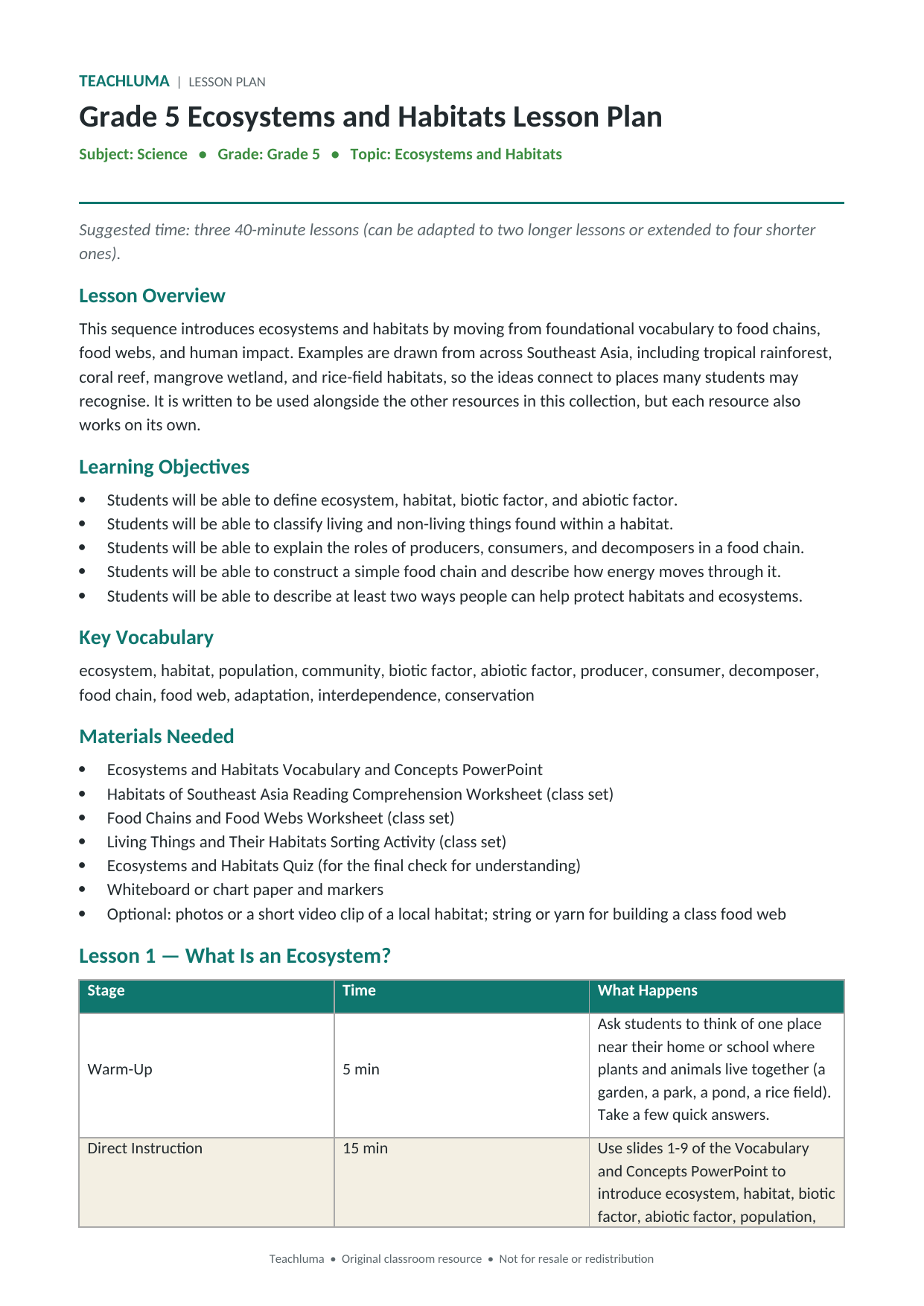
Grade 5 Ecosystems and Habitats Lesson Plan

About This Resource

A complete three-lesson plan that introduces Grade 5 students to ecosystems and habitats, moving from core vocabulary through food chains and food webs to human impact and conservation. Examples are drawn from across Southeast Asia (tropical rainforest, coral reef, mangrove wetland, rice field), and the plan is written to sequence naturally with the other resources in this collection. It's for Grade 5 Science teachers who want a ready-made pathway through the topic rather than building one from scratch.

Overview

The plan covers three connected 40-minute lessons: an introduction to ecosystems, habitats, biotic and abiotic factors; a lesson on Southeast Asian habitats and food chains, paired with a reading passage; and a final lesson on food webs, adaptation, and protecting habitats, ending with a short quiz. Each lesson lists a warm-up, direct instruction, guided practice, independent practice, and closure, with timings and clear teacher talk points, so it can be picked up and taught with minimal extra preparation.

Resource Details

Subject
Science
Topic
Ecosystems and Habitats
Category
Life Science
File Type
PDF
File Size
77.8 KB
Published
07 Sep 2026
Downloads
0

Members Only

Upgrade to Teacher Pro (from ฿199/month) to download this resource.

Share:

Grade 5 50-60 Minutes Lesson Plan Ecosystem and Habitats

Learning Objectives

  • Students will be able to define ecosystem, habitat, biotic factor, and abiotic factor.
  • Students will be able to classify living and non-living things found within a habitat.
  • Students will be able to explain the roles of producers, consumers, and decomposers in a food chain.
  • Students will be able to construct a simple food chain and describe how energy moves through it.
  • Students will be able to describe at least two ways people can help protect habitats and ecosystems.

Lesson Procedure

  • Read through all three lessons before teaching the sequence, and have the Vocabulary and Concepts PowerPoint, the reading worksheet, the food chain worksheet, and the sorting activity ready, since each lesson references one of them. The three lessons can be taught on consecutive days or spread across a week; each is designed to stand on a normal 40-minute class period, but the timings can be compressed or stretched depending on your schedule. Use the differentiation notes to adjust support for English language learners before you start, not partway through.

Assessment

Teacher observation during the sorting and food-web activities.
Completed Habitats of Southeast Asia Reading Comprehension Worksheet and Food Chains and Food Webs Worksheet.
Ecosystems and Habitats Quiz as a formal check for understanding at the end of the sequence.
The Ecosystems and Habitats Grading Rubric can be used alongside a short written or drawn "My Ecosystem" task for a fuller picture of understanding.

Differentiation

SUPPORT: Provide the vocabulary list with simple definitions and small pictures where possible. Pair English language learners with a peer who can explain instructions in a shared first language when available. Accept drawn or single-word answers where a full sentence isn't yet realistic, and reduce the number of items in the sorting or comprehension tasks if needed.
ON-LEVEL: Students complete all worksheets and activities as designed, working in full sentences where required.
CHALLENGE: Ask students to research one additional Southeast Asian habitat not covered in the PowerPoint, or design their own six-organism food web and explain what happens if one organism is removed.

Classroom Activity Ideas

  • Before Lesson 3, ask students to bring in (or draw) a picture of one animal. Use these as the "organisms" for the class food web, physically taping or pinning them to the board and connecting them with string — this gives every student a personal stake in the web you build together.

Teacher Tips

The rice-field food chain (sun, rice plant, grasshopper, frog, snake) works well as a running example across all three lessons — students remember it more easily than a new example each time, and you can keep returning to it when introducing food webs and adaptation.

What's Included

  • 4-page lesson plan (3 lessons)
  • Editable DOCX version
  • Print-ready PDF version

Additional Files

  • Grade 5 Ecosystems and Habitats Lesson Plan.docx

Teacher Reviews

No ratings yet

Be the first teacher to review this resource.

Sign in to review this resource.

Related Resources

Members Grade 5

Grade 5 Living Things and Their Habitats Sorting Activity

Classroom Activity · Living Things and Their Habitats

A three-part classroom activity that has Grade 5 students sort living and non-living thing...

View Resource
Free Grade 5

Grade 5 Habitats of Southeast Asia Reading Comprehension Worksheet

Reading Activity · Habitats

A three-page reading comprehension worksheet built around an original passage, "Life in th...

View Resource
Free Grade 5

Grade 5 Food Chains and Food Webs Worksheet

Worksheet · Food Chains and Food Webs

A three-part worksheet that gives Grade 5 students hands-on practice with food chains and ...

View Resource
Members Grade 5

Grade 5 Ecosystems and Habitats Vocabulary and Concepts PowerPoint

PowerPoint · Ecosystems and Habitats

A 17-slide PowerPoint that introduces Grade 5 students to ecosystems and habitats: key voc...

View Resource
Members Grade 4

Grade 4 The Water Cycle Lesson Plan

Lesson Plan · The Water Cycle

A complete 50–60 minute lesson plan introducing the four stages of the water cycle — evapo...

View Resource
Free Grade 5

Grade 5 Ecosystems and Habitats Quiz

Quiz · Ecosystems and Habitats

A 31-point quiz covering the full Ecosystems and Habitats topic, with multiple choice, fil...

View Resource

Advertisement