Skip to content
Preview
Free ESL Speaking Activity Grade 7
No ratings yet

Grade 7 ESL Speaking Activity: Map Information Gap — Asking for Directions

About This Resource

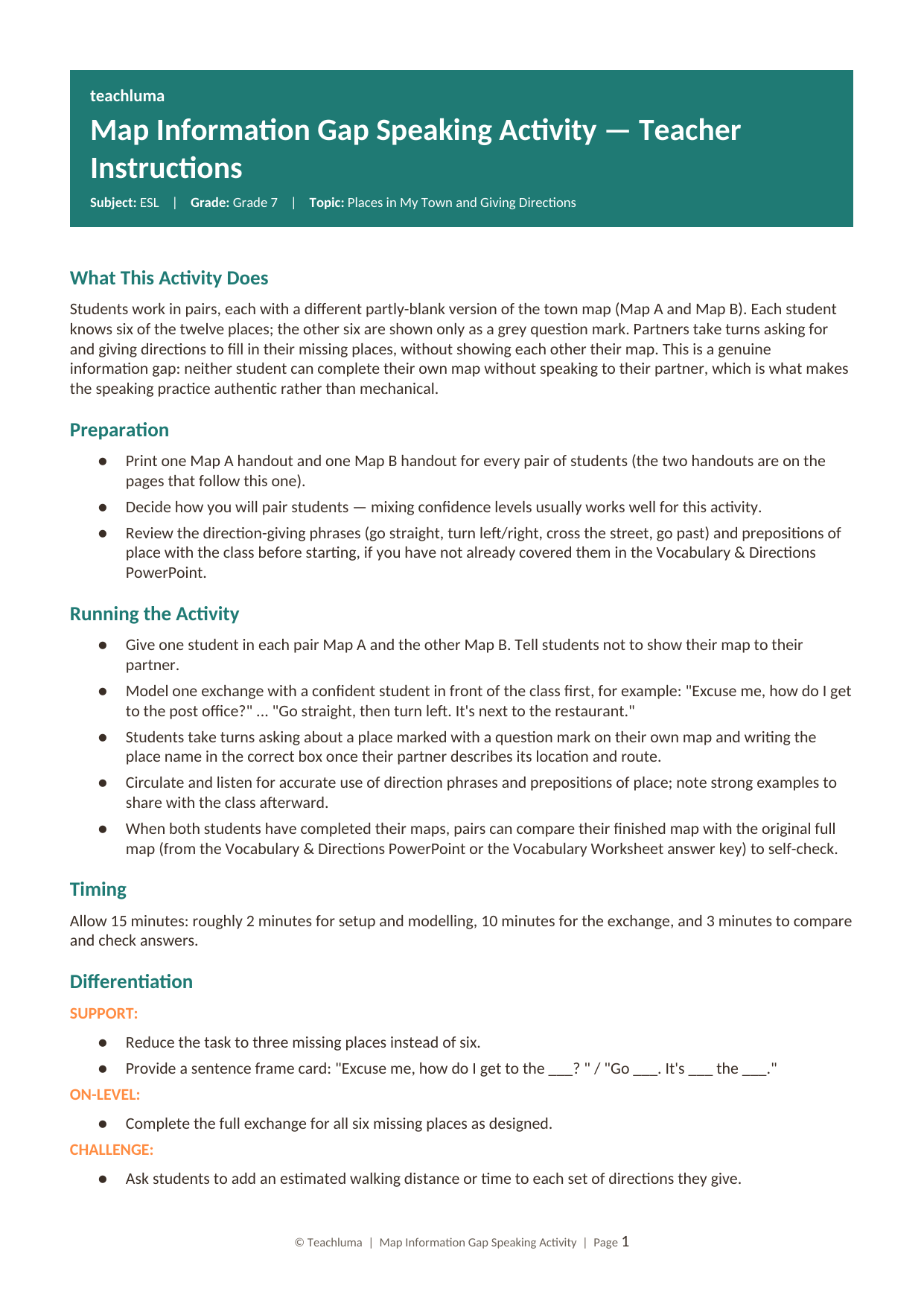
A paired speaking activity built around two complementary partial maps (Map A and Map B): each student knows six of the twelve town places and must ask their partner for directions to find the other six. Includes full teacher instructions plus both ready-to-copy student handouts, giving genuine, structured speaking practice rather than a scripted repetition drill.

Overview

Map A and Map B are drawn from the same shared town map used across this topic, but each hides a different six places behind a question mark, so the two students genuinely need each other's information to complete their own map — this is what makes it an information gap activity rather than a matching exercise. The teacher instructions page explains setup, modelling, timing, and differentiation; the two following pages are the student handouts, each with its own known-places list, map, and a bank of useful language for asking and giving directions.

Resource Details

Subject
ESL
Topic
Map Information Gap — Asking for Directions
Category
Speaking
File Type
PDF
File Size
290.2 KB
Published
06 Sep 2026
Downloads
9
Download

Free download — no account required.

Teaching this in class? Try our free Random Name Picker & Timer.

Share:

Looking for something different? Request a Resource.

Learning Objectives

  • Students will be able to ask for directions to a place using a complete question.
  • Students will be able to give clear, ordered spoken directions using direction phrases and prepositions of place.
  • Students will be able to listen to a partner's spoken directions and record the correct information.

How to Use This Resource

  • See the Teacher Instructions page included in this resource for full preparation steps, a model exchange script, timing guidance, and differentiation ideas.

Classroom Activity Ideas

  • Once both students have completed their maps, have each pair join another pair and compare all four completed maps to spot and correct any mismatches before checking against the answer.

Differentiation

SUPPORT: Reduce to three missing places instead of six; provide the sentence-frame card described on the teacher instructions page; allow the pair to complete the task with the teacher modelling the first exchange directly with the student before they continue independently with a partner.
ON-LEVEL: Complete the full six-place exchange as designed.
CHALLENGE: Add an estimated walking distance or time to each set of directions given.

Assessment

Use the Places & Directions Grading Rubric's "Giving & Following Directions (oral)" criteria while circulating during the activity; a quick observation checklist (does the student ask a full question, use at least one direction phrase, use at least one preposition of place) also works well here.

Teacher Tips

Walk the room during the activity rather than standing at the front — you'll hear a much wider range of student language, and you can quietly prompt a stuck pair with one direction phrase rather than solving the whole exchange for them.

What's Included

  • 3-page document (Teacher Instructions, Map A handout, Map B handout)
  • Editable DOCX version
  • Print-ready PDF version

Additional Files


Teacher Reviews

No ratings yet

Be the first teacher to review this resource.

Sign in to review this resource.

Related Resources

Advertisement