Skip to content
Preview
Members Only Science Complete Lesson Pack Grade 5 (Year 6)
No ratings yet

High, Low, Loud, Soft: Sound, Pitch and Volume

About This Resource

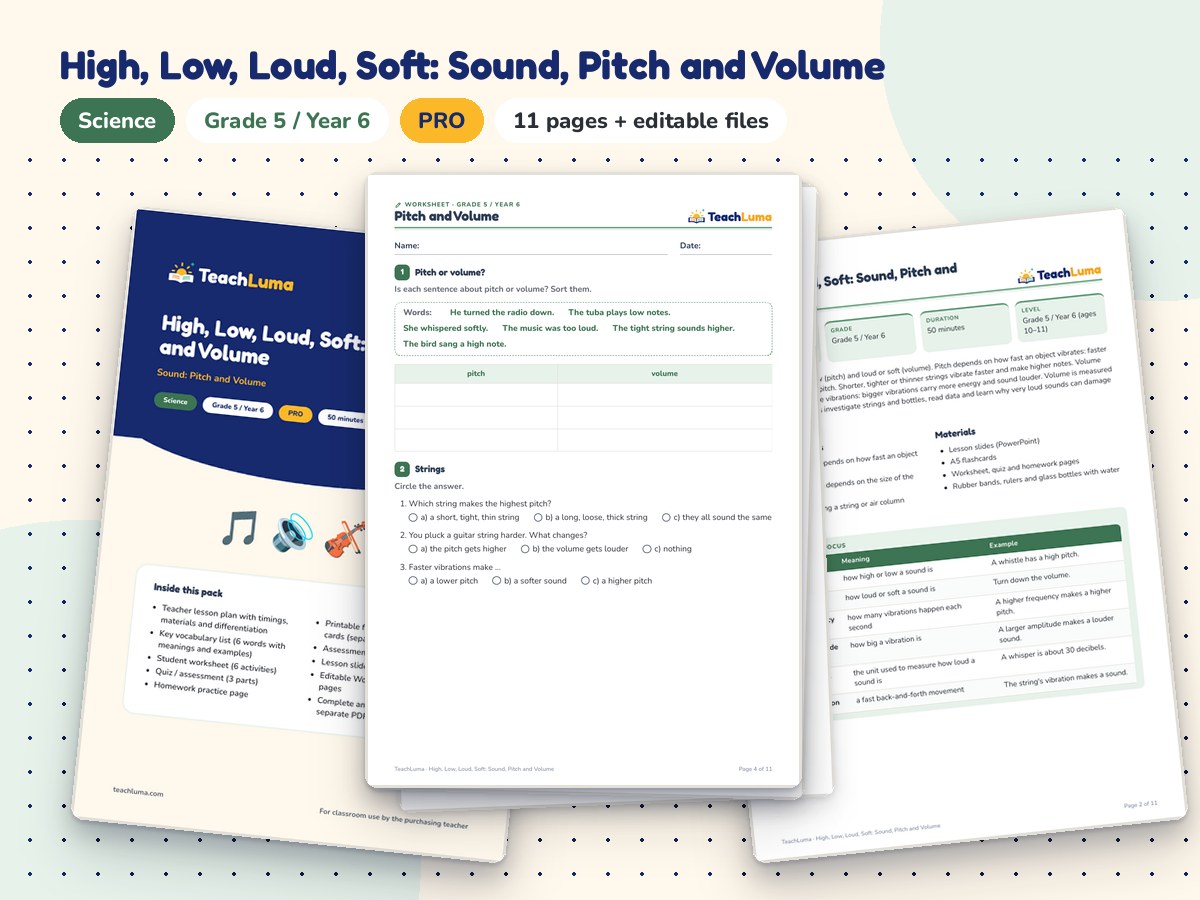
A complete Grade 5 science pack on pitch and volume. Students learn that pitch depends on how fast something vibrates (frequency) and volume depends on how big the vibrations are, investigate how string length and tightness change pitch, read results from a water-bottle xylophone test, interpret a decibel scale and explain how to protect their hearing. Includes slides, a lesson plan, worksheet, quiz, homework, A5 flashcards, a rubric, Word files and answer keys.

Overview

Sounds can be high or low (pitch) and loud or soft (volume). Pitch depends on how fast an object vibrates: faster vibrations make a higher pitch. Shorter, tighter or thinner strings vibrate faster and make higher notes. Volume depends on the size of the vibrations: bigger vibrations carry more energy and sound louder. Volume is measured in decibels (dB). Students investigate strings and bottles, read data and learn why very loud sounds can damage hearing.

Resource Details

Subject
Science
Topic
Sound: Pitch and Volume
Category
Forces & Energy
File Type
PDF
File Size
306.6 KB
Published
23 Nov 2026
Downloads
0

Members Only

Create a free account to download this resource with one of your 3 Free Pro Previews, or upgrade to Teacher Pro (from ฿199/month) for the whole library.

Share:

Looking for something different? Request a Resource.

Grade 5 (ages 10–11) 50 minutes Investigating predicting reading data explaining

Learning Objectives

  • Explain that pitch depends on how fast an object vibrates.
  • Explain that volume depends on the size of the vibrations.
  • Predict how changing a string or air column changes pitch.

How to Use This Resource

  • Pluck a stretched rubber band, then stretch it tighter and pluck again. Ask: "What changed?"
  • Teach pitch and volume with the slides, then do activities 1 and 2 together.
  • Students complete activities 3 to 6. Use the quiz and send the homework page home.

Classroom Activity Ideas

  • Ruler twang: change how much ruler hangs over a desk and listen.
  • Bottle xylophone: tap bottles with different water levels.
  • Decibel detectives: use a sound meter app (with permission) around school.

Differentiation

Support: give a pitch and volume card with pictures. Challenge: explain why blowing across bottles and tapping them give opposite pitch patterns.

Assessment

Use the worksheet and quiz to check understanding. Use the rubric for the homework instrument.

Teacher Tips

Students often mix up pitch and volume. Use hand signals: hands up and down for pitch, hands wide and narrow for volume.

What's Included

  • 11-page printable PDF lesson pack: teacher lesson plan with timings, materials and differentiation
  • Key vocabulary list (6 words with meanings and examples)
  • Student worksheet (6 activities)
  • Quiz / assessment (3 parts)
  • Homework practice page
  • Printable flashcards: 6 A5 picture cards (separate PDF)
  • Assessment rubric (4 levels)
  • Lesson slides (editable PowerPoint)
  • Editable Word version of all student pages
  • Complete answer key (also as a separate PDF)

Additional Files

  • Lesson Slides (PPTX)
  • Editable Student Pages and Lesson Plan (DOCX)
  • A5 Flashcards (PDF)
  • Answer Key (PDF)

Teacher Reviews

No ratings yet

Be the first teacher to review this resource.

Sign in to review this resource.

Related Resources

Advertisement