Skip to content
Preview
Members Only Science Complete Lesson Pack Grade 6 (Year 7)
No ratings yet

Making Waves: Amplitude, Frequency and Wavelength

About This Resource

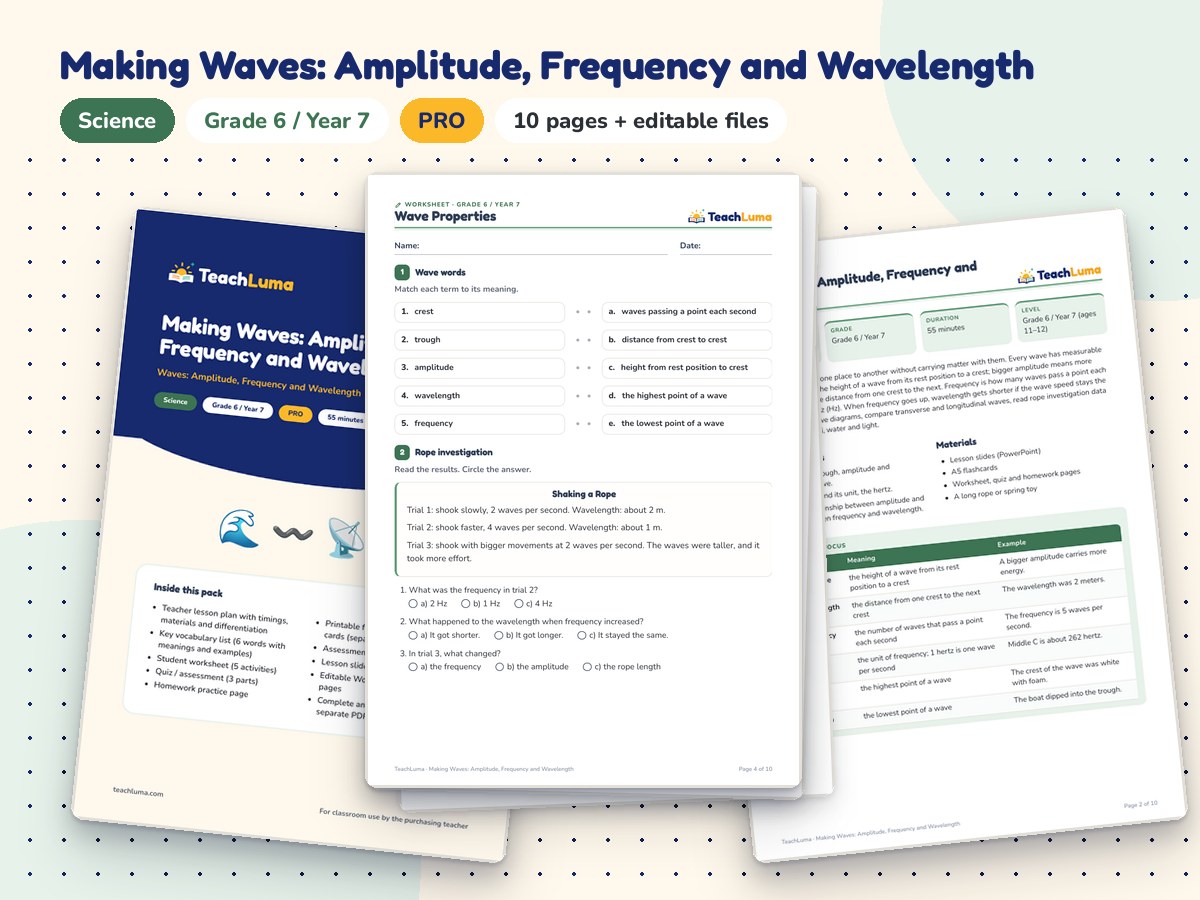
A complete Grade 6 science pack on wave properties. Students label crests, troughs, amplitude and wavelength, learn that frequency is the number of waves per second (measured in hertz), compare transverse and longitudinal waves, read a rope wave investigation, and connect amplitude to energy and loudness. Includes slides, a lesson plan, worksheet, quiz, homework, A5 flashcards, a rubric, Word files and answer keys.

Overview

Waves carry energy from one place to another without carrying matter with them. Every wave has measurable properties. Amplitude is the height of a wave from its rest position to a crest; bigger amplitude means more energy. Wavelength is the distance from one crest to the next. Frequency is how many waves pass a point each second, measured in hertz (Hz). When frequency goes up, wavelength gets shorter if the wave speed stays the same. Students label wave diagrams, compare transverse and longitudinal waves, read rope investigation data and apply ideas to sound, water and light.

Resource Details

Subject
Science
Topic
Waves: Amplitude, Frequency and Wavelength
Category
Forces & Energy
File Type
PDF
File Size
312.1 KB
Published
23 Nov 2026
Downloads
0

Members Only

Create a free account to download this resource with one of your 3 Free Pro Previews, or upgrade to Teacher Pro (from ฿199/month) for the whole library.

Share:

Looking for something different? Request a Resource.

Grade 6 (ages 11–12) 55 minutes Modeling reading data labeling diagrams explaining

Learning Objectives

  • Identify the crest, trough, amplitude and wavelength of a wave.
  • Explain frequency and its unit, the hertz.
  • Describe the relationship between amplitude and energy, and between frequency and wavelength.

How to Use This Resource

  • Shake a long rope or spring slowly, then quickly. Ask: "What changed?"
  • Teach wave properties with the slides, then do activities 1 and 2 together.
  • Students complete activities 3 to 6. Use the quiz and send the homework page home.

Classroom Activity Ideas

  • Rope waves: change shaking speed and height and record observations.
  • Slinky waves: compare side-to-side and push-pull waves.
  • Stadium wave: model how energy moves while people stay in place.

Differentiation

Support: give a pre-labeled wave diagram. Challenge: use wave speed = frequency × wavelength for simple calculations.

Assessment

Use the worksheet and quiz to check terms and relationships. Use the rubric for the homework diagram.

Teacher Tips

Students often think water in a wave travels forward. Show a cork bobbing up and down in a tub as waves pass under it.

What's Included

  • 10-page printable PDF lesson pack: teacher lesson plan with timings, materials and differentiation
  • Key vocabulary list (6 words with meanings and examples)
  • Student worksheet (5 activities)
  • Quiz / assessment (3 parts)
  • Homework practice page
  • Printable flashcards: 6 A5 picture cards (separate PDF)
  • Assessment rubric (4 levels)
  • Lesson slides (editable PowerPoint)
  • Editable Word version of all student pages
  • Complete answer key (also as a separate PDF)

Additional Files

  • Lesson Slides (PPTX)
  • Editable Student Pages and Lesson Plan (DOCX)
  • A5 Flashcards (PDF)
  • Answer Key (PDF)

Teacher Reviews

No ratings yet

Be the first teacher to review this resource.

Sign in to review this resource.

Related Resources

Advertisement