Skip to content
Preview
Members Only Science Complete Lesson Pack Grade 6 (Year 7)
No ratings yet

Splitting White Light: The Colors of Light

About This Resource

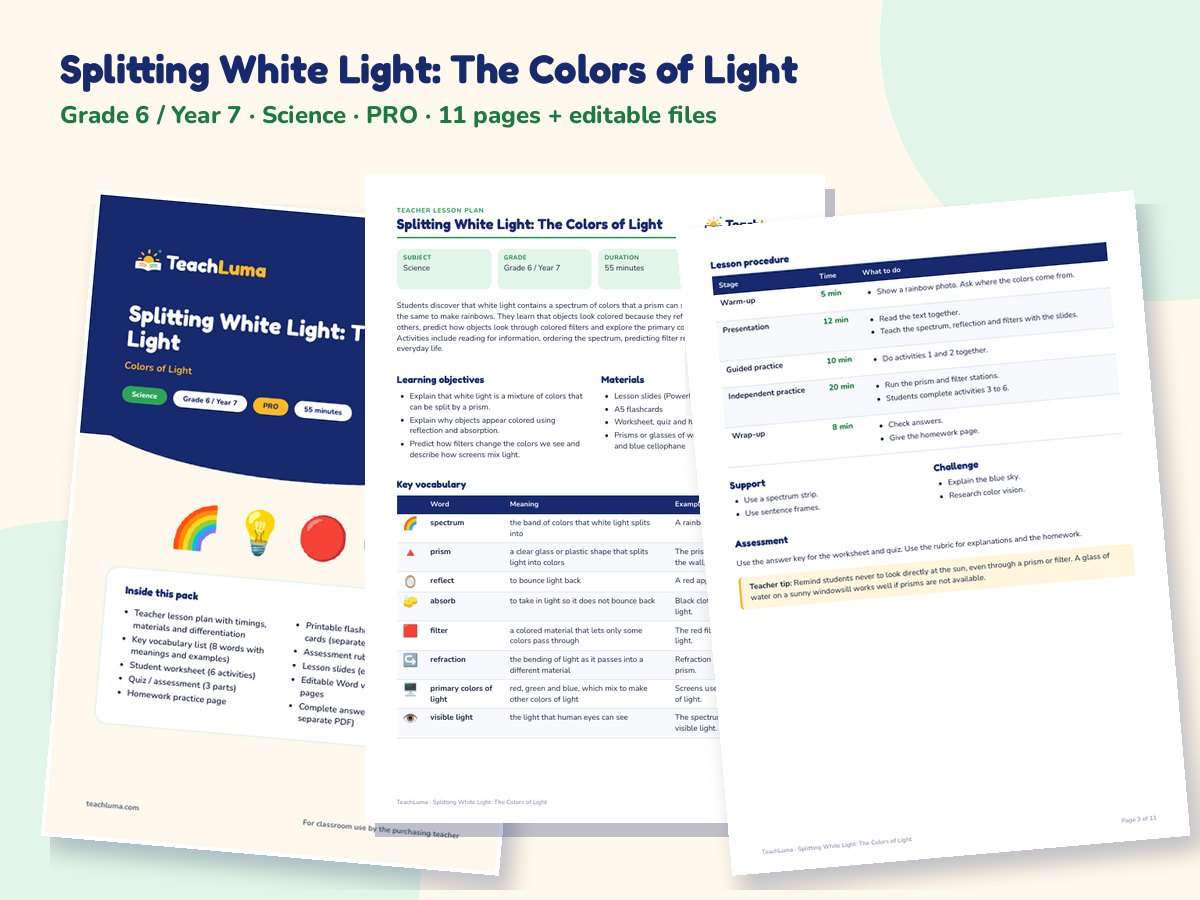
A complete Grade 6 science pack on color and light. Students learn that white light is a mixture of colors, how prisms and raindrops make a spectrum, why objects appear colored, how filters work and how screens mix the primary colors of light. Includes slides, a lesson plan, worksheet, quiz, homework, flashcards, a rubric and answer keys.

Overview

Students discover that white light contains a spectrum of colors that a prism can separate, and that raindrops do the same to make rainbows. They learn that objects look colored because they reflect some colors and absorb others, predict how objects look through colored filters and explore the primary colors of light used in screens. Activities include reading for information, ordering the spectrum, predicting filter results and explaining color in everyday life.

Resource Details

Subject
Science
Topic
Colors of Light
Category
Forces & Energy
File Type
PDF
File Size
318.8 KB
Published
13 Nov 2026
Downloads
1

Members Only

Create a free account to download this resource with one of your 3 Free Pro Previews, or upgrade to Teacher Pro (from ฿199/month) for the whole library.

Share:

Looking for something different? Request a Resource.

Grade 6 science (ages 11–12) 55 minutes Physical science predicting explaining reading for information

Learning Objectives

  • Explain that white light is a mixture of colors that can be split by a prism.
  • Explain why objects appear colored using reflection and absorption.
  • Predict how filters change the colors we see and describe how screens mix light.

How to Use This Resource

  • Show the slides: a rainbow photo. Ask: "Where do the colors come from?"
  • Read the text and do worksheet activities 1 and 2 together.
  • Students complete activities 3 to 6, then use the quiz and send the homework page home.

Classroom Activity Ideas

  • Prism station: shine a flashlight or sunlight through a prism or a glass of water and record the spectrum.
  • Filter test: look at colored objects through red, green and blue cellophane and record what students see.
  • Color spinner: color a card disk with the spectrum and spin it fast to see it look pale or whitish.

Differentiation

Support: give a colored spectrum strip and sentence frames such as "The ___ reflects ___ light." Challenge: students explain why the sky looks blue or research how eyes detect color.

Assessment

Use the worksheet and quiz to check understanding of the spectrum, reflection and filters. Use the rubric for explanations and the homework.

Teacher Tips

Remind students never to look directly at the sun, even through a prism or filter. A glass of water on a sunny windowsill works well if prisms are not available.

What's Included

  • 11-page printable PDF lesson pack: teacher lesson plan with timings, materials and differentiation
  • Key vocabulary list (8 words with meanings and examples)
  • Student worksheet (6 activities)
  • Quiz / assessment (3 parts)
  • Homework practice page
  • Printable flashcards: 8 A5 picture cards (separate PDF)
  • Assessment rubric (4 levels)
  • Lesson slides (editable PowerPoint)
  • Editable Word version of all student pages
  • Complete answer key (also as a separate PDF)

Additional Files

  • Lesson Slides (PPTX)
  • Editable Student Pages and Lesson Plan (DOCX)
  • A5 Flashcards (PDF)
  • Answer Key (PDF)

Teacher Reviews

No ratings yet

Be the first teacher to review this resource.

Sign in to review this resource.

Related Resources

Advertisement