Skip to content
Preview
Free ESL Worksheet Grade 9 (Year 10)
No ratings yet

In Your Own Words: Paraphrasing and Quoting Sources

About This Resource

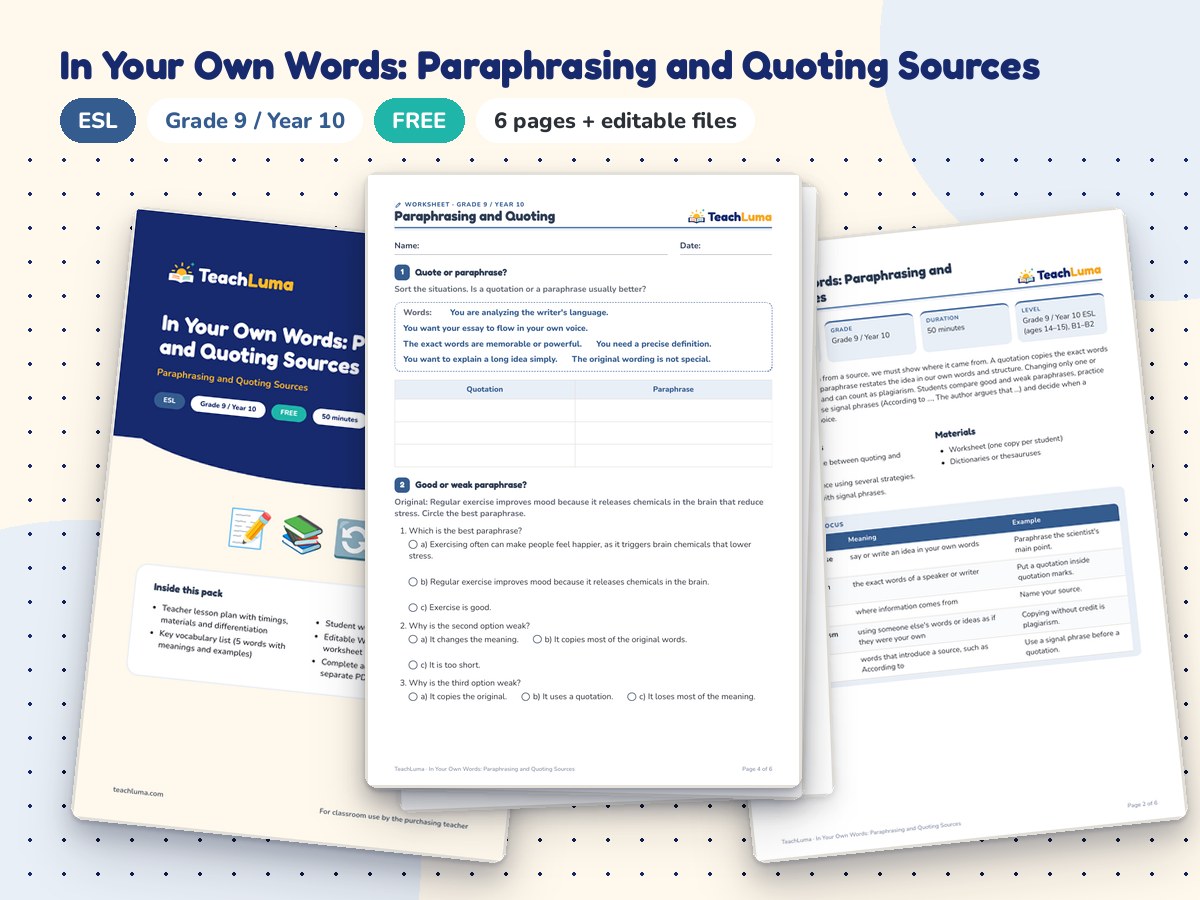
A free Grade 9 ESL writing worksheet on using sources honestly. Students learn when to quote and when to paraphrase, practice four paraphrasing strategies (change words, change structure, change word form, combine ideas), judge which paraphrases are acceptable and introduce sources with signal phrases such as According to ... Includes a timed lesson plan, an editable Word version and an answer key.

Overview

When we use information from a source, we must show where it came from. A quotation copies the exact words inside quotation marks; a paraphrase restates the idea in our own words and structure. Changing only one or two words is not enough and can count as plagiarism. Students compare good and weak paraphrases, practice strategies for rewriting, use signal phrases (According to ..., The author argues that ...) and decide when a quotation is the better choice.

Resource Details

Subject
ESL
Topic
Paraphrasing and Quoting Sources
Category
Writing
File Type
PDF
File Size
255.7 KB
Published
20 Nov 2026
Downloads
0
Download Free

Free with a TeachLuma account — it takes a minute.

Share:

Looking for something different? Request a Resource.


Grade 9 ESL (ages 14–15), B1–B2 50 minutes Academic writing vocabulary sentence transformation research skills

Student Task

  • Ask: "If you use an idea from a website in your essay, what must you do?"
  • Teach quotation versus paraphrase and the four strategies, then do activities 1 and 2 together.
  • Students complete activities 3 to 5. Answers are in the answer key.

Classroom Use

  • Paraphrase relay: each student changes one more part of a sentence until it is fully paraphrased.
  • Quote or paraphrase? Teams decide which is better for different source sentences.
  • Source check: students compare their paraphrase with the original and highlight copied words.

Differentiation

Support: give synonym banks for each source sentence. Challenge: students summarize a short paragraph in one sentence and cite it.

Answer Key & Assessment

Activities 1 to 4 check understanding (answer key included). Activity 5 shows whether students can paraphrase and cite independently.

Learning Objectives

  • Explain the difference between quoting and paraphrasing.
  • Paraphrase a sentence using several strategies.
  • Introduce sources with signal phrases.

Teacher Tips

A useful method is read, cover, write, check: read the source, cover it, write the idea from memory, then check that the meaning is the same and the words are different. Remind students that technical terms (such as photosynthesis) can stay the same.

What's Included

  • 6-page printable PDF lesson pack: teacher lesson plan with timings, materials and differentiation
  • Key vocabulary list (5 words with meanings and examples)
  • Student worksheet (5 activities)
  • Editable Word version of the worksheet
  • Complete answer key (also as a separate PDF)

Additional Files


Teacher Reviews

No ratings yet

Be the first teacher to review this resource.

Sign in to review this resource.

Related Resources

Advertisement