Skip to content
Preview
Members Only ESL Assessment Kindergarten
No ratings yet

Kindergarten ESL Test: Fruits and Vegetables — Paper and Speaking Check (20 Marks)

About This Resource

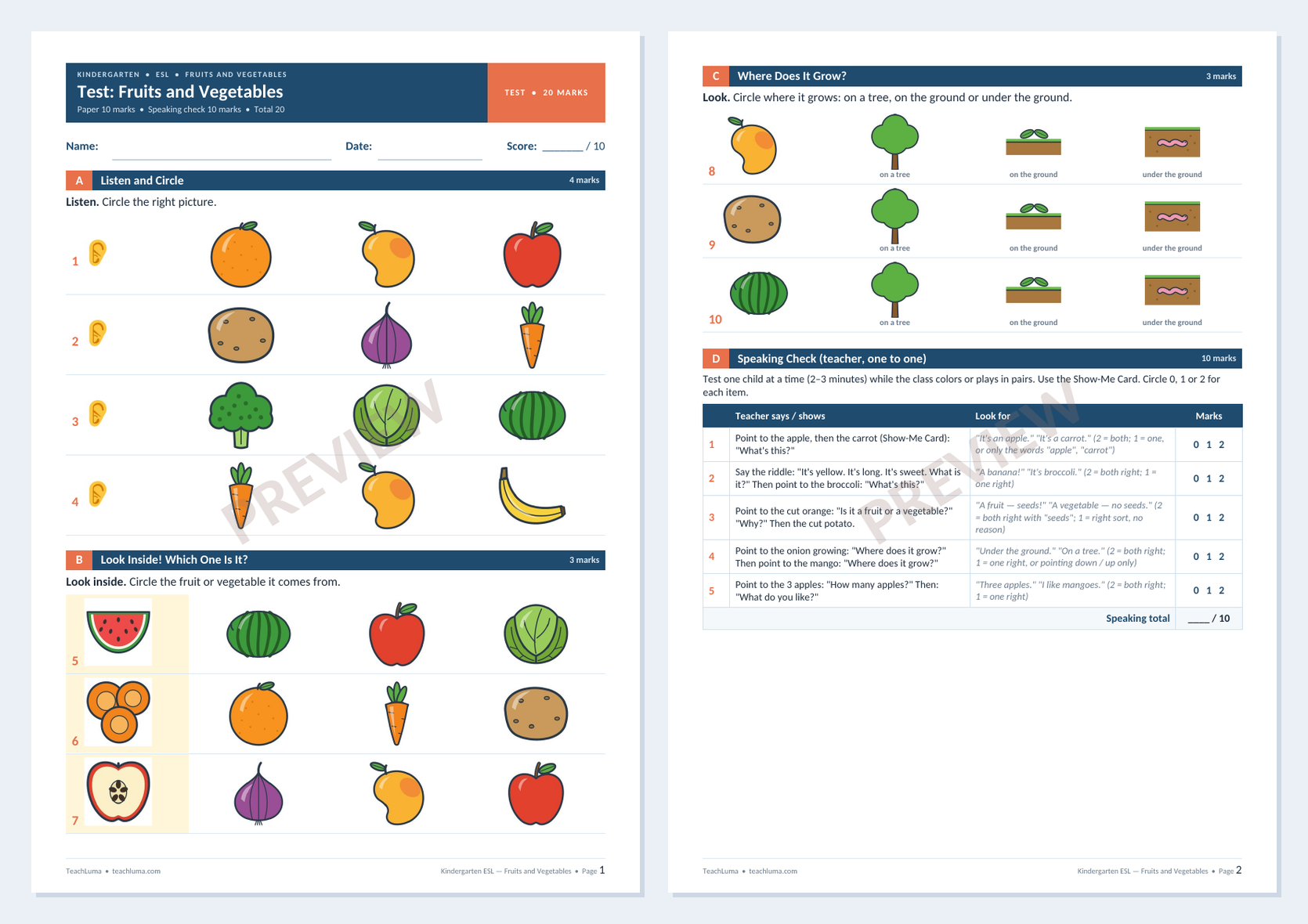
A 20-mark test: listen and circle (4), look inside — which one is it? (3), where does it grow? (3) and a one-to-one speaking check (10) that asks children WHY ("Seeds!"), with a Show-Me Card, class record sheet and full answer key.

Overview

This pack teaches Kindergarten children 10 everyday fruits and vegetables — apple, banana, orange, mango, watermelon, carrot, potato, onion, broccoli and cabbage — and, just as important, helps them UNDERSTAND the difference instead of memorising two lists. Children learn one big idea they can test for themselves: "Look inside! Seeds? It's a fruit! No seeds? It's a vegetable!" (the 10 words are chosen so this rule always works). They also learn where each one grows (on a tree, on the ground, under the ground), that a fruit can change color (a green apple is still an apple; a green mango is not ready yet), and how to describe and guess ("It's yellow. It's long. It's sweet."). Language: "What's this? – It's an apple / a carrot / It's broccoli.", "Is it a fruit or a vegetable? – A fruit. Seeds!", "Where does it grow?", "How many apples?" and "I like mangoes." Hands-on Discovery Activities (cutting real fruit, a taste test, regrowing a carrot top), a picture story set in a Bangkok market (Nok's Market Day), five classroom posters, chants, a market role play and an offline team game make the ideas concrete for very young ESL / EFL learners. Every fruit and vegetable is drawn by TeachLuma in one clear style — whole, cut open and growing — and most activities need no reading. This listing covers the Assessment only.

Resource Details

Subject
ESL
Topic
Fruits and Vegetables
Category
Assessments
File Type
PDF
File Size
323.9 KB
Published
18 Oct 2026
Downloads
0

Members Only

Upgrade to Teacher Pro (from ฿199/month) to download this resource.

Share:

Looking for something different? Request a Resource.

Kindergarten 30 Minutes Vocabulary Fruits & Vegetables

Question Types & Suggested Use

Paper 10 marks + speaking 10 marks = 20, with clear 0 / 1 / 2 descriptors, score bands (Excellent / Good / Developing / Needs practice) and what to accept.

Skills Assessed

  • Say the 10 words: apple, banana, orange, mango, watermelon, carrot, potato, onion, broccoli, cabbage.
  • Ask and answer "What's this?" – "It's an apple." / "It's a carrot." / "It's broccoli."
  • Sort fruits and vegetables and give a reason with the seed test: "Seeds inside — it's a fruit!"
  • Say or show where each one grows: on a tree, on the ground or under the ground.
  • Know that a fruit can change color (a green apple is still an apple) and describe a fruit: "It's yellow. It's long. It's sweet."
  • Count fruits and vegetables to 6 and say what they like: "I like mangoes."

How to Administer

  • Give the paper part to the whole class: read the Part A script two times; Parts B and C are look-and-think. While they work, call children one at a time for the speaking check with the Show-Me Card. Circle 0, 1 or 2 for each speaking item and record the scores on the class sheet.

Differentiation

Support: Teach 3 fruits and 3 vegetables first (apple, banana, mango, carrot, potato, broccoli) and add the others later. Let children hold the real food while they say the word, and accept the word alone ("Mango!") before modelling "It's a mango." For the seed test, children only point: seeds or no seeds. In Where does it grow? they do the action (up, flat, down) instead of saying it. In tracing, children can trace one word and color the picture.
Extension: Children explain in a full sentence: "It's a fruit because it has seeds." They describe a fruit for the class to guess, count the seeds in a real apple or orange, sort NEW foods with the seed test (a tomato, a cucumber, a lime) and say where they grow. Strong children can copy the words without the dots, label the posters and be the seller in the market role play: "Fruit or vegetable?"

Follow-Up Activities

  • Do the speaking check over two days if your class is big.
  • Use the class record sheet to plan small-group review of the seed test or where things grow.

Teacher Tips

Bring REAL fruit and vegetables and a knife to Lesson 3 (only you use the knife). Cut an apple across the middle so children see the star of seeds, then cut an orange, a banana, a carrot and an onion. Let every child look closely and say "Seeds!" or "No seeds!" before you name the group. This one experience turns "fruit" and "vegetable" from words to remember into an idea children can check for themselves — and they will try it at home. If a child asks about a tomato or a cucumber, cut one too: they have seeds, so scientists call them fruits. Praise the thinking!

What's Included

  • Test, 4 pages: paper (10), speaking check (10), Show-Me Card, class record sheet (DOCX + PDF)
  • Answer key with listening script and speaking guide, 1 page (DOCX + PDF)

Additional Files

  • Kindergarten ESL Test: Fruits and Vegetables — Paper and Speaking Check (20 Marks) (DOCX)
  • Answer Key (PDF)

Teacher Reviews

No ratings yet

Be the first teacher to review this resource.

Sign in to review this resource.

Related Resources

Advertisement