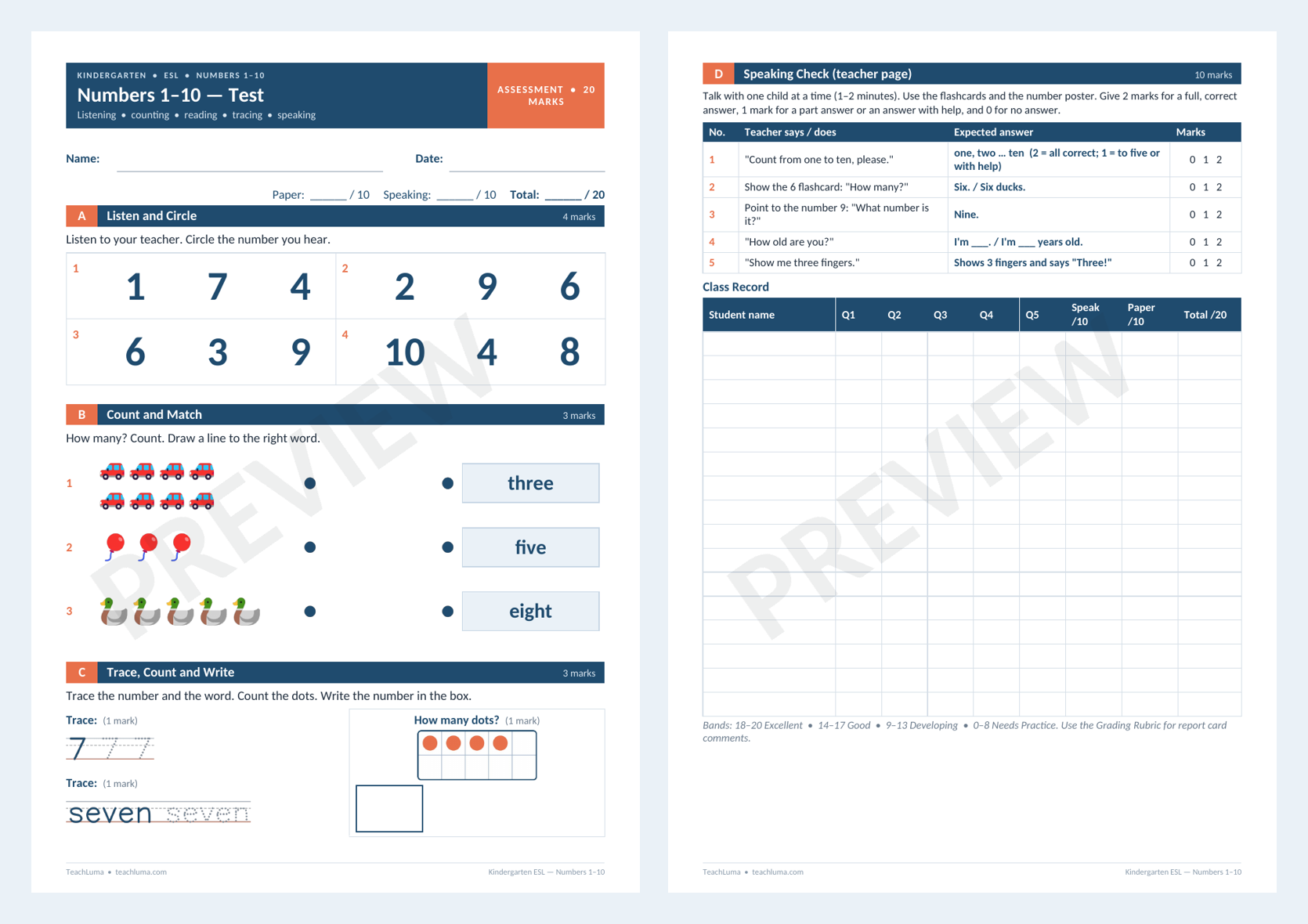
Kindergarten ESL Test: Numbers 1–10 — Paper and Speaking Check (20 Marks)
About This Resource
A 20-mark Kindergarten numbers test: a 10-mark paper (listen and circle, count and match, trace, count and write) and a 10-mark one-to-one speaking check with a class record sheet and a full answer key.
Resource Details
- Subject
- ESL
- Topic
- Kindergarten ESL Test: Numbers 1–10
- Category
- Assessments
- File Type
- File Size
- 225.8 KB
- Published
- 24 Sep 2026
- Downloads
- 0
Free download — no account required.
Teaching this in class? Try our free Random Name Picker & Timer.
Looking for something different? Request a Resource.
Question Types & Suggested Use
Paper 10 + speaking 10 = 20 marks. Bands: 18–20 Excellent, 14–17 Good, 9–13 Developing, 0–8 Needs Practice. The answer key explains 2 / 1 / 0 scoring for each speaking question.
Skills Assessed
- Count from 1 to 10 in English, in order.
- Say the number when they see 1–10 in any order.
- Count up to 10 objects, touching each one, and say how many.
- Answer "How many?" with a number: "Five!" / "Five apples."
- Answer "How old are you?" – "I'm five."
- Trace and write the numbers 1–10 and the words one–ten.
How to Administer
- Give the paper to the whole class; read the Part A script from the answer key. While children color or play Number Bingo, call them one at a time for the 5-question speaking check (Part D) and record scores on the class record sheet.
Differentiation
Support: Work with 1–5 until children are confident, then add 6–10. Give children real objects to move while they count, and let them keep a desk number line. Accept a number or fingers first, then model "Five apples." for them to repeat.
Extension: Count to 20. Count backwards from 10 ("Ten, nine, eight … zero – blast off!"). Use plurals: "one apple, two apples". Ask "How many boys? How many girls?" and compare with more / less.
Follow-Up Activities
- Do the speaking check with a small bag of blocks so it feels like a game.
- Use the class record to group children for review of 6–10.
Teacher Tips
Listen for three, five, seven and six. Many children in Thailand, Vietnam, Laos and Cambodia say "tree" for three (no "th"), "fife" for five, "sewen" for seven and "sick" for six (the "ks" end is lost). Show the tongue between the teeth for "th" and the top teeth on the bottom lip for "v" – make it a silly-face game, and children will soon correct each other.
What's Included
- 2-page test: student paper + teacher speaking check and class record (DOCX + PDF)
- Answer key with listening script and speaking scoring guide (DOCX + PDF)
Additional Files
Teacher Reviews
No ratings yet
Be the first teacher to review this resource.
Related Resources
Kindergarten ESL Test: Greetings and Introductions — Paper and Speaking Check (20 Marks)
Assessment · Greetings and Introductions
A 20-mark Kindergarten test: a 10-mark paper (listen and circle, match, trace and write) a...
View Resource
Kindergarten ESL Quiz: Colors — Look and Circle, Listen and Circle
Quiz · Colors
A 1-page, 10-mark picture quiz: 5 look-and-circle color words and 5 listen-and-circle cray...
View Resource
Kindergarten ESL Grading Rubric: Colors — Speaking, Listening and Writing
Grading Rubric · Colors
A 1-page rubric for 6 skills — color words, listening, "What color is it?", "I like ___", ...
View Resource
Kindergarten ESL Grading Rubric: All About Me
Grading Rubric · All About Me
A teacher-facing assessment rubric for the All About Me topic, covering vocabulary recogni...
View Resource
Grade 4 ESL Assessment: Hobbies and Free Time — 30-Mark Unit Test with Answer Key
Assessment · Hobbies and Free Time
A 2-page, 30-mark end-of-unit test: picture vocabulary, play / go / do, -ing spelling, gra...
View Resource
Grade 9 Personal Identity Unit Assessment (25 Points, with Answer Key)
Assessment · Personal Identity
A comprehensive 2-page, 25-point summative test covering trait definitions, "used to" gram...
View ResourceAdvertisement