Skip to content
Preview
Members Only Science Complete Lesson Pack Grade 3 (Year 4)
No ratings yet

Our Neighbor in Space: The Moon's Craters, Light and Orbit

About This Resource

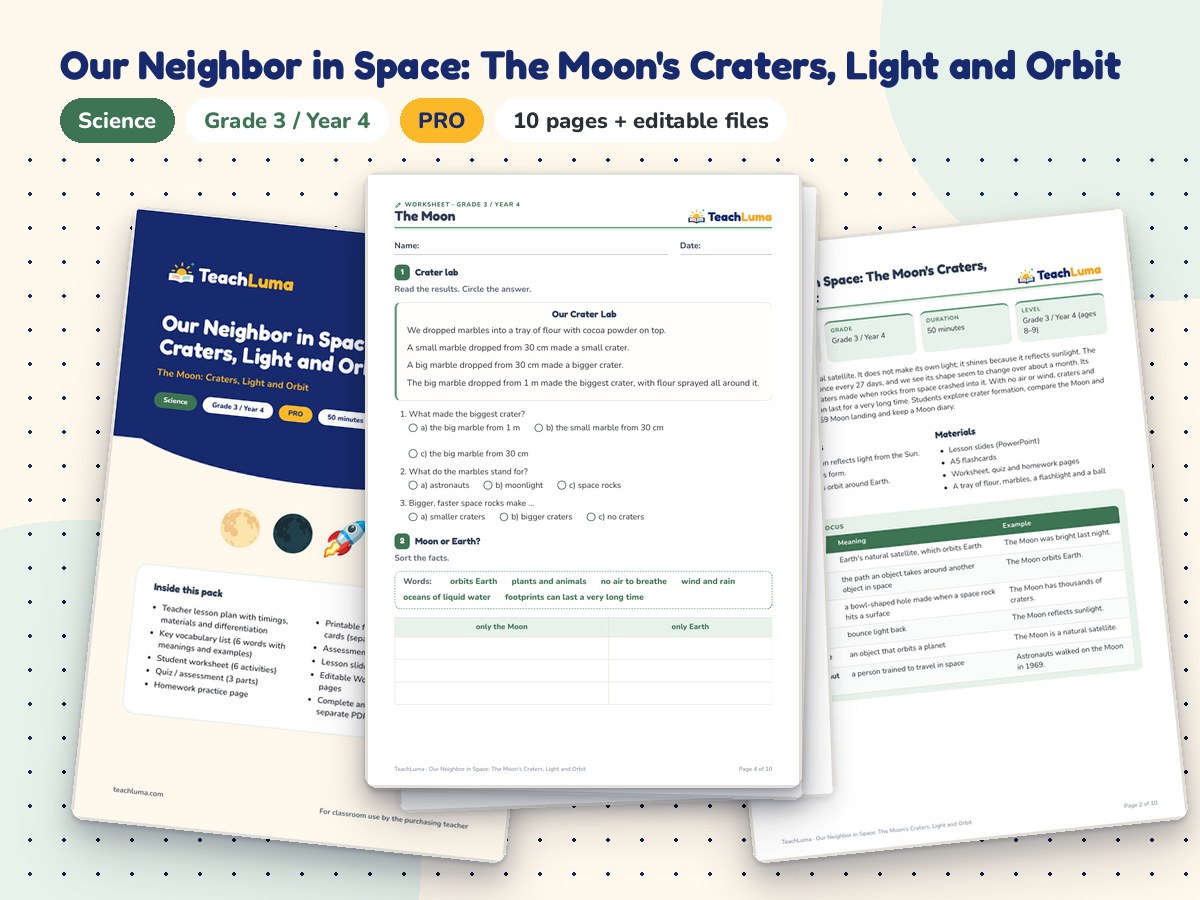
A complete Grade 3 science pack on the Moon. Students learn that the Moon reflects light from the Sun, orbits Earth about once a month, has craters made by space rocks and has no air or liquid water. They make crater observations, compare the Moon and Earth, read facts about the first Moon landing and record the Moon's shape for a week. Includes slides, a lesson plan, worksheet, quiz, homework, A5 flashcards, a rubric, Word files and answer keys.

Overview

The Moon is Earth's natural satellite. It does not make its own light; it shines because it reflects sunlight. The Moon orbits Earth about once every 27 days, and we see its shape seem to change over about a month. Its surface is covered with craters made when rocks from space crashed into it. With no air or wind, craters and footprints on the Moon can last for a very long time. Students explore crater formation, compare the Moon and Earth, read about the 1969 Moon landing and keep a Moon diary.

Resource Details

Subject
Science
Topic
The Moon: Craters, Light and Orbit
Category
Earth & Space
File Type
PDF
File Size
354.7 KB
Published
23 Nov 2026
Downloads
0

Members Only

Create a free account to download this resource with one of your 3 Free Pro Previews, or upgrade to Teacher Pro (from ฿199/month) for the whole library.

Share:

Looking for something different? Request a Resource.

Grade 3 (ages 8–9) 50 minutes Observing comparing modeling recording

Learning Objectives

  • Explain that the Moon reflects light from the Sun.
  • Describe how craters form.
  • Describe the Moon's orbit around Earth.

How to Use This Resource

  • Show a photo of the full Moon. Ask: "Where does the Moon's light come from?"
  • Teach light, orbit and craters with the slides, then do activities 1 and 2 together.
  • Students complete activities 3 to 6. Use the quiz and send the homework page home.

Classroom Activity Ideas

  • Crater lab: drop marbles of different sizes into a tray of flour.
  • Flashlight model: shine a torch on a ball to show reflected light.
  • Moon walk: act out the Moon orbiting Earth while spinning slowly.

Differentiation

Support: give a labeled Moon and Earth comparison chart. Challenge: explain why we always see the same side of the Moon.

Assessment

Use the worksheet and quiz to check understanding. Use the rubric for the homework Moon diary.

Teacher Tips

Many students believe the Moon makes its own light. Use a flashlight and a ball in a dark room so they can see light bouncing off the surface.

What's Included

  • 10-page printable PDF lesson pack: teacher lesson plan with timings, materials and differentiation
  • Key vocabulary list (6 words with meanings and examples)
  • Student worksheet (6 activities)
  • Quiz / assessment (3 parts)
  • Homework practice page
  • Printable flashcards: 6 A5 picture cards (separate PDF)
  • Assessment rubric (4 levels)
  • Lesson slides (editable PowerPoint)
  • Editable Word version of all student pages
  • Complete answer key (also as a separate PDF)

Additional Files

  • Lesson Slides (PPTX)
  • Editable Student Pages and Lesson Plan (DOCX)
  • A5 Flashcards (PDF)
  • Answer Key (PDF)

Teacher Reviews

No ratings yet

Be the first teacher to review this resource.

Sign in to review this resource.

Related Resources

Advertisement