Skip to content
Preview
Members Only Science Complete Lesson Pack Grade 3
No ratings yet

Clues in the Rocks: How Fossils Form

About This Resource

A complete Grade 3 science lesson pack on fossils: what a fossil is, how fossils form in layers of sediment, body fossils and trace fossils, what fossils teach us about the past, and the work of paleontologists. Includes a lesson plan, worksheet, quiz, homework, A5 flashcards, a rubric, detailed slides with speaker notes, Word files and answer keys.

Overview

Children find out that fossils are the remains or traces of living things from long ago, preserved in rock. They put the steps of fossil formation in order, learn the difference between body fossils (bones, shells, teeth) and trace fossils (footprints, burrows), read about a paleontologist's discovery and explain what fossils tell us about plants, animals and environments of the past.

Resource Details

Subject
Science
Topic
Fossils
Category
Earth & Space
File Type
PDF
File Size
348.5 KB
Published
31 Oct 2026
Downloads
0

Members Only

Upgrade to Teacher Pro (from ฿199/month) to download this resource.

Share:

Looking for something different? Request a Resource.

Grade 3 (ages 8–9) 50 minutes Earth science sequencing classifying reading explaining

Learning Objectives

  • Explain what a fossil is and describe how most fossils form.
  • Tell the difference between body fossils and trace fossils.
  • Describe what fossils can teach us about life long ago.

How to Use This Resource

  • Show the slides and pass around a shell or a photo of a fossil.
  • Use the flashcards to teach the key words, then complete the worksheet.
  • Use the quiz to check learning and send the fossil model homework; answers are in the answer keys.

Classroom Activity Ideas

  • Dough fossils: press a shell or toy dinosaur foot into salt dough to make a mold, then let it dry.
  • Layer cake: build layers of colored sand in a clear cup with a small shell in the bottom layer.
  • Fossil detective: show photos of footprints and ask children what animal made them and how it moved.

Differentiation

Support: use picture cards for the formation steps and a word bank. Challenge: explain why fossils of sea animals can be found on mountain tops.

Assessment

The worksheet and quiz check fossil formation and types (answer keys included). Use the rubric for explanations and the model.

Teacher Tips

Stress that fossils form over a very, very long time. A sandwich model helps: each new layer of sediment is like a new slice pressing down on the ones below.

What's Included

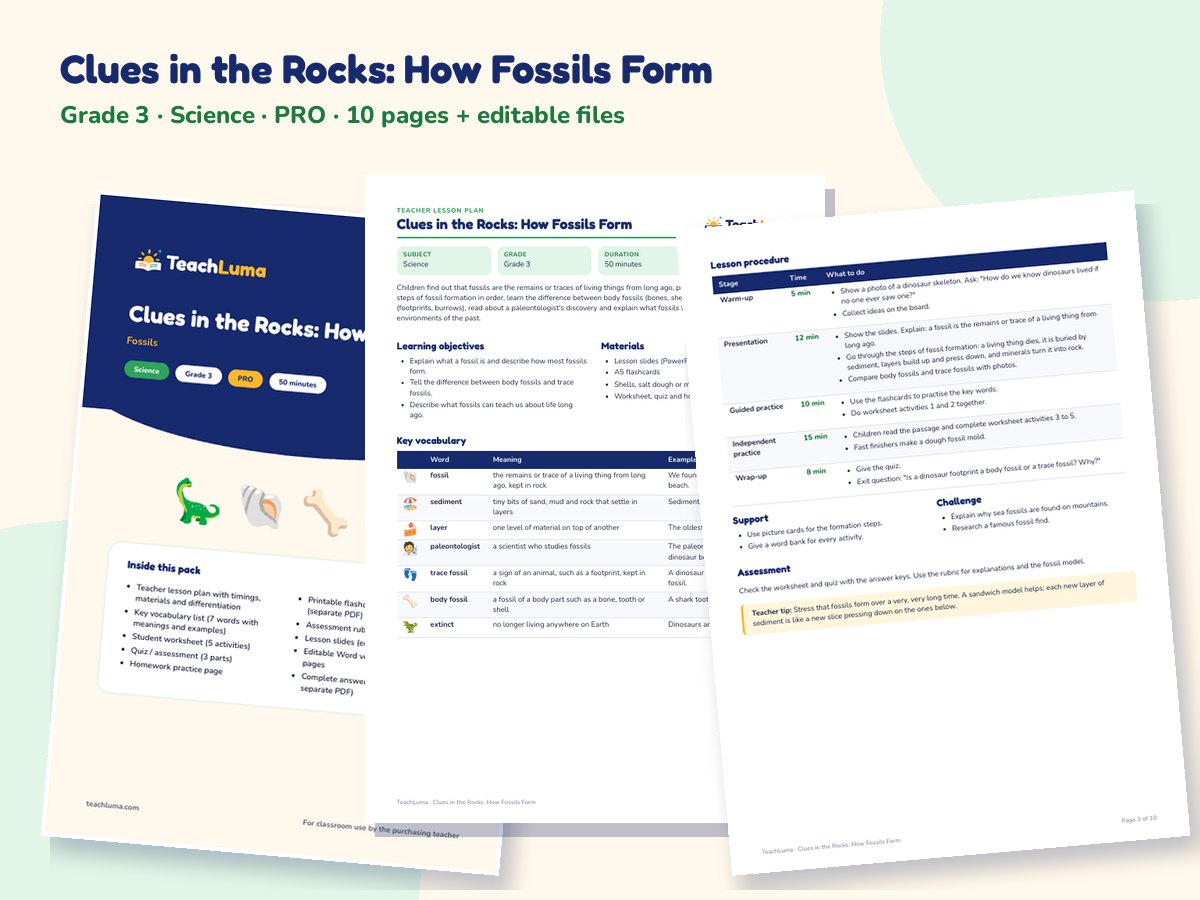
  • 10-page printable PDF lesson pack: teacher lesson plan with timings, materials and differentiation
  • Key vocabulary list (7 words with meanings and examples)
  • Student worksheet (5 activities)
  • Quiz / assessment (3 parts)
  • Homework practice page
  • Printable flashcards: 7 A5 picture cards (separate PDF)
  • Assessment rubric (4 levels)
  • Lesson slides (editable PowerPoint)
  • Editable Word version of all student pages
  • Complete answer key (also as a separate PDF)

Additional Files

  • Lesson Slides (PowerPoint, editable) (PPTX)
  • Editable Student Pages + Lesson Plan (Word) (DOCX)
  • Flashcards (PDF, A5, one card per page) (PDF)
  • Answer Key (PDF) (PDF)

Teacher Reviews

No ratings yet

Be the first teacher to review this resource.

Sign in to review this resource.

Related Resources

Advertisement