Skip to content
Preview
Members Only Math Complete Lesson Pack Grade 5 (Year 6)
No ratings yet

Prime Time: Prime and Composite Numbers

About This Resource

A complete Grade 5 math pack on prime and composite numbers. Students find factor pairs, classify numbers to 100 as prime or composite, learn why 1 is neither, use divisibility rules for 2, 3, 5 and 10, explore the sieve method to find all primes to 50 and write composite numbers as products of primes. Includes slides, a lesson plan, worksheet, quiz, homework, A5 flashcards, a rubric, Word files and answer keys.

Overview

A prime number has exactly two factors: 1 and itself (2, 3, 5, 7, 11 ...). A composite number has more than two factors (4, 6, 8, 9 ...). The number 1 is neither prime nor composite, because it has only one factor. Students use arrays and factor pairs to classify numbers, apply quick divisibility rules, follow the sieve method to find primes to 50 and break composite numbers into prime factors.

Resource Details

Subject
Math
Topic
Prime and Composite Numbers
Category
Number Sense
File Type
PDF
File Size
314.5 KB
Published
23 Nov 2026
Downloads
0

Members Only

Create a free account to download this resource with one of your 3 Free Pro Previews, or upgrade to Teacher Pro (from ฿199/month) for the whole library.

Share:

Looking for something different? Request a Resource.

Grade 5 (ages 10–11) 50 minutes Factors multiplication divisibility reasoning

Learning Objectives

  • Find all factor pairs of a whole number.
  • Classify numbers as prime or composite.
  • Write a composite number as a product of prime factors.

How to Use This Resource

  • Give students 12 counters. Ask: "How many different rectangles can you make?" Then try with 7 counters.
  • Teach prime and composite with the slides, then do activities 1 and 2 together.
  • Students complete activities 3 to 6. Use the quiz and send the homework page home.

Classroom Activity Ideas

  • Array challenge: build rectangles with counters to test numbers.
  • Prime or composite? Stand up for prime, sit down for composite.
  • Sieve race: cross out multiples on a hundred chart.

Differentiation

Support: give a multiplication table to help find factors. Challenge: explain why every number greater than 1 is either prime or a product of primes.

Assessment

Use the worksheet and quiz to check classification and factors. Use the rubric for the homework sieve.

Teacher Tips

Remind students that 2 is the only even prime number. Every other even number has 2 as a factor, so it is composite.

What's Included

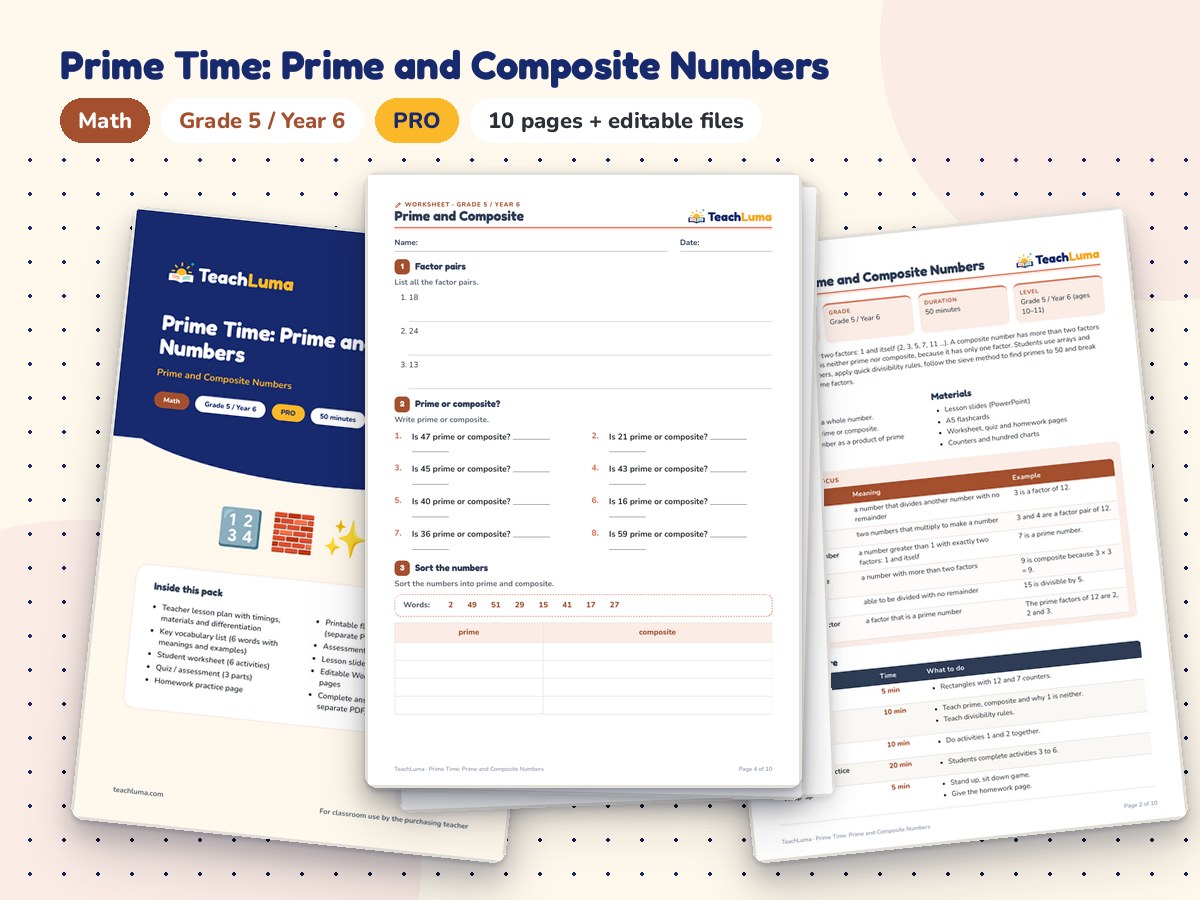
  • 10-page printable PDF lesson pack: teacher lesson plan with timings, materials and differentiation
  • Key vocabulary list (6 words with meanings and examples)
  • Student worksheet (6 activities)
  • Quiz / assessment (3 parts)
  • Homework practice page
  • Printable flashcards: 6 A5 picture cards (separate PDF)
  • Assessment rubric (4 levels)
  • Lesson slides (editable PowerPoint)
  • Editable Word version of all student pages
  • Complete answer key (also as a separate PDF)

Additional Files

  • Lesson Slides (PPTX)
  • Editable Student Pages and Lesson Plan (DOCX)
  • A5 Flashcards (PDF)
  • Answer Key (PDF)

Teacher Reviews

No ratings yet

Be the first teacher to review this resource.

Sign in to review this resource.

Related Resources

Advertisement