Skip to content
Preview
Members Only Science Complete Lesson Pack Grade 6 (Year 7)
No ratings yet

Rivers in the Sea: How Ocean Currents Work

About This Resource

A complete Grade 6 science pack on ocean currents. Students learn that surface currents are driven mainly by wind, that deep currents are driven by differences in temperature and saltiness (density), how warm and cold currents affect the climate of coastal places, and how currents carry heat, nutrients, animals and even plastic around the world. Includes slides, a lesson plan, worksheet, quiz, homework, A5 flashcards, a rubric, Word files and answer keys.

Overview

Ocean water is always moving in huge streams called currents. Surface currents are pushed mainly by winds and are bent by Earth's rotation into large circular patterns. Deep currents form because cold, salty water is denser and sinks, while warmer, less salty water rises. Together they form a global conveyor belt that moves heat from the equator toward the poles. Warm currents make some coasts milder than expected, and cold currents bring nutrient-rich water that supports fish. Students model density with a simple demonstration, interpret a simplified current map description and explain how currents affect climate, wildlife and pollution.

Resource Details

Subject
Science
Topic
Ocean Currents
Category
Earth & Space
File Type
PDF
File Size
321.9 KB
Published
20 Nov 2026
Downloads
0

Members Only

Create a free account to download this resource with one of your 3 Free Pro Previews, or upgrade to Teacher Pro (from ฿199/month) for the whole library.

Share:

Looking for something different? Request a Resource.

Grade 6 (ages 11–12) 55 minutes Explaining cause and effect interpreting models data reasoning

Learning Objectives

  • Explain what drives surface and deep ocean currents.
  • Describe how warm and cold currents affect coastal climates.
  • Explain how currents move heat, nutrients and pollution.

How to Use This Resource

  • Ask: "If you dropped a message in a bottle into the sea, where would it go?"
  • Teach surface and deep currents with the slides and a density demonstration, then do activities 1 and 2 together.
  • Students complete activities 3 to 6. Use the quiz and send the homework page home.

Classroom Activity Ideas

  • Density demonstration: colored cold salty water poured gently into warm fresh water sinks to the bottom.
  • Wind and water: blow across a tray of water with pepper sprinkled on top to show wind-driven currents.
  • Drift tracking: discuss how scientists track floating objects to map currents.

Differentiation

Support: give a labeled diagram of surface and deep currents. Challenge: students explain why a city near a warm current can be milder than a city at the same latitude near a cold current.

Assessment

Use the worksheet and quiz to check understanding. Use the rubric for the cause-and-effect explanations.

Teacher Tips

Keep the density idea concrete: cold water and salty water are heavier for the same amount, so they sink. The global conveyor belt is a simplified model; real currents are more complex.

What's Included

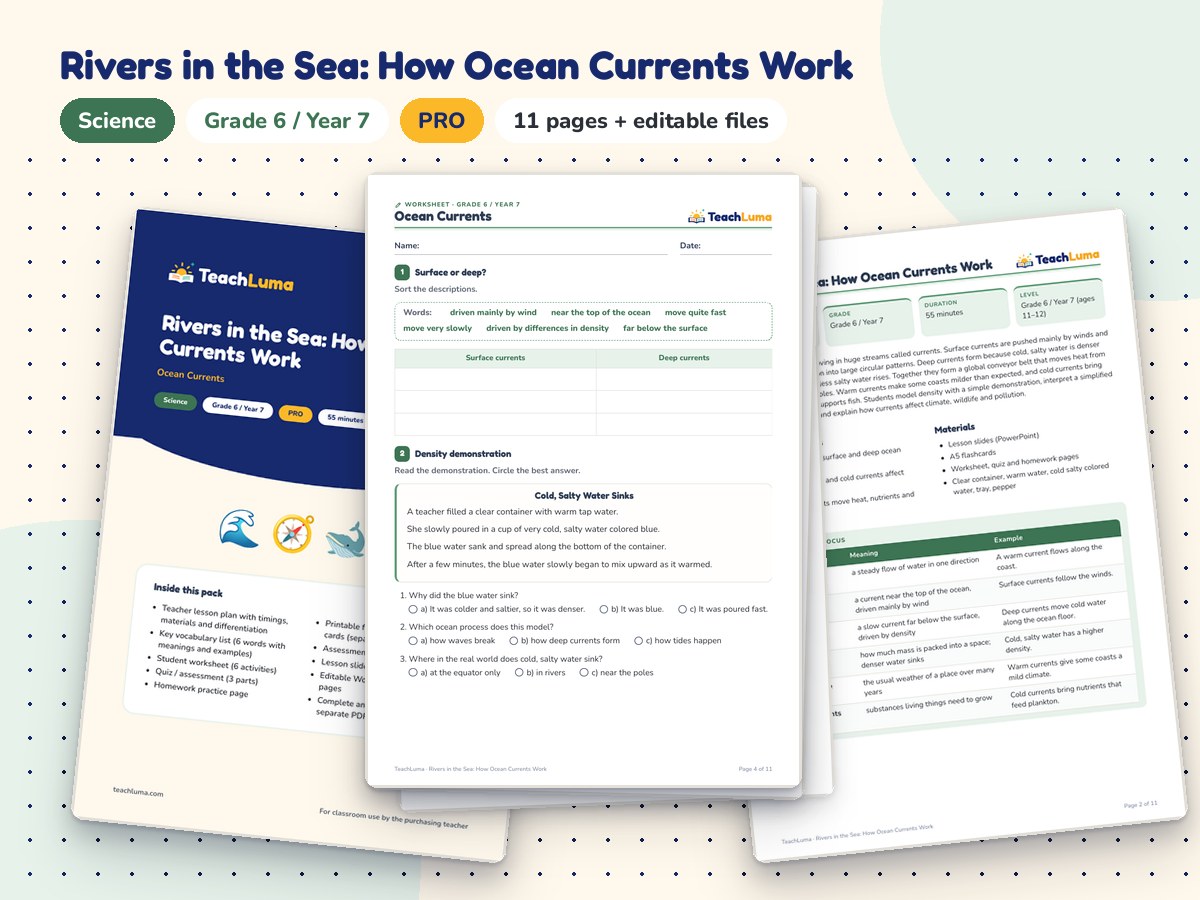
  • 11-page printable PDF lesson pack: teacher lesson plan with timings, materials and differentiation
  • Key vocabulary list (6 words with meanings and examples)
  • Student worksheet (6 activities)
  • Quiz / assessment (3 parts)
  • Homework practice page
  • Printable flashcards: 6 A5 picture cards (separate PDF)
  • Assessment rubric (4 levels)
  • Lesson slides (editable PowerPoint)
  • Editable Word version of all student pages
  • Complete answer key (also as a separate PDF)

Additional Files

  • Lesson Slides (PPTX)
  • Editable Student Pages and Lesson Plan (DOCX)
  • A5 Flashcards (PDF)
  • Answer Key (PDF)

Teacher Reviews

No ratings yet

Be the first teacher to review this resource.

Sign in to review this resource.

Related Resources

Advertisement