Skip to content
Preview
Members Only Science Complete Lesson Pack Grade 5 (Year 6)
No ratings yet

Space Rocks! Asteroids, Comets and Meteors

About This Resource

A complete Grade 5 science pack on small bodies in the solar system. Students learn the differences between asteroids, comets, meteoroids, meteors and meteorites, where the asteroid belt is, why comets grow tails near the Sun, what causes meteor showers and how scientists track objects near Earth. Includes slides, a lesson plan, worksheet, quiz, homework, A5 flashcards, a rubric, Word files and answer keys.

Overview

The solar system holds many small rocky and icy objects. Asteroids are rocky bodies, and most orbit the Sun in the asteroid belt between Mars and Jupiter. Comets are balls of ice and dust; near the Sun they heat up and form glowing tails that point away from the Sun. A meteoroid is a small space rock. When it burns up in Earth's atmosphere, we see a streak of light called a meteor. If a piece reaches the ground, it is a meteorite.

Resource Details

Subject
Science
Topic
Asteroids, Comets and Meteors
Category
Earth & Space
File Type
PDF
File Size
352.7 KB
Published
21 Nov 2026
Downloads
0

Members Only

Create a free account to download this resource with one of your 3 Free Pro Previews, or upgrade to Teacher Pro (from ฿199/month) for the whole library.

Share:

Looking for something different? Request a Resource.

Grade 5 (ages 10–11) 50 minutes Space science comparing reading for information explaining

Learning Objectives

  • Describe asteroids and comets and where they are found.
  • Explain the difference between a meteoroid, a meteor and a meteorite.
  • Explain why comets have tails and what causes meteor showers.

How to Use This Resource

  • Show a photo of a shooting star. Ask: "Is it really a star?"
  • Teach the space rock words with the slides, then do activities 1 and 2 together.
  • Students complete activities 3 to 6. Use the quiz and send the homework page home.

Classroom Activity Ideas

  • Space rock sort: sort cards into asteroid, comet and meteoroid.
  • Comet model: make a comet with a ball of paper and ribbons; blow on it to show the tail direction.
  • Meteor shower watch: check when the next shower is and observe with an adult.

Differentiation

Support: use a picture chart of the three meteor words. Challenge: research a famous comet or asteroid mission and present three facts.

Assessment

Use the worksheet and quiz to check understanding. Use the rubric for explanations.

Teacher Tips

Use the memory trick: a meteoROID is in space, a meteOR is in the air, and a meteorITE hits the ground.

What's Included

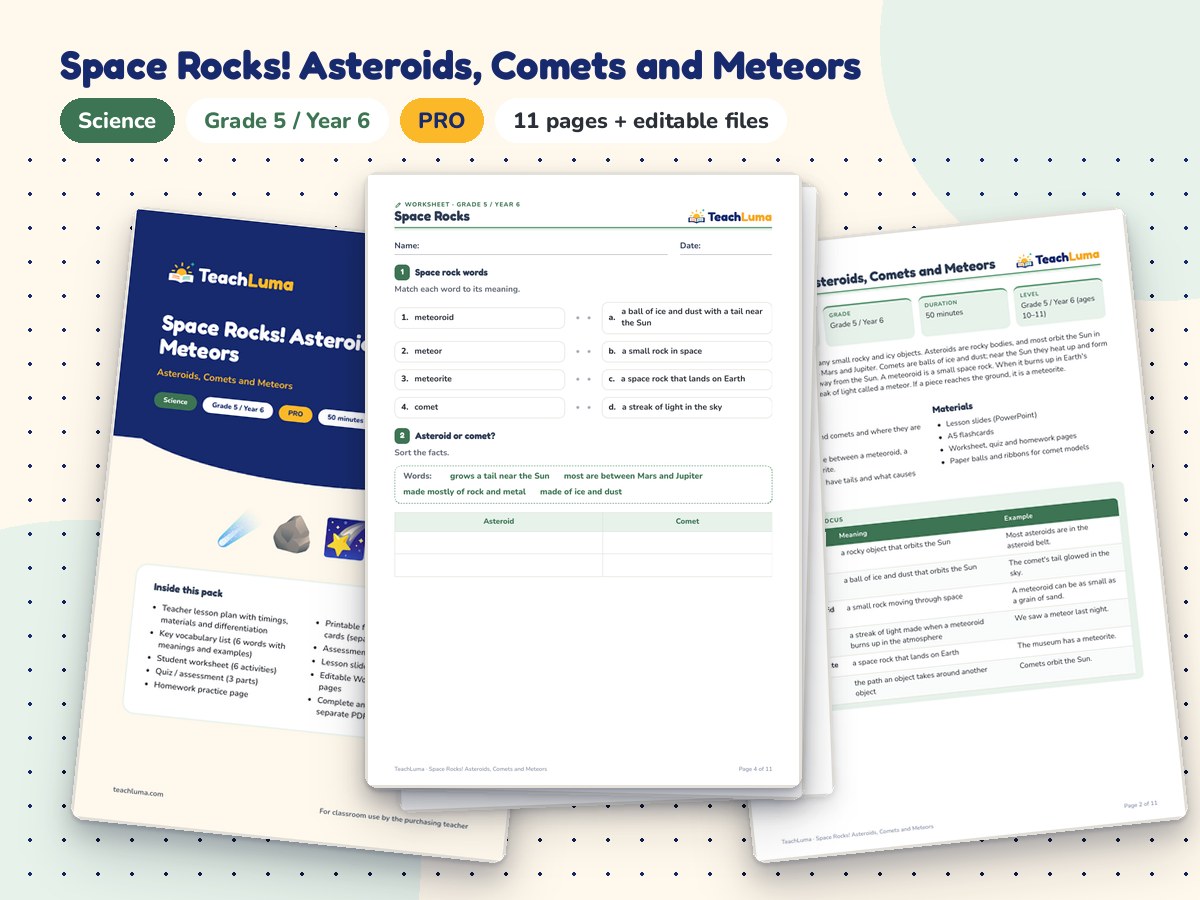
  • 11-page printable PDF lesson pack: teacher lesson plan with timings, materials and differentiation
  • Key vocabulary list (6 words with meanings and examples)
  • Student worksheet (6 activities)
  • Quiz / assessment (3 parts)
  • Homework practice page
  • Printable flashcards: 6 A5 picture cards (separate PDF)
  • Assessment rubric (4 levels)
  • Lesson slides (editable PowerPoint)
  • Editable Word version of all student pages
  • Complete answer key (also as a separate PDF)

Additional Files

  • Lesson Slides (PPTX)
  • Editable Student Pages and Lesson Plan (DOCX)
  • A5 Flashcards (PDF)
  • Answer Key (PDF)

Teacher Reviews

No ratings yet

Be the first teacher to review this resource.

Sign in to review this resource.

Related Resources

Advertisement