Skip to content
Preview
Members Only Science Complete Lesson Pack Grade 5 (Year 6)
No ratings yet

Seeing the Light: How Our Eyes Work

About This Resource

A complete Grade 5 science pack on light and vision. Students learn that light travels in straight lines from a source, reflects off objects and enters the eye. They label the parts of the eye (cornea, iris, pupil, lens, retina, optic nerve), explain how the pupil changes size, and learn how to protect their eyes. Includes slides, a lesson plan, worksheet, quiz, homework, A5 flashcards, a rubric, Word files and answer keys.

Overview

We see objects when light travels from a light source, bounces off an object and enters our eyes. Light passes through the cornea and the pupil, the lens focuses it onto the retina at the back of the eye, and the optic nerve carries signals to the brain, which makes an image. The iris controls how much light enters by making the pupil bigger or smaller. Students trace light paths, label the eye, observe their pupils and learn eye safety.

Resource Details

Subject
Science
Topic
How We See: Light and the Eye
Category
Human Body
File Type
PDF
File Size
320 KB
Published
21 Nov 2026
Downloads
0

Members Only

Create a free account to download this resource with one of your 3 Free Pro Previews, or upgrade to Teacher Pro (from ฿199/month) for the whole library.

Share:

Looking for something different? Request a Resource.

Grade 5 (ages 10–11) 50 minutes Light human body diagrams observing

Learning Objectives

  • Explain how we see objects using the idea that light travels in straight lines.
  • Name and describe the main parts of the eye.
  • Explain how the pupil responds to light.

How to Use This Resource

  • Turn off the lights and close the blinds. Ask: "Why is it harder to see now?"
  • Teach how we see with the slides, then do activities 1 and 2 together.
  • Students complete activities 3 to 6. Use the quiz and send the homework page home.

Classroom Activity Ideas

  • Pupil watch: partners watch each other's pupils change size near a window.
  • Light path drawing: draw arrows from a lamp to a book to an eye.
  • Blind spot test: find your blind spot with a simple card test.

Differentiation

Support: use a labeled eye diagram with word cards. Challenge: explain why we cannot see in complete darkness.

Assessment

Use the worksheet and quiz to check understanding. Use the rubric for light path diagrams and explanations.

Teacher Tips

A common mistake is drawing light going from the eye to the object. Always draw arrows from the light source to the object, then into the eye. Never look directly at the Sun.

What's Included

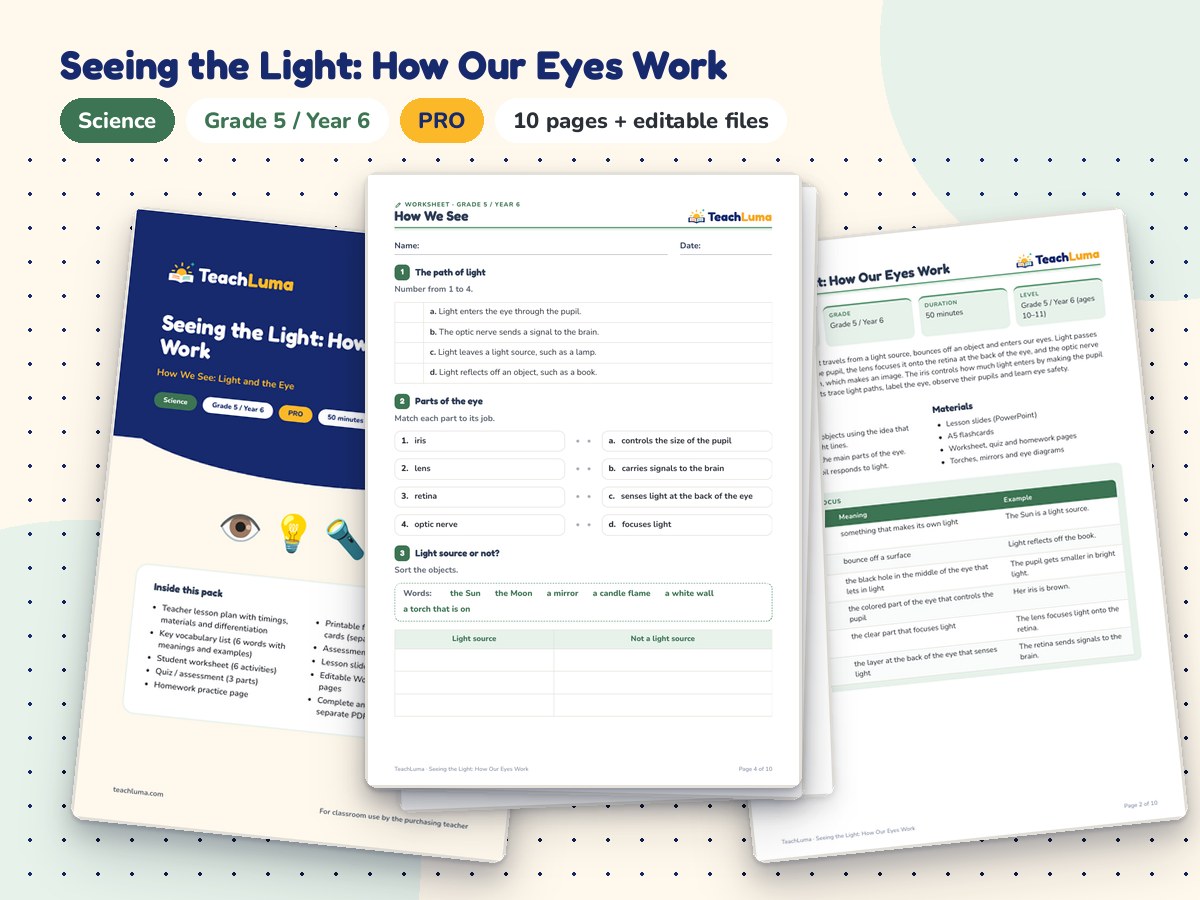
  • 10-page printable PDF lesson pack: teacher lesson plan with timings, materials and differentiation
  • Key vocabulary list (6 words with meanings and examples)
  • Student worksheet (6 activities)
  • Quiz / assessment (3 parts)
  • Homework practice page
  • Printable flashcards: 6 A5 picture cards (separate PDF)
  • Assessment rubric (4 levels)
  • Lesson slides (editable PowerPoint)
  • Editable Word version of all student pages
  • Complete answer key (also as a separate PDF)

Additional Files

  • Lesson Slides (PPTX)
  • Editable Student Pages and Lesson Plan (DOCX)
  • A5 Flashcards (PDF)
  • Answer Key (PDF)

Teacher Reviews

No ratings yet

Be the first teacher to review this resource.

Sign in to review this resource.

Related Resources

Advertisement