Skip to content
Preview
Members Only Science Lesson Plan Grade 5
No ratings yet

Take a Deep Breath: The Respiratory System

About This Resource

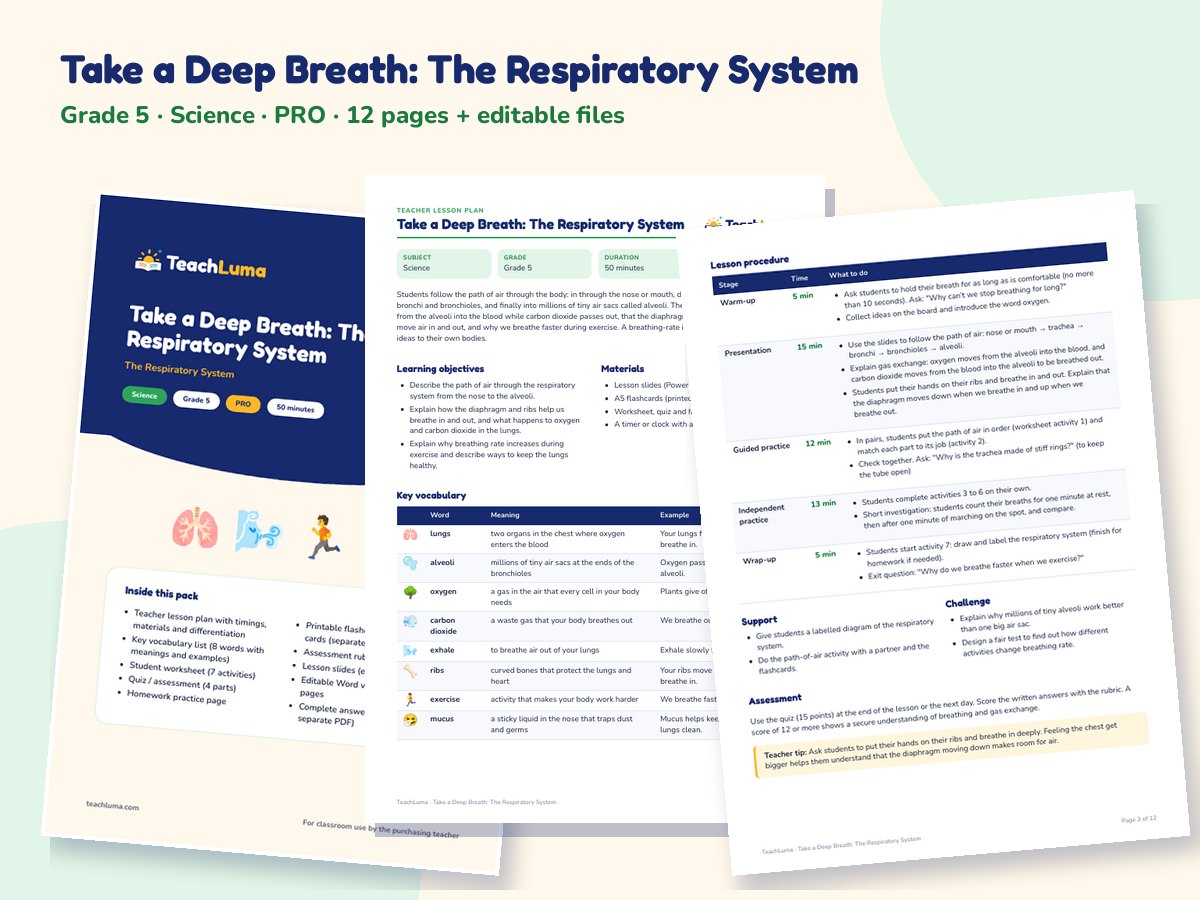
A complete Grade 5 science pack on the respiratory system: the path of air from nose to alveoli, how the diaphragm helps us breathe, gas exchange, and keeping lungs healthy. Includes a lesson plan, worksheet, quiz, homework, A5 flashcards, a rubric, editable slides and Word files, and answer keys.

Overview

Students follow the path of air through the body: in through the nose or mouth, down the trachea, into the bronchi and bronchioles, and finally into millions of tiny air sacs called alveoli. They learn that oxygen passes from the alveoli into the blood while carbon dioxide passes out, that the diaphragm and ribs work together to move air in and out, and why we breathe faster during exercise. A breathing-rate investigation connects the ideas to their own bodies.

Resource Details

Subject
Science
Topic
The Respiratory System
Category
Human Body
File Type
PDF
File Size
394.1 KB
Published
28 Oct 2026
Downloads
0

Members Only

Upgrade to Teacher Pro (from ฿199/month) to download this resource.

Share:

Looking for something different? Request a Resource.

Grade 5 (ages 10–11) 50 minutes Sequencing explaining processes collecting and comparing data scientific vocabulary labelling diagrams

Learning Objectives

  • Describe the path of air through the respiratory system from the nose to the alveoli.
  • Explain how the diaphragm and ribs help us breathe in and out, and what happens to oxygen and carbon dioxide in the lungs.
  • Explain why breathing rate increases during exercise and describe ways to keep the lungs healthy.

Lesson Procedure

  • Teach the lesson with the slides and the lesson plan; let students feel their ribs and diaphragm move as they breathe.
  • Use the worksheet for guided and independent practice.
  • Give the quiz at the end of the lesson or the next day, and score the written answers with the rubric.
  • Send the homework breathing-rate investigation home and use the A5 flashcards for vocabulary review.

Assessment

The quiz (15 points) checks the air path, breathing movements and gas exchange. The rubric gives four levels for each of these areas and for using science words.

Differentiation

Support: give students a labelled diagram of the respiratory system to use during the worksheet. Challenge: ask students to explain why the alveoli need to be so tiny and so many.

Classroom Activity Ideas

  • Breathing rate investigation: count breaths per minute at rest and after one minute of jumping, then compare class results.
  • Model lungs: use a plastic bottle and balloons to show how the diaphragm pulls air into the lungs.
  • Air path relay: students hold cards (nose, trachea, bronchi, bronchioles, alveoli) and line up in the right order.

Teacher Tips

Ask students to put their hands on their ribs and breathe in deeply. Feeling the chest get bigger helps them understand that the diaphragm moving down makes room for air.

What's Included

  • 12-page printable PDF lesson pack: teacher lesson plan with timings, materials and differentiation
  • Key vocabulary list (8 words with meanings and examples)
  • Student worksheet (7 activities)
  • Quiz / assessment (4 parts)
  • Homework practice page
  • Printable flashcards: 8 A5 picture cards (separate PDF)
  • Assessment rubric (4 levels)
  • Lesson slides (editable PowerPoint)
  • Editable Word version of all student pages
  • Complete answer key (also as a separate PDF)

Additional Files

  • Lesson Slides (PowerPoint, editable) (PPTX)
  • Editable Student Pages + Lesson Plan (Word) (DOCX)
  • Flashcards (PDF, A5, one card per page) (PDF)
  • Answer Key (PDF) (PDF)

Teacher Reviews

No ratings yet

Be the first teacher to review this resource.

Sign in to review this resource.

Related Resources

Advertisement