Skip to content
Preview
Free ESL Worksheet Grade 3 (Year 4)
No ratings yet

Sound the Same, Mean Something Different: Homophones

About This Resource

A free Grade 3 ESL worksheet on homophones: words that sound the same but have different spellings and meanings, such as see/sea, right/write, hear/here, sun/son, pair/pear and to/too/two. Students match homophone pairs, choose the right word in context, fix mistakes in a short note and write their own sentences. Includes a timed lesson plan, a six-activity worksheet, an editable Word version and answer key.

Overview

Students learn that homophones sound exactly alike but are spelled differently and mean different things. They match common homophone pairs with pictures and meanings, choose the correct word to complete sentences, learn tricks to remember the hardest ones (there, their, they're and to, too, two), find and fix homophone mistakes in a short note, and write sentences that show the meaning of each word in a pair.

Resource Details

Subject
ESL
Topic
Homophones
Category
Vocabulary
File Type
PDF
File Size
252.1 KB
Published
04 Nov 2026
Downloads
3
Download

Free download — no account required.

Teaching this in class? Try our free Random Name Picker & Timer.

Share:

Looking for something different? Request a Resource.
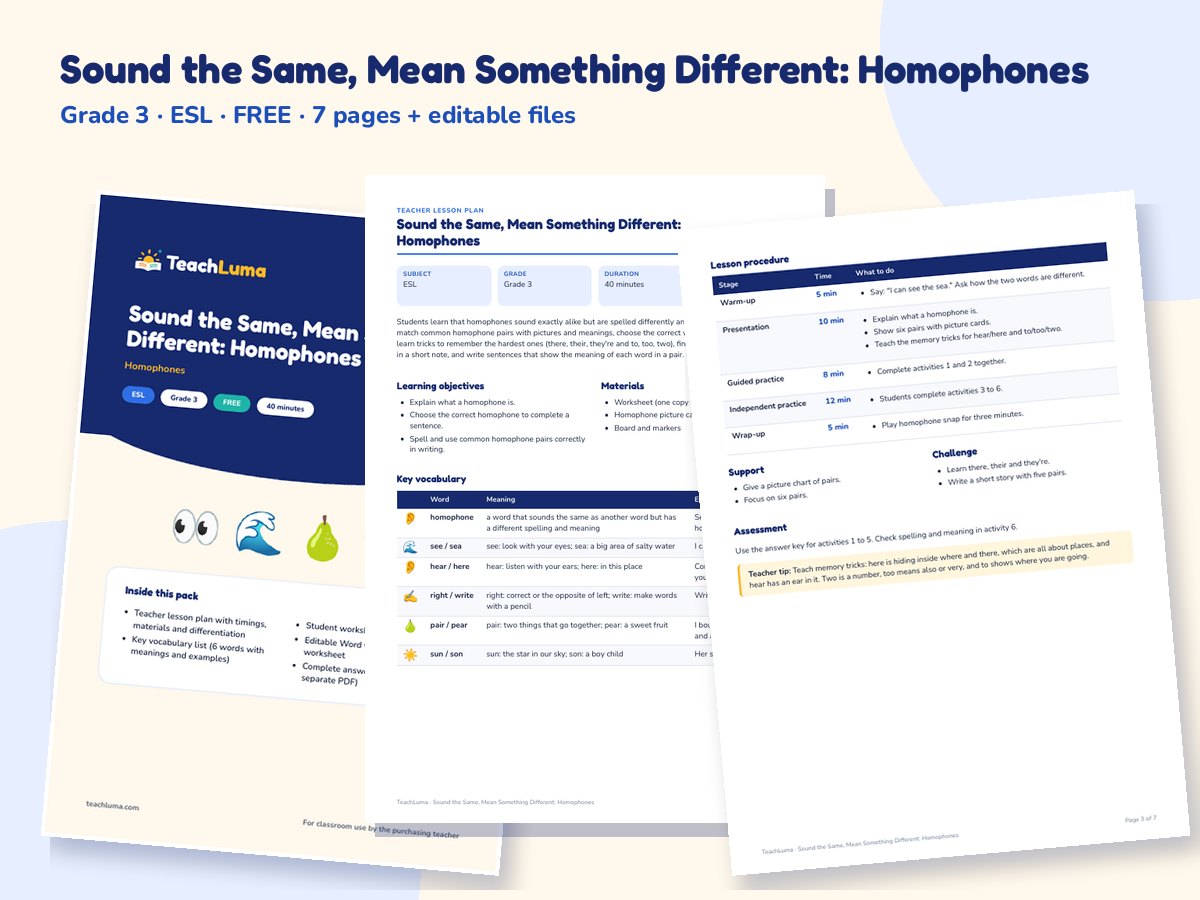

Grade 3 (ages 8–9), elementary ESL 40 minutes Spelling vocabulary reading in context proofreading writing

Student Task

  • Say "I can see the sea." Ask: "Are the two words the same? How are they different?" Write both on the board.
  • Teach the meaning of homophone and the memory tricks, then do activities 1 and 2 together.
  • Students complete activities 3 to 6. Answers are in the answer key.

Classroom Use

  • Homophone snap: students turn over cards and say "Snap!" when they find a matching pair, then use both words in a sentence.
  • Picture it: students draw a funny picture showing the wrong homophone (a bear holding a pair of pears).
  • Proofreading detectives: students find homophone mistakes in sentences written on the board.

Differentiation

Support: give a picture chart of the homophone pairs and focus on six pairs. Challenge: learn three-word sets (to, too, two; there, their, they're) and write a short story using five pairs.

Answer Key & Assessment

Activities 1 to 5 check choosing and spelling homophones in context (answer key included). Activity 6 checks using homophones correctly in sentences.

Learning Objectives

  • Explain what a homophone is.
  • Choose the correct homophone to complete a sentence.
  • Spell and use common homophone pairs correctly in writing.

Teacher Tips

Teach memory tricks: here is hiding inside where and there, which are all about places, and hear has an ear in it. Two is a number, too means also or very, and to shows where you are going.

What's Included

  • 7-page printable PDF lesson pack: teacher lesson plan with timings, materials and differentiation
  • Key vocabulary list (6 words with meanings and examples)
  • Student worksheet (6 activities)
  • Editable Word version of the worksheet
  • Complete answer key (also as a separate PDF)

Additional Files


Teacher Reviews

No ratings yet

Be the first teacher to review this resource.

Sign in to review this resource.

Related Resources

Advertisement