Skip to content
Preview
Members Only Science Lesson Plan Grade 3
No ratings yet

Bones and Muscles: How Our Bodies Move

About This Resource

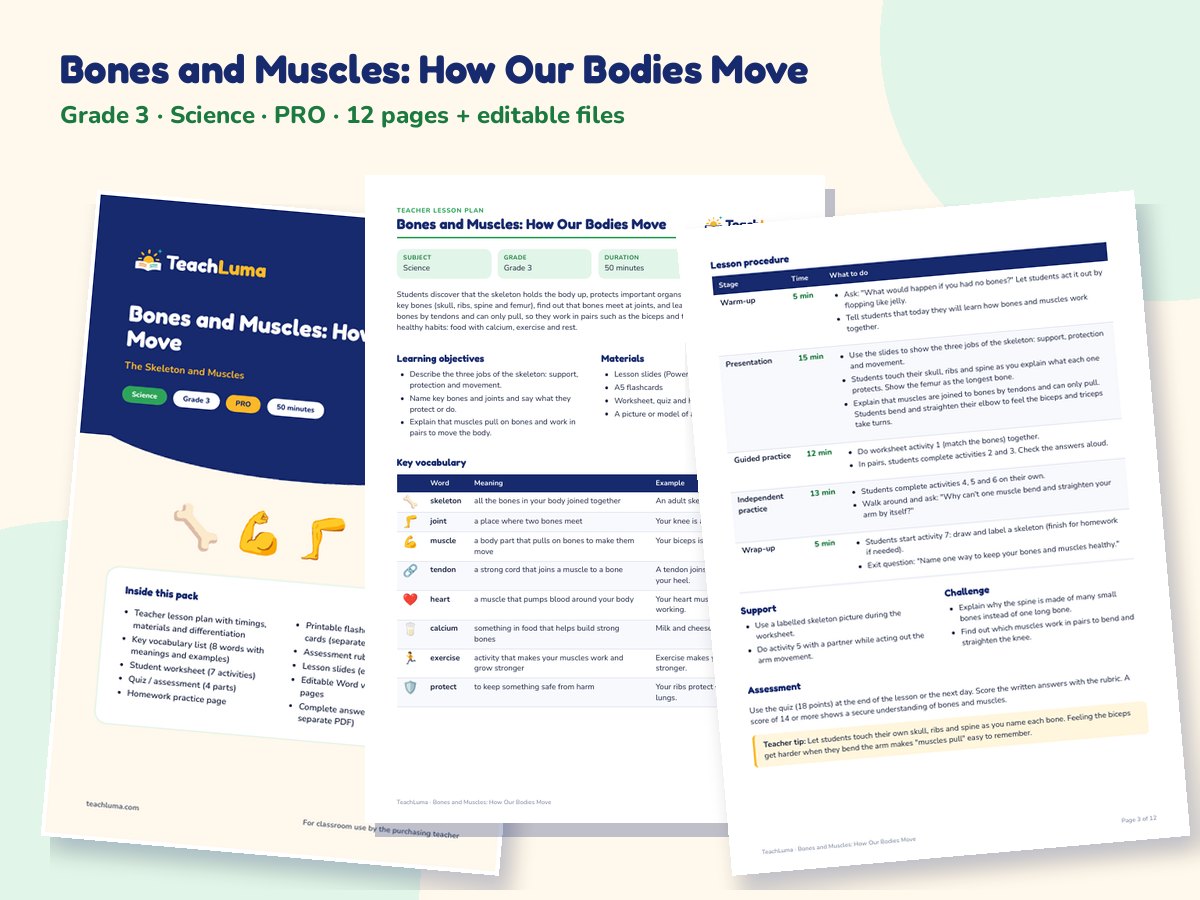
A complete Grade 3 science pack on the skeleton and muscles: the three jobs of the skeleton, important bones and joints, how muscles pull in pairs, and keeping bones and muscles healthy. Includes a lesson plan, worksheet, quiz, homework, A5 flashcards, a rubric, editable slides and Word files, and answer keys.

Overview

Students discover that the skeleton holds the body up, protects important organs and helps us move. They meet key bones (skull, ribs, spine and femur), find out that bones meet at joints, and learn that muscles are joined to bones by tendons and can only pull, so they work in pairs such as the biceps and triceps. The lesson ends with healthy habits: food with calcium, exercise and rest.

Resource Details

Subject
Science
Topic
The Skeleton and Muscles
Category
Human Body
File Type
PDF
File Size
384.4 KB
Published
28 Oct 2026
Downloads
0

Members Only

Upgrade to Teacher Pro (from ฿199/month) to download this resource.

Share:

Looking for something different? Request a Resource.

Grade 3 (ages 8–9) 50 minutes Observing explaining classifying sequencing scientific vocabulary

Learning Objectives

  • Describe the three jobs of the skeleton: support, protection and movement.
  • Name key bones and joints and say what they protect or do.
  • Explain that muscles pull on bones and work in pairs to move the body.

Lesson Procedure

  • Teach the lesson with the slides; let students feel their own bones, joints and muscles as you go.
  • Use the worksheet for guided and independent practice.
  • Give the quiz at the end of the lesson or the next day, and use the rubric for the written answers.
  • Send the homework page home and use the A5 flashcards for vocabulary games.

Assessment

The quiz (18 points) checks the jobs of the skeleton, bones and muscles. The rubric gives four levels for the skeleton's jobs, bones and joints, how muscles move, and using science words.

Differentiation

Support: give students a labelled skeleton picture to use during the worksheet. Challenge: ask students why the skull is one solid bone but the spine is made of many small bones.

Classroom Activity Ideas

  • Muscle pairs: students hold one hand on their upper arm and bend and straighten the elbow to feel the biceps and triceps.
  • Joint hunt: students find and name as many joints as they can by moving their bodies.
  • Paper skeleton: assemble a cut-out skeleton with paper fasteners at the joints.

Teacher Tips

Let students touch their own skull, ribs and spine as you name each bone. Feeling the biceps get harder when they bend the arm makes "muscles pull" easy to remember.

What's Included

  • 12-page printable PDF lesson pack: teacher lesson plan with timings, materials and differentiation
  • Key vocabulary list (8 words with meanings and examples)
  • Student worksheet (7 activities)
  • Quiz / assessment (4 parts)
  • Homework practice page
  • Printable flashcards: 8 A5 picture cards (separate PDF)
  • Assessment rubric (4 levels)
  • Lesson slides (editable PowerPoint)
  • Editable Word version of all student pages
  • Complete answer key (also as a separate PDF)

Additional Files

  • Lesson Slides (PowerPoint, editable) (PPTX)
  • Editable Student Pages + Lesson Plan (Word) (DOCX)
  • Flashcards (PDF, A5, one card per page) (PDF)
  • Answer Key (PDF) (PDF)

Teacher Reviews

No ratings yet

Be the first teacher to review this resource.

Sign in to review this resource.

Related Resources

Advertisement