Skip to content
Preview
Free Math Worksheet Grade 6
No ratings yet

Unfold the Box: Surface Area Using Nets

About This Resource

A free Grade 6 math worksheet pack on surface area using nets: what surface area means, faces, edges and vertices, drawing and recognizing nets of cubes, rectangular prisms and triangular prisms, finding the area of each face and adding them, using the formula 2(lw + lh + wh), and solving wrapping and painting problems. Includes a timed lesson plan, a six-activity worksheet, an editable Word version and answer key.

Overview

Students learn that surface area is the total area of all the faces of a solid figure, measured in square units. They unfold a box to see its net, count faces, edges and vertices, and decide which drawings are nets of a cube. They find the surface area of rectangular prisms by finding the area of each pair of matching faces and adding them, then use the shortcut 2(lw + lh + wh). They compare surface area and volume, find the surface area of a triangular prism from its net and solve real problems such as how much paper is needed to wrap a gift.

Resource Details

Subject
Math
Topic
Surface Area Using Nets
Category
Shapes & Geometry
File Type
PDF
File Size
242.3 KB
Published
01 Nov 2026
Downloads
0
Download

Free download — no account required.

Teaching this in class? Try our free Random Name Picker & Timer.

Share:

Looking for something different? Request a Resource.

Grade 6 (ages 11–12) 50 minutes Geometry area multiplication spatial reasoning problem solving

Student Task

  • Start by cutting open a small cardboard box along its edges and laying it flat. Ask: "How much cardboard was used to make this box?"
  • Teach faces, nets, the area of each face and the surface area formula, then do activities 1 and 2 together.
  • Students complete activities 3 to 6. Answers are in the answer key.

Classroom Use

  • Box unfold: groups cut open cereal or tea boxes, measure each face and calculate the surface area.
  • Cube net hunt: students draw as many different nets of a cube as they can on grid paper (there are 11) and test them by folding.
  • Gift wrap challenge: give each group a box and a sheet of paper; they calculate the minimum paper needed before wrapping.

Differentiation

Support: give printed nets on grid paper so students can count squares, and focus on cubes before rectangular prisms. Challenge: find the surface area of triangular prisms and of an open box with no lid, and explain how doubling every side changes the surface area.

Answer Key & Assessment

Activities 1 to 5 check faces, nets and calculating surface area (answer key included). Activity 6 checks applying surface area to real problems and explaining the difference between surface area and volume.

Learning Objectives

  • Explain surface area as the total area of all faces of a solid, measured in square units.
  • Recognize and use nets of cubes, rectangular prisms and triangular prisms.
  • Find the surface area of prisms by adding the areas of the faces and solve real-world problems.

Teacher Tips

Color-code matching faces on the net: top and bottom in one color, front and back in another, left and right in a third. Students then see that a rectangular prism always has three pairs of identical faces, which makes the formula 2(lw + lh + wh) easy to remember.

What's Included

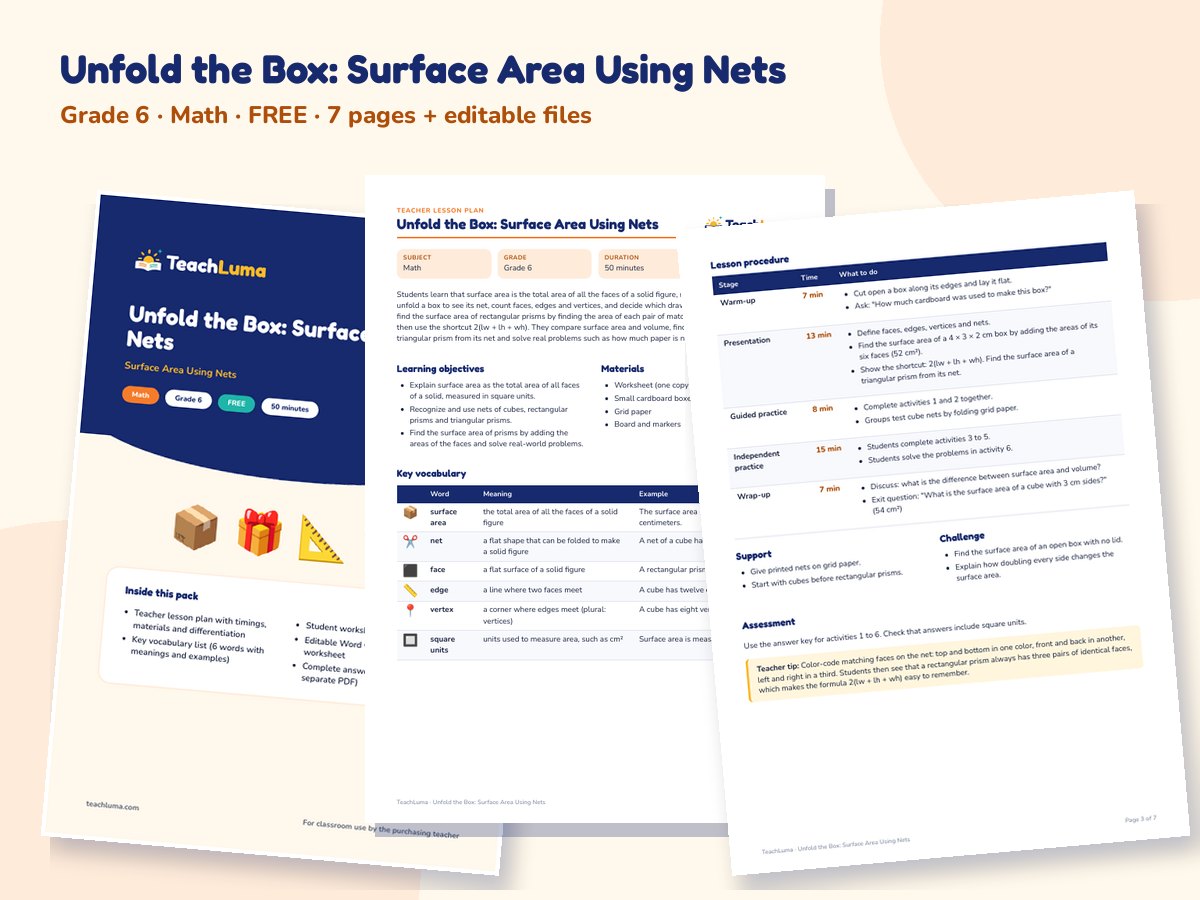
  • 7-page printable PDF lesson pack: teacher lesson plan with timings, materials and differentiation
  • Key vocabulary list (6 words with meanings and examples)
  • Student worksheet (6 activities)
  • Editable Word version of the worksheet
  • Complete answer key (also as a separate PDF)

Additional Files


Teacher Reviews

No ratings yet

Be the first teacher to review this resource.

Sign in to review this resource.

Related Resources

Advertisement