Skip to content
Preview
Free Math Worksheet Grade 3 (Year 4)
No ratings yet

Walk Around the Edge: Perimeter of Rectangles

About This Resource

A free Grade 3 math worksheet on perimeter: what perimeter means, adding the four sides of rectangles and squares, finding a missing side when the perimeter is known, comparing rectangles with the same perimeter, and solving fence, frame and ribbon problems. Includes a timed lesson plan, a six-activity worksheet with labeled rectangle pictures, an editable Word version and answer key.

Overview

Students learn that perimeter is the distance all the way around the outside of a shape. They find the perimeter of labeled rectangles by adding all four sides, discover the shortcut that opposite sides of a rectangle are equal and that all four sides of a square are equal, work backward to find a missing side, and compare two rectangles that have the same perimeter but different shapes. Real-world problems about fences, picture frames and ribbon show why perimeter matters.

Resource Details

Subject
Math
Topic
Perimeter of Rectangles
Category
Measurement
File Type
PDF
File Size
225 KB
Published
04 Nov 2026
Downloads
0
Download

Free download — no account required.

Teaching this in class? Try our free Random Name Picker & Timer.

Share:

Looking for something different? Request a Resource.

Grade 3 (ages 8–9) 45 minutes Measurement addition multiplication reasoning problem solving

Student Task

  • Walk around the edge of a rug or table and ask: "How far did I walk?" Introduce the word perimeter.
  • Model adding four sides and the rectangle shortcut, then do activities 1 and 2 together.
  • Students complete activities 3 to 6. Answers are in the answer key.

Classroom Use

  • String perimeter: students wrap string around a book, then measure the string with a ruler.
  • Geoboard rectangles: students make different rectangles with a perimeter of 12 units on geoboards or dot paper.
  • Classroom measure: groups measure the sides of their desk or a door and calculate its perimeter.

Differentiation

Support: use rectangles drawn on grid paper so students can count the units around the edge. Challenge: find all the rectangles with whole-number sides and a perimeter of 20 units, and explain which has the largest area.

Answer Key & Assessment

Activities 1 to 5 check finding perimeters and missing sides (answer key included). Activity 6 checks solving and explaining real-world problems.

Learning Objectives

  • Explain perimeter as the distance around the outside of a shape.
  • Find the perimeter of rectangles and squares by adding the sides.
  • Find a missing side length and solve real-world perimeter problems.

Teacher Tips

Have students trace the edge of each shape with a finger while counting, and tick each side as they add it so they never miss one. Remind them that perimeter is measured in units (cm, m), not square units.

What's Included

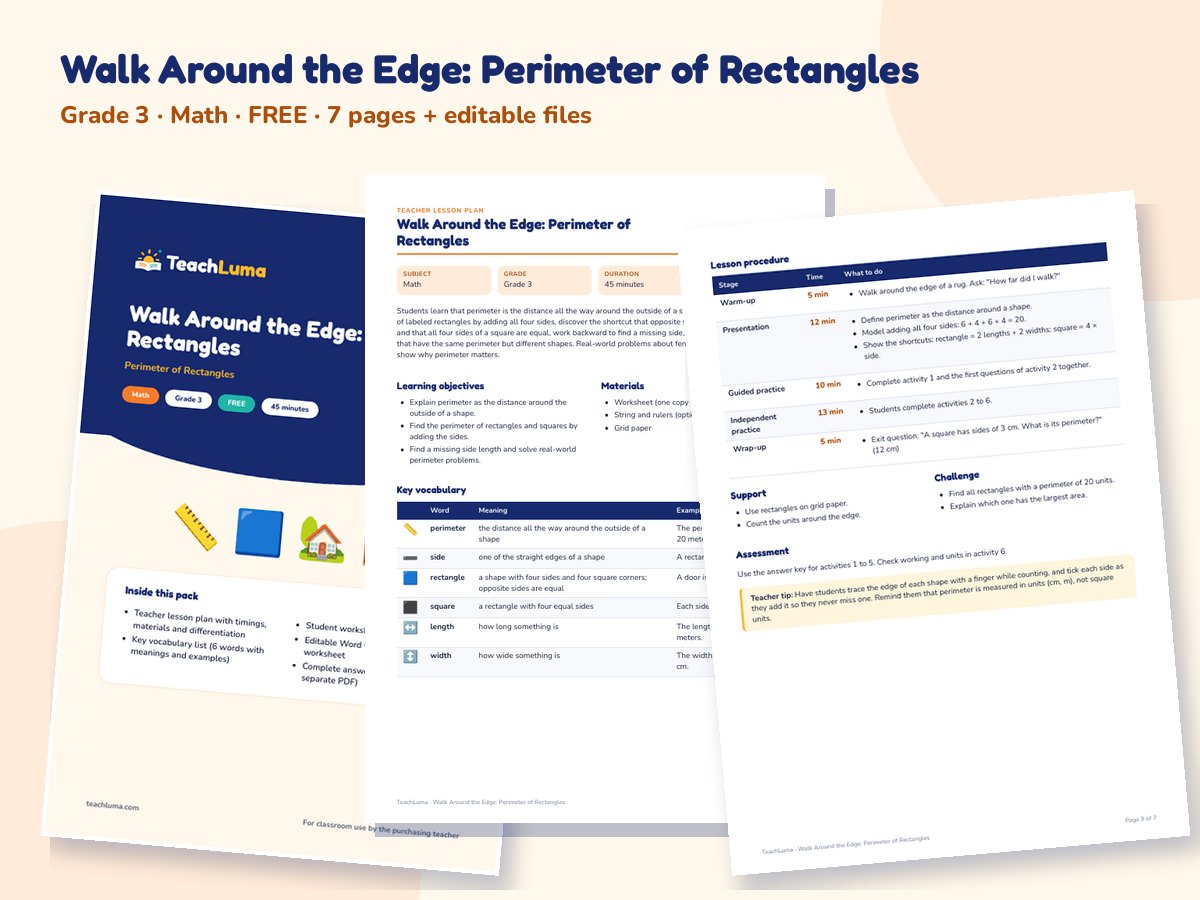
  • 7-page printable PDF lesson pack: teacher lesson plan with timings, materials and differentiation
  • Key vocabulary list (6 words with meanings and examples)
  • Student worksheet (6 activities)
  • Editable Word version of the worksheet
  • Complete answer key (also as a separate PDF)

Additional Files


Teacher Reviews

No ratings yet

Be the first teacher to review this resource.

Sign in to review this resource.

Related Resources

Advertisement