Skip to content
Preview
Members Only Science Complete Lesson Pack Grade 1
No ratings yet

Why Do We Have Day and Night?

About This Resource

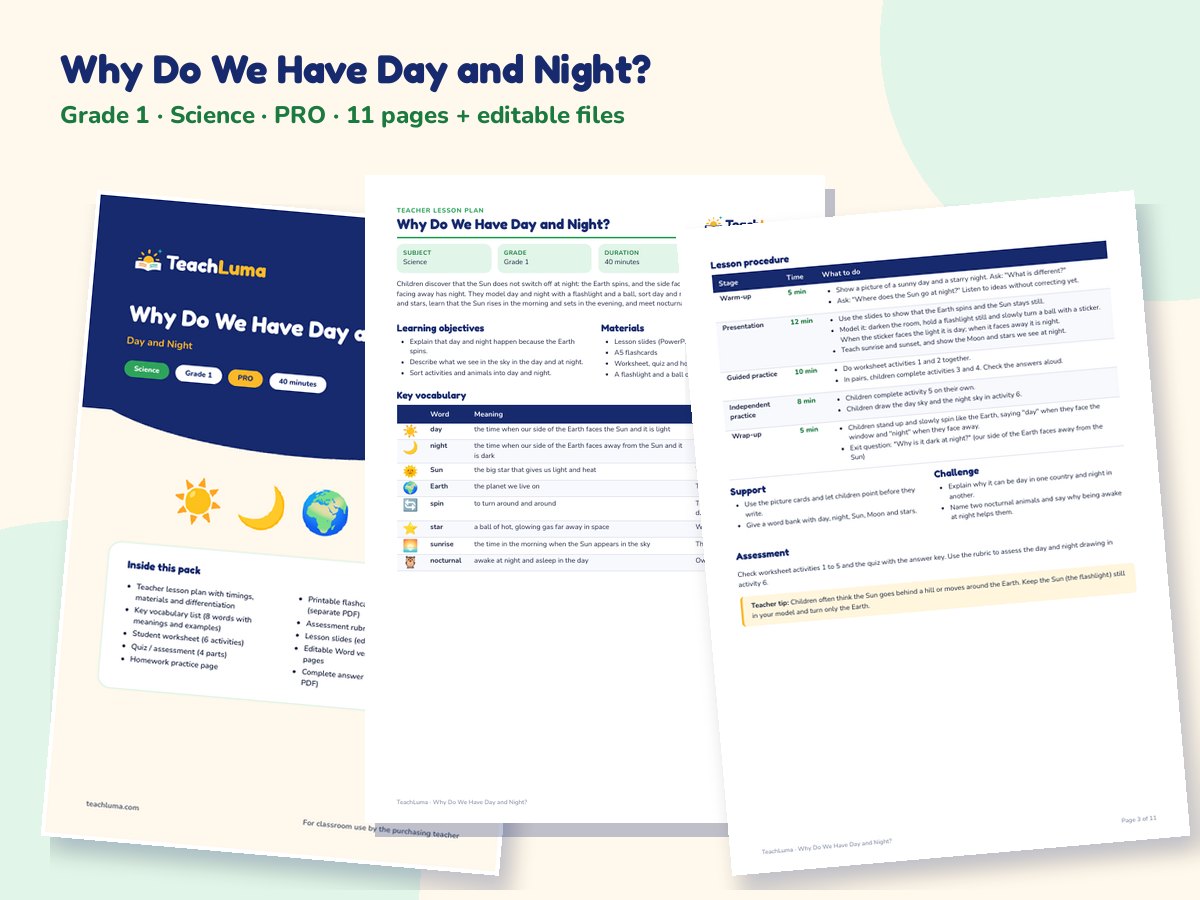
A complete Grade 1 science pack on day and night: the spinning Earth, the Sun, Moon and stars, sunrise and sunset, and animals that are awake at night. Includes a lesson plan, worksheet, quiz, homework, A5 flashcards, a rubric, detailed slides with speaker notes, Word files and answer keys.

Overview

Children discover that the Sun does not switch off at night: the Earth spins, and the side facing the Sun has day while the side facing away has night. They model day and night with a flashlight and a ball, sort day and night activities, name the Sun, Moon and stars, learn that the Sun rises in the morning and sets in the evening, and meet nocturnal animals such as owls and bats.

Resource Details

Subject
Science
Topic
Day and Night
Category
Earth & Space
File Type
PDF
File Size
410.7 KB
Published
30 Oct 2026
Downloads
0

Members Only

Upgrade to Teacher Pro (from ฿199/month) to download this resource.

Share:

Looking for something different? Request a Resource.

Grade 1 (ages 6–7) 40 minutes Earth and space observing sorting modelling science vocabulary

Learning Objectives

  • Explain that day and night happen because the Earth spins.
  • Describe what we see in the sky in the day and at night.
  • Sort activities and animals into day and night.

How to Use This Resource

  • If you can, darken the room and use a flashlight (the Sun) and a ball or globe (the Earth) to model day and night.
  • Teach the key words with the flashcards and slides, then use worksheet activities 1 to 6.
  • Use the quiz to check learning and send the sky-watching homework home.

Classroom Activity Ideas

  • Flashlight model: a child holds a flashlight still while another slowly turns a ball with a sticker on it; the class calls out "day" or "night" for the sticker.
  • Day and night sort: children sort picture cards of activities into a day hoop and a night hoop.
  • Shadow check: go outside in the morning and at noon and compare how long a child's shadow is.

Differentiation

Support: use the picture cards and let children point before they write. Challenge: ask children to explain why it is day in one country while it is night in another.

Assessment

Worksheet activities 1 to 5 and the quiz check vocabulary, sorting and the reason for day and night. Use the rubric for the drawing in activity 6.

Teacher Tips

Children often think the Sun goes behind a hill or moves around the Earth. Keep the Sun (the flashlight) still in your model and turn only the Earth.

What's Included

  • 11-page printable PDF lesson pack: teacher lesson plan with timings, materials and differentiation
  • Key vocabulary list (8 words with meanings and examples)
  • Student worksheet (6 activities)
  • Quiz / assessment (4 parts)
  • Homework practice page
  • Printable flashcards: 8 A5 picture cards (separate PDF)
  • Assessment rubric (4 levels)
  • Lesson slides (editable PowerPoint)
  • Editable Word version of all student pages
  • Complete answer key (also as a separate PDF)

Additional Files

  • Lesson Slides (PowerPoint, editable) (PPTX)
  • Editable Student Pages + Lesson Plan (Word) (DOCX)
  • Flashcards (PDF, A5, one card per page) (PDF)
  • Answer Key (PDF) (PDF)

Teacher Reviews

No ratings yet

Be the first teacher to review this resource.

Sign in to review this resource.

Related Resources

Advertisement