Skip to content
Preview
Members Only Science Complete Lesson Pack Grade 5
No ratings yet

Why Does the Moon Change Shape? Phases of the Moon

About This Resource

A complete Grade 5 science pack on the phases of the Moon: why the Moon shines, the eight phases from new moon to full moon, waxing and waning, the 29.5-day cycle, and a month-long Moon diary. Includes a lesson plan, worksheet, quiz, homework, A5 flashcards, a rubric, detailed slides with speaker notes, Word files and answer keys.

Overview

Students learn that the Moon does not make its own light: it reflects sunlight, and one half of it is always lit. As the Moon travels around Earth, we see different amounts of its lit half, which gives the phases. Students name and order the eight phases, learn the words waxing (growing) and waning (shrinking), model the phases with a lamp and a ball, and start a Moon diary to observe the changes themselves.

Resource Details

Subject
Science
Topic
Phases of the Moon
Category
Earth & Space
File Type
PDF
File Size
377.8 KB
Published
30 Oct 2026
Downloads
0

Members Only

Upgrade to Teacher Pro (from ฿199/month) to download this resource.

Share:

Looking for something different? Request a Resource.

Grade 5 (ages 10–11) 50 minutes Earth and space modelling sequencing observing explaining

Learning Objectives

  • Explain that the Moon reflects light from the Sun and that half of it is always lit.
  • Name and order the eight phases of the Moon.
  • Explain the meaning of waxing and waning and that the cycle takes about 29.5 days.

How to Use This Resource

  • Darken the room. Use a lamp as the Sun and a ball on a stick as the Moon. A student's head is Earth.
  • Teach the phases with the slides, then use worksheet activities 1 to 6.
  • Use the quiz to check learning and start the Moon diary homework.

Classroom Activity Ideas

  • Lamp and ball model: each student holds a ball at arm's length and turns slowly around a lamp to see the phases.
  • Cookie phases: scrape the cream from sandwich cookies to make each phase and arrange them in order.
  • Moon diary: students sketch the Moon every clear night for a month.

Differentiation

Support: focus on the four main phases (new, first quarter, full, third quarter) and use the picture cards. Challenge: explain why we always see the same side of the Moon.

Assessment

Worksheet activities 1 to 5 and the quiz check the phases, their order and the vocabulary. Use the rubric for the model drawing in activity 6.

Teacher Tips

A common idea is that Earth's shadow causes the phases. Show with the model that the phases come from our changing view of the Moon's sunlit half. Earth's shadow only falls on the Moon during a lunar eclipse.

What's Included

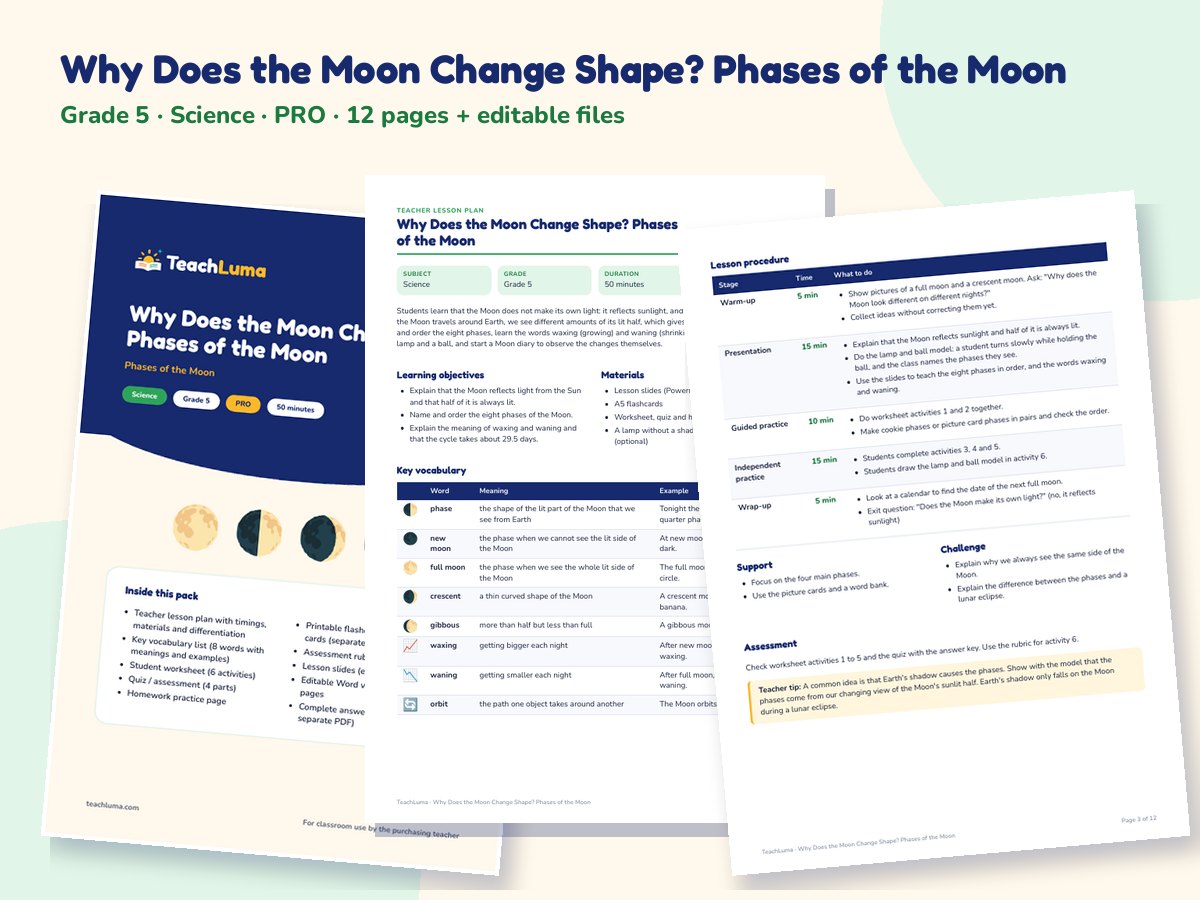
  • 12-page printable PDF lesson pack: teacher lesson plan with timings, materials and differentiation
  • Key vocabulary list (8 words with meanings and examples)
  • Student worksheet (6 activities)
  • Quiz / assessment (4 parts)
  • Homework practice page
  • Printable flashcards: 8 A5 picture cards (separate PDF)
  • Assessment rubric (4 levels)
  • Lesson slides (editable PowerPoint)
  • Editable Word version of all student pages
  • Complete answer key (also as a separate PDF)

Additional Files

  • Lesson Slides (PowerPoint, editable) (PPTX)
  • Editable Student Pages + Lesson Plan (Word) (DOCX)
  • Flashcards (PDF, A5, one card per page) (PDF)
  • Answer Key (PDF) (PDF)

Teacher Reviews

No ratings yet

Be the first teacher to review this resource.

Sign in to review this resource.

Related Resources

Advertisement