Skip to content
Preview
Free Math Worksheet Grade 3 (Year 4)
No ratings yet

About How Many? Estimating Sums and Differences

About This Resource

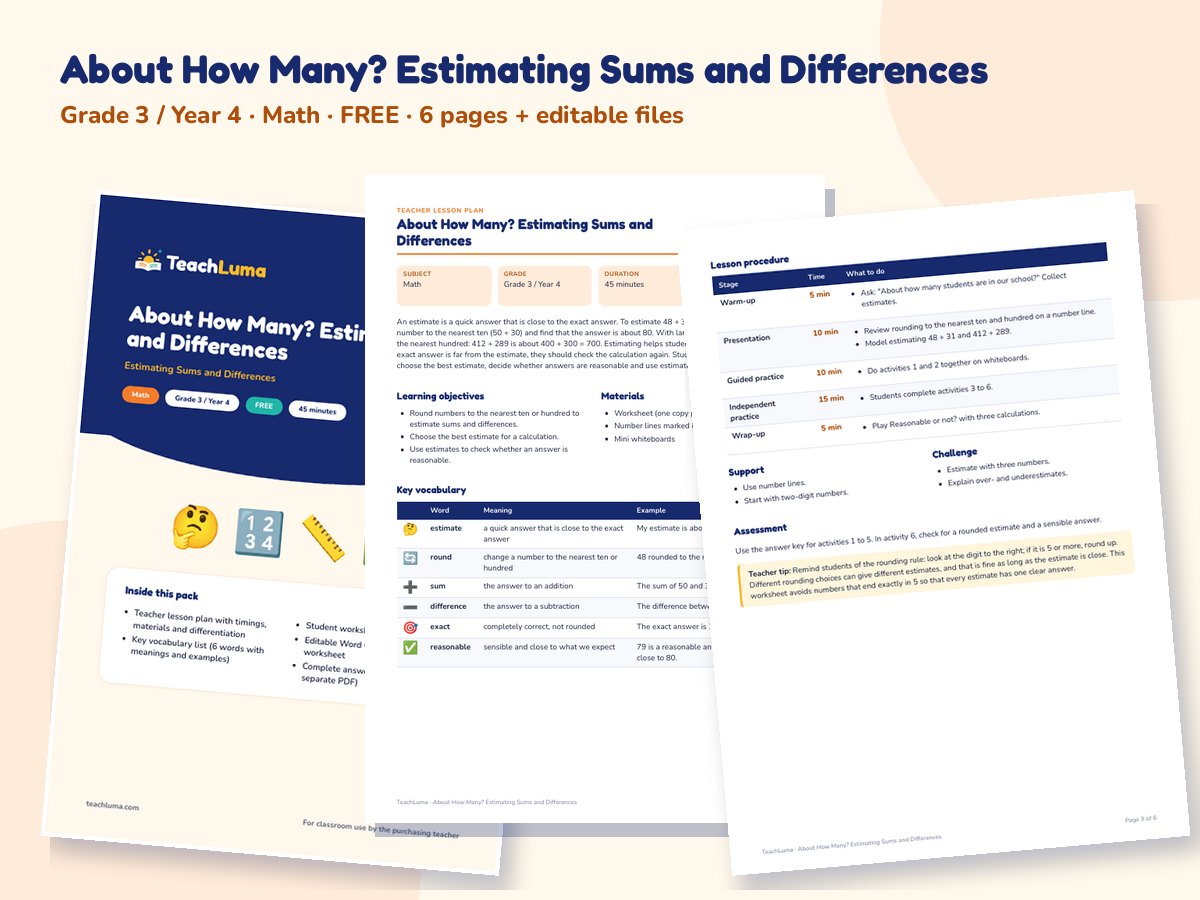
A free Grade 3 math worksheet on estimating sums and differences by rounding to the nearest ten or hundred. Students round each number, add or subtract the rounded numbers, choose the best estimate, use estimates to check whether an answer is reasonable and estimate answers to word problems. Includes a timed lesson plan, a six-activity worksheet, an editable Word version and answer key.

Overview

An estimate is a quick answer that is close to the exact answer. To estimate 48 + 31, students round each number to the nearest ten (50 + 30) and find that the answer is about 80. With larger numbers, they round to the nearest hundred: 412 + 289 is about 400 + 300 = 700. Estimating helps students check their work: if an exact answer is far from the estimate, they should check the calculation again. Students round and estimate, choose the best estimate, decide whether answers are reasonable and use estimates in real-life word problems.

Resource Details

Subject
Math
Topic
Estimating Sums and Differences
Category
Addition & Subtraction
File Type
PDF
File Size
210.8 KB
Published
12 Nov 2026
Downloads
0
Download

Free download — no account required.

Teaching this in class? Try our free Random Name Picker & Timer.

Share:

Looking for something different? Request a Resource.

Grade 3 math (ages 8–9) 45 minutes Rounding mental math addition subtraction checking answers

Student Task

  • Ask: "About how many students are in our school?" Explain that we do not always need an exact answer.
  • Model rounding and estimating on the board, then do activities 1 and 2 together.
  • Students complete activities 3 to 6. Answers are in the answer key.

Classroom Use

  • Estimate first: before each calculation, students write an estimate, then compare it with the exact answer.
  • Reasonable or not? Show answers to calculations, some correct and some wrong; students use estimates to spot the wrong ones.
  • Shopping estimates: students estimate the total cost of two items from a price list.

Differentiation

Support: give a number line marked in tens to help with rounding and start with two-digit numbers. Challenge: students estimate with three numbers and explain whether their estimate is more or less than the exact answer.

Answer Key & Assessment

Activities 1 to 5 check rounding and estimating (answer key included). Activity 6 shows whether students can use estimates in context.

Learning Objectives

  • Round numbers to the nearest ten or hundred to estimate sums and differences.
  • Choose the best estimate for a calculation.
  • Use estimates to check whether an answer is reasonable.

Teacher Tips

Remind students of the rounding rule: look at the digit to the right; if it is 5 or more, round up. Different rounding choices can give different estimates, and that is fine as long as the estimate is close. This worksheet avoids numbers that end exactly in 5 so that every estimate has one clear answer.

What's Included

  • 6-page printable PDF lesson pack: teacher lesson plan with timings, materials and differentiation
  • Key vocabulary list (6 words with meanings and examples)
  • Student worksheet (6 activities)
  • Editable Word version of the worksheet
  • Complete answer key (also as a separate PDF)

Additional Files


Teacher Reviews

No ratings yet

Be the first teacher to review this resource.

Sign in to review this resource.

Related Resources

Advertisement