Skip to content
Preview
Members Only ESL Complete Lesson Pack Grade 10 (Year 11)
No ratings yet

Beyond Similes: Figurative Language in Literature

About This Resource

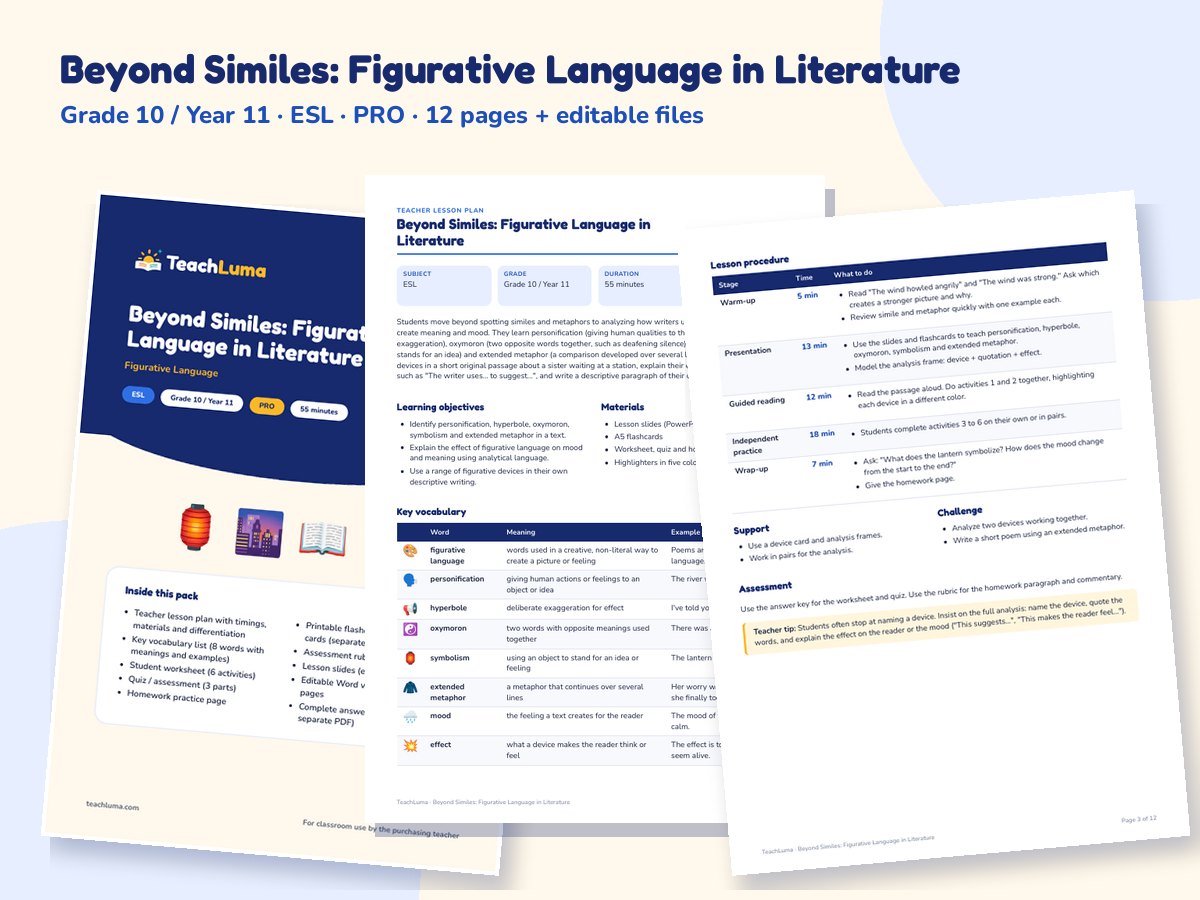
A complete Grade 10 ESL reading and writing pack on advanced figurative language: personification, hyperbole, oxymoron, symbolism and extended metaphor, plus a quick review of simile and metaphor. Students identify devices in an original prose passage, explain their effect on the reader, and write their own descriptive paragraph using at least four devices. Includes slides, a lesson plan, worksheet, quiz, homework, flashcards, a rubric and answer keys.

Overview

Students move beyond spotting similes and metaphors to analyzing how writers use figurative language to create meaning and mood. They learn personification (giving human qualities to things), hyperbole (deliberate exaggeration), oxymoron (two opposite words together, such as deafening silence), symbolism (an object that stands for an idea) and extended metaphor (a comparison developed over several lines). Students find these devices in a short original passage about a sister waiting at a station, explain their effect using analytical frames such as "The writer uses… to suggest…", and write a descriptive paragraph of their own.

Resource Details

Subject
ESL
Topic
Figurative Language
Category
Vocabulary
File Type
PDF
File Size
381.6 KB
Published
09 Nov 2026
Downloads
0

Members Only

Upgrade to Teacher Pro (from ฿199/month) to download this resource.

Share:

Looking for something different? Request a Resource.

Grade 10 ESL (ages 15–16), B1–B2 55 minutes Literary analysis reading academic writing creative writing vocabulary

Learning Objectives

  • Identify personification, hyperbole, oxymoron, symbolism and extended metaphor in a text.
  • Explain the effect of figurative language on mood and meaning using analytical language.
  • Use a range of figurative devices in their own descriptive writing.

How to Use This Resource

  • Start with the slides: read "The wind howled angrily" and "The wind was strong" and ask which creates a stronger picture and why.
  • Teach the five devices with the slides and flashcards, then read the passage and do worksheet activities 1 and 2 together.
  • Students complete activities 3 to 6, then use the quiz and write the descriptive paragraph for homework.

Classroom Activity Ideas

  • Device detectives: groups search song lyrics or poems (chosen by the teacher) for examples of each device.
  • Make it come alive: students rewrite plain sentences using personification or hyperbole.
  • Symbol gallery: students choose an everyday object and explain what it could symbolize in a story.

Differentiation

Support: give a device card with a definition and an example for each device, and an analysis sentence frame. Challenge: students analyze how two devices work together in the last paragraph of the passage.

Assessment

Use the worksheet and quiz to check identification and analysis. Use the rubric to assess the homework descriptive paragraph and its commentary.

Teacher Tips

Students often stop at naming a device. Insist on the full analysis: name the device, quote the words, and explain the effect on the reader or the mood ("This suggests…", "This makes the reader feel…").

What's Included

  • 12-page printable PDF lesson pack: teacher lesson plan with timings, materials and differentiation
  • Key vocabulary list (8 words with meanings and examples)
  • Student worksheet (6 activities)
  • Quiz / assessment (3 parts)
  • Homework practice page
  • Printable flashcards: 8 A5 picture cards (separate PDF)
  • Assessment rubric (4 levels)
  • Lesson slides (editable PowerPoint)
  • Editable Word version of all student pages
  • Complete answer key (also as a separate PDF)

Additional Files

  • Lesson Slides (PPTX)
  • Editable Student Pages and Lesson Plan (DOCX)
  • A5 Flashcards (PDF)
  • Answer Key (PDF)

Teacher Reviews

No ratings yet

Be the first teacher to review this resource.

Sign in to review this resource.

Related Resources

Advertisement