Skip to content
Preview
Free ESL Worksheet Grade 7 (Year 8)
No ratings yet

Bored or Boring? Adjectives Ending in -ed and -ing

About This Resource

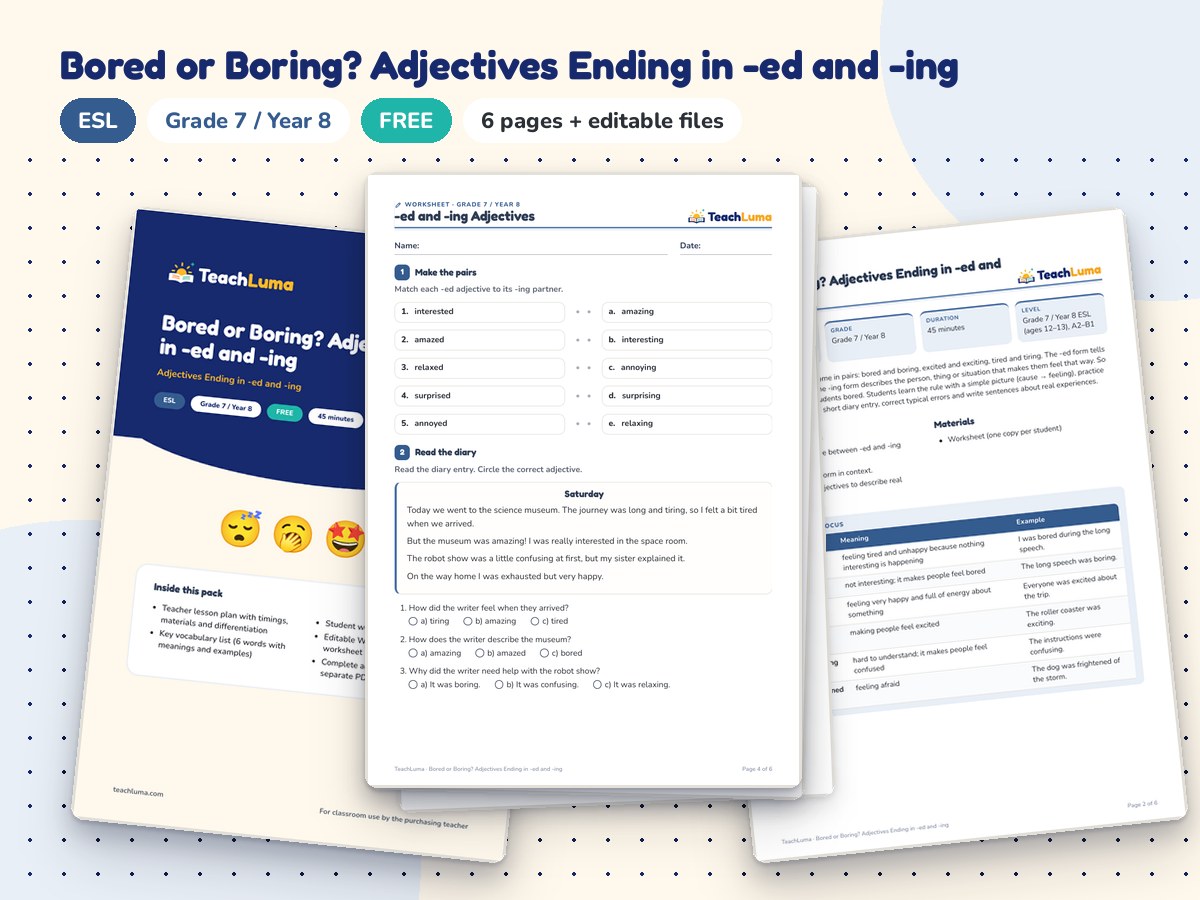
A free Grade 7 ESL vocabulary worksheet on a common confusion: adjectives ending in -ed describe how a person feels (I'm bored), while adjectives ending in -ing describe the thing that causes the feeling (The film is boring). Students match pairs, choose the right form in context, correct mistakes and write about their own experiences. Includes a timed lesson plan, an editable Word version and an answer key.

Overview

Many feeling adjectives come in pairs: bored and boring, excited and exciting, tired and tiring. The -ed form tells us how someone feels. The -ing form describes the person, thing or situation that makes them feel that way. So a boring lesson makes students bored. Students learn the rule with a simple picture (cause → feeling), practice ten common pairs, read a short diary entry, correct typical errors and write sentences about real experiences.

Resource Details

Subject
ESL
Topic
Adjectives Ending in -ed and -ing
Category
Vocabulary
File Type
PDF
File Size
250.5 KB
Published
14 Nov 2026
Downloads
0
Download Free

Free with a TeachLuma account — it takes a minute.

Share:

Looking for something different? Request a Resource.


Grade 7 ESL (ages 12–13), A2–B1 45 minutes Vocabulary grammar writing speaking

Student Task

  • Yawn and say: "I'm bored. This is boring." Ask students what the difference is.
  • Teach the cause → feeling rule, then do activities 1 and 2 together.
  • Students complete activities 3 to 5. Answers are in the answer key.

Classroom Use

  • Find someone who: Find someone who is frightened of spiders or thinks math is interesting.
  • Mime and guess: a student mimes a feeling; the class says You look ___ (confused, surprised).
  • Review it: students rate a film or game using three -ing adjectives.

Differentiation

Support: give a two-column table with each pair and a face symbol for -ed. Challenge: add less common pairs such as fascinated/fascinating and disappointed/disappointing.

Answer Key & Assessment

Activities 1 to 4 check understanding and accuracy (answer key included). Activity 5 shows whether students can use the forms in their own sentences.

Learning Objectives

  • Explain the difference between -ed and -ing adjectives.
  • Choose the correct form in context.
  • Use -ed and -ing adjectives to describe real experiences.

Teacher Tips

A common error is I am boring when students mean I am bored, which changes the meaning completely. Make it memorable: if you say I'm boring, you are saying other people find you dull! Point out that people can be -ing too: My uncle is very interesting.

What's Included

  • 6-page printable PDF lesson pack: teacher lesson plan with timings, materials and differentiation
  • Key vocabulary list (6 words with meanings and examples)
  • Student worksheet (5 activities)
  • Editable Word version of the worksheet
  • Complete answer key (also as a separate PDF)

Additional Files


Teacher Reviews

No ratings yet

Be the first teacher to review this resource.

Sign in to review this resource.

Related Resources

Advertisement