
Grade 2 Daily Routines Grammar Worksheet: Present Simple I / He / She
Free ESL Worksheet Grade 2
No ratings yet

Grade 2 Daily Routines Grammar Worksheet: Present Simple I / He / She

About This Resource

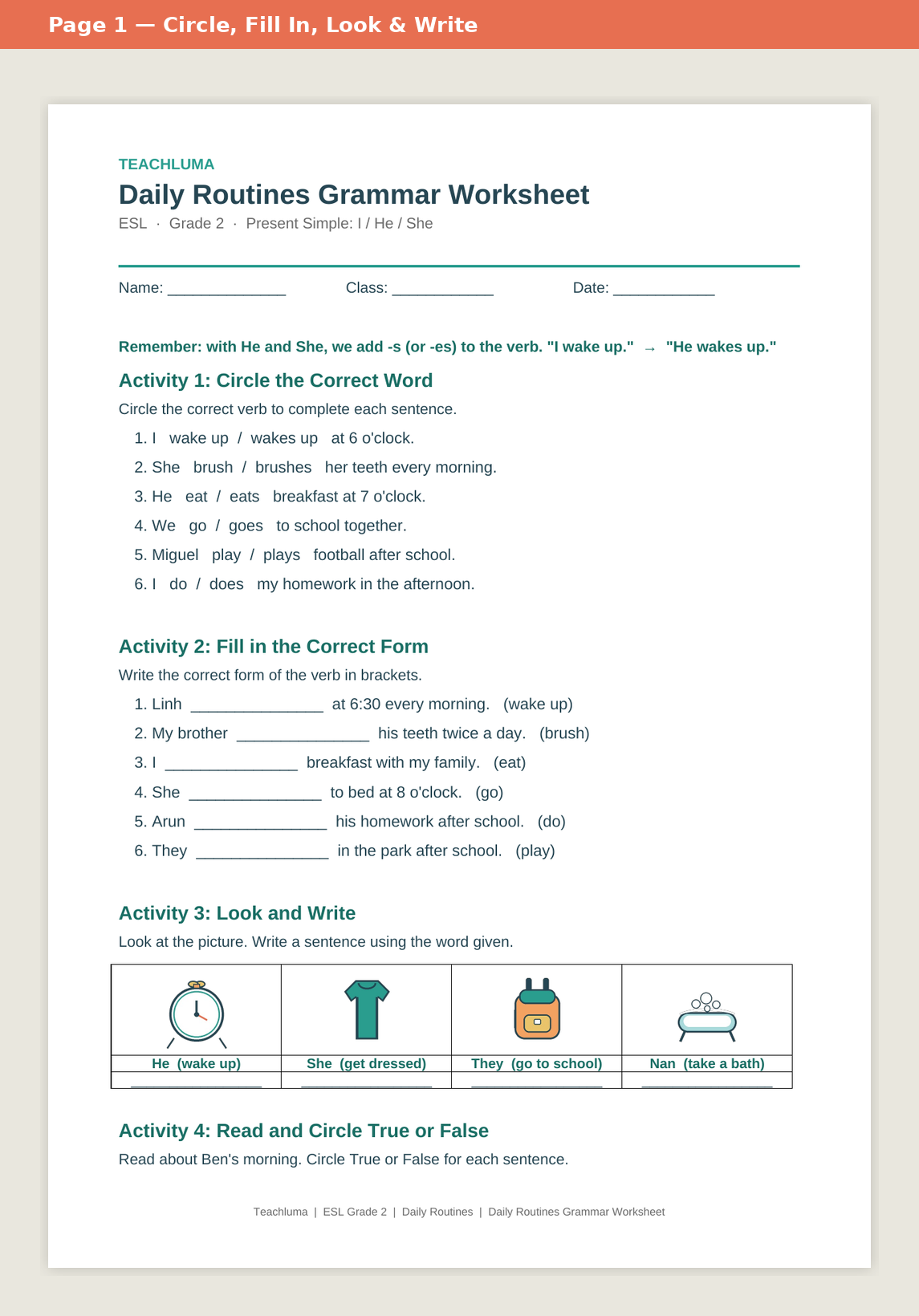
A two-page grammar worksheet that teaches Grade 2 English learners how to add -s or -es to present simple verbs when talking about someone else's daily routine, through four activities that move from recognition to reading comprehension.

Overview

This worksheet targets one of the trickiest points in early English grammar: remembering the -s ending for he/she in the present simple. It opens with a clear rule reminder ("I wake up" → "He wakes up") and then practises the rule four ways. Activity 1 (Circle the Correct Word) has students choose between the base verb and the -s form. Activity 2 (Fill in the Correct Form) removes the multiple-choice support and asks students to write the correct form themselves. Activity 3 (Look and Write) connects the grammar point to the Daily Routines picture vocabulary, asking students to build a full sentence from a subject, a verb, and an icon. Activity 4 (Read and Circle True or False) puts the grammar to work in a short original reading passage about a character named Ben, checking comprehension rather than just form. A Grammar Reminder box at the end summarises the rule one more time for quick reference.

Resource Details

Subject
ESL
Topic
Daily Routines Grammar Worksheet: Present Simple I / He / She
Category
Grammar
File Type
PDF
File Size
91.7 KB
Published
03 Sep 2026
Downloads
1
Download

Free download — no account required.

Share:

Grade 2 45-55 Minutes Daily Routine Grammar

Student Task

  • Use this worksheet after students are comfortable with the Daily Routines vocabulary (from the Vocabulary PowerPoint, Flashcards, and Vocabulary Worksheet), since it assumes students already know the routine words and are now ready to focus on sentence grammar. Review the rule reminder at the top of the page together before students begin. Activities 1 and 2 work well as guided or independent practice; Activity 3 is a good check of whether students can produce the grammar rather than just recognise it; Activity 4 combines grammar with reading comprehension and works well as a closing task. Keep the Grammar Reminder box visible as an anchor chart idea for your classroom wall.

Classroom Use

  • Play a quick "He Says, She Says" oral drill before the written work: say a base-form sentence like "I eat breakfast," and have students respond with the he/she version ("He eats breakfast" or "She eats breakfast," alternating). This builds automaticity with the -s ending before students have to apply it in writing.

Differentiation

SUPPORT: Let students underline the subject (I, He, She) in each sentence before choosing or writing the verb, as a visual cue for which rule applies. Reduce Activity 2 to four items if six feels like too much.
ON-LEVEL: Students complete all four activities independently in one sitting.
CHALLENGE: Ask students to rewrite two sentences from Activity 4 by changing "Ben" to "I" and adjusting the verbs accordingly, to practise the rule in both directions.

Answer Key & Assessment

Use the completed worksheet as a direct check of the -s/-es rule, and mark it against the included answer key. Watch for the specific error pattern of dropping the -s entirely, which is extremely common with English learners and worth a quick small-group review if several students make it.

Learning Objectives

  • Students will be able to identify the correct present simple verb form for I, he, and she.
  • Students will be able to write the correct -s or -es form of common daily routine verbs.
  • Students will be able to build a complete present simple sentence from a subject and a verb prompt.
  • Students will be able to read a short present simple passage and answer true/false comprehension questions correctly.

Teacher Tips

When a student makes a wrong choice in Activity 1, ask them to say both options out loud rather than simply correcting them. Grade 2 English learners often self-correct once they hear "he wake up" against "he wakes up," because the missing -s sounds noticeably wrong to the ear even before it is understood as a rule.

What's Included

  • 2-page student worksheet
  • Editable DOCX version
  • Print-ready PDF version
  • Separate answer key (DOCX and PDF)

Additional Files


Teacher Reviews

No ratings yet

Be the first teacher to review this resource.

Sign in to review this resource.

From the Teacher Hub


Related Resources

Members Grade 1

Numbers — Grammar Worksheet

Worksheet · Numbers - Grammar

A three-part worksheet practicing "There are ___." number words, singular vs. plural namin...

View Resource
Members Grade 1

Greetings and Introductions Grammar — am / is / are, Question Word Order

Worksheet · am / is / are, Question Word Order

A two-part grammar worksheet practicing the verb to be (am / is / are) with I, you, he, an...

View Resource
Members Grade 2

Grade 2 Daily Routines Vocabulary Worksheet

Worksheet · Daily Routines

A two-page vocabulary worksheet that gives Grade 2 English learners four varied ways to pr...

View Resource
Free Grade 2

Grade 2 Daily Routines Flashcards (12 Cards)

Flashcards · Daily Routines

A set of 12 large, print-ready flashcards covering the core Daily Routines vocabulary, eac...

View Resource
Members Grade 2

Grade 2 Daily Routines Reading Activity: Putri's Busy Day

Reading Activity · Daily Routine

A 120-word reading passage about a school day in Southeast Asia, paired with four comprehe...

View Resource
Members Grade 2

Grade 2 Daily Routines Vocabulary PowerPoint

PowerPoint · Daily Routines Vocabulary PowerPoint

A 16-slide vocabulary presentation that teaches 12 daily routine phrases to Grade 2 Englis...

View Resource