Grade 2 Multiplying by Repeated Addition Worksheet
About This Resource
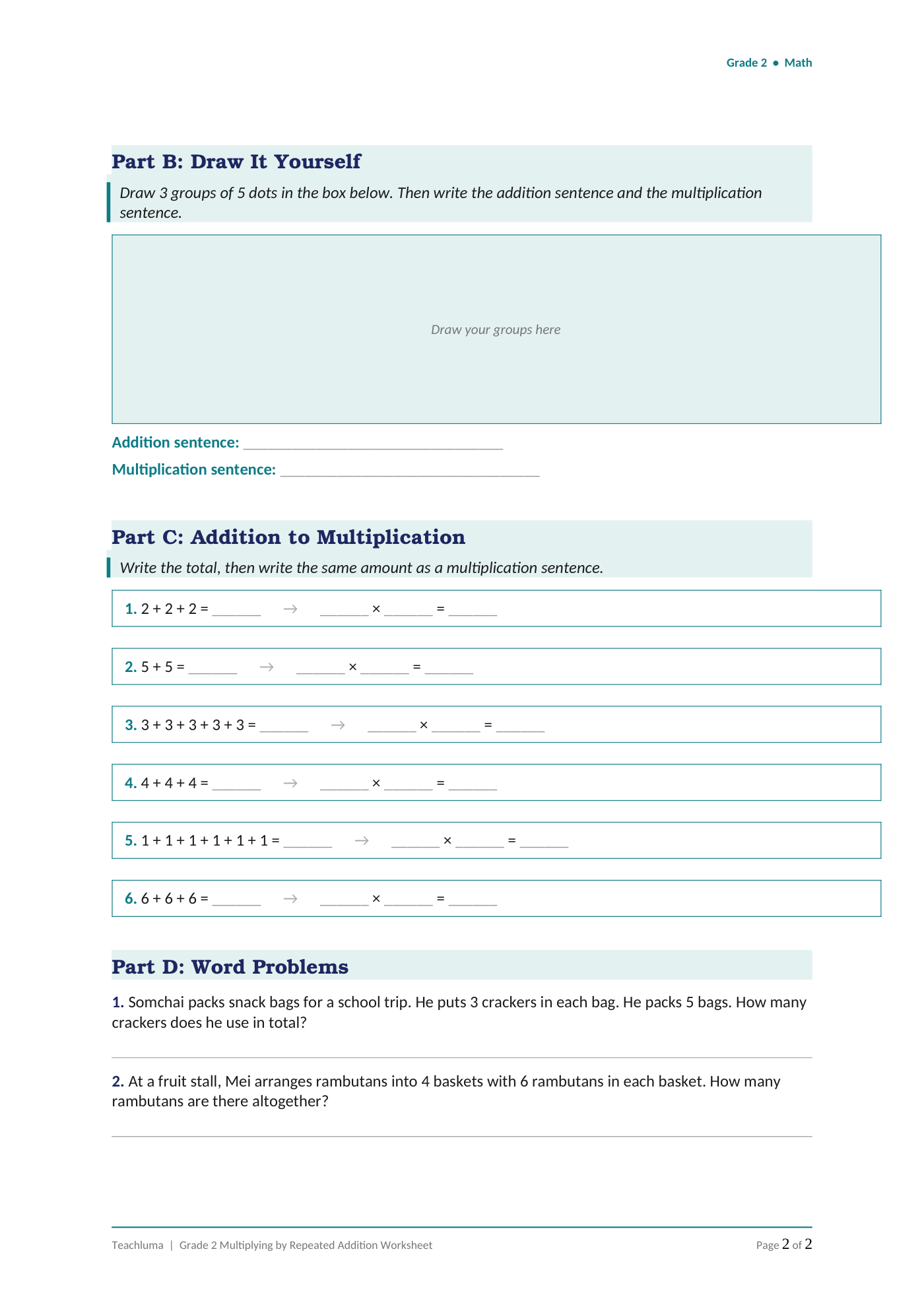
A two-page worksheet that introduces multiplication as a fast way to add equal groups. Students read equal-group pictures, write the matching addition and multiplication sentences, draw their own set of groups, convert addition strings into multiplication facts, and solve two short word problems. Built for Grade 2 classrooms across Southeast Asia, including English Program and bilingual settings.
Overview
This worksheet is the practice companion to the unit's opening idea: multiplication is repeated addition of equal-sized groups. Students move through four short parts — reading grouped-dot pictures and writing both an addition and a multiplication sentence for each, drawing their own groups in a blank box, converting six addition strings into multiplication sentences, and applying the skill to two real-life word problems set in a Southeast Asian context (packing snack bags, arranging fruit at a market stall). The progression is concrete to abstract: pictures first, then student-drawn groups, then numbers alone, then application. This builds the foundation students need before moving on to specific times tables later in the unit.
Resource Details
- Subject
- Math
- Topic
- Multiplying by Repeated Addition
- Category
- Addition & Subtraction
- File Type
- File Size
- 66.7 KB
- Published
- 11 Sep 2026
- Downloads
- 0
Free download — no account required.
Teaching this in class? Try our free Random Name Picker & Timer.
Student Task
- Print one copy per student, or share the PDF for digital annotation. Introduce the lesson by showing a real equal-groups example in the room (e.g., pencils in cups, three rows of four chairs) before handing out the worksheet. Students can complete Part A independently after a modelled first example; Part B works well as partner talk before students draw and write on their own; Parts C and D are best done independently once Parts A-B are checked, since they remove the picture support. Review answers as a class or in small groups, asking students to say each multiplication sentence aloud ("3 groups of 4 is 3 times 4").
Classroom Use
- Equal Groups Around the Room: In pairs, students find or create three real examples of equal groups somewhere in the classroom or on the playground (e.g., legs on 4 chairs, wheels on 2 bicycles in a photo, snacks in packs). Each pair writes the addition and multiplication sentence for their examples on mini whiteboards and shares one with the class.
Differentiation
Support: Provide a printed set of counters or buttons so students can physically build each group before writing the number sentence. For Part C, allow students to draw tally marks or dots above each addend if they need to count rather than recall. Pair English learners with a partner who can help read the word problems aloud.
On-Level: Students complete all four parts as designed, moving from picture support to numbers-only practice.
Challenge: Ask students to write a third equal-groups example of their own (with a picture) for Part A, or to write one extra word problem for a partner to solve using today's skill.
Answer Key & Assessment
Collect the completed worksheet and check Parts A and C against the answer key for accuracy. Part B (the drawing task) shows whether a student can generate their own equal-groups model rather than just reading one — use it as a quick check of understanding rather than a right/wrong mark. Circulate during Part D and listen for students explaining their word-problem reasoning aloud as an informal oral check.
Learning Objectives
- Students will be able to describe a multiplication situation as a number of equal groups.
- Students will be able to write an addition sentence and a matching multiplication sentence for a set of equal groups.
- Students will be able to convert a repeated-addition expression into a multiplication sentence.
- Students will be able to solve simple one-step word problems using multiplication.
Teacher Tips
Before handing out the worksheet, do one example together using real objects in the classroom (books in stacks, students in rows). Students who can physically see and count "3 groups of 4" have a much easier time connecting it to "3 × 4" than students who only see the worksheet's dot pictures cold.
What's Included
- 2-page student worksheet (Parts A-D)
- Editable DOCX version
- Print-ready PDF version (A4)
- Answer key (PDF)
Additional Files
Teacher Reviews
No ratings yet
Be the first teacher to review this resource.
Related Resources
Subtraction With Regrouping Word Problems Worksheet
Worksheet · Subtraction With Regrouping
A 2-page word problem worksheet for Grade 2 students, applying subtraction with regrouping...
View ResourceGrade 2 Subtraction With Regrouping Practice Worksheet
Worksheet · Subtraction With Regrouping
A 2-page independent practice worksheet for Grade 2 students learning to subtract two-digi...
View ResourceGrade 2 Subtraction With Regrouping Homework
Worksheet · Subtraction With Regrouping
A short, one-page homework sheet for Grade 2 students to practise subtraction with regroup...
View ResourceGrade 2 Subtraction With Regrouping Grading Rubric
Grading Rubric · Subtraction With Regrouping
A one-page grading rubric for assessing Grade 2 student work on subtraction with regroupin...
View ResourceSubtraction With Regrouping Teacher's Guide
Teacher Resource · Subtraction With Regrouping
Background reading for any teacher delivering the Subtraction With Regrouping collection, ...
View ResourceSubtraction With Regrouping Quiz
Assessment · Subtraction With Regrouping
A 26-point individual quiz for Grade 2 students covering subtraction with regrouping, incl...
View ResourceAdvertisement