Grade 3
45-55 Minutes
Assessment
Time Telling
Question Types & Suggested Use
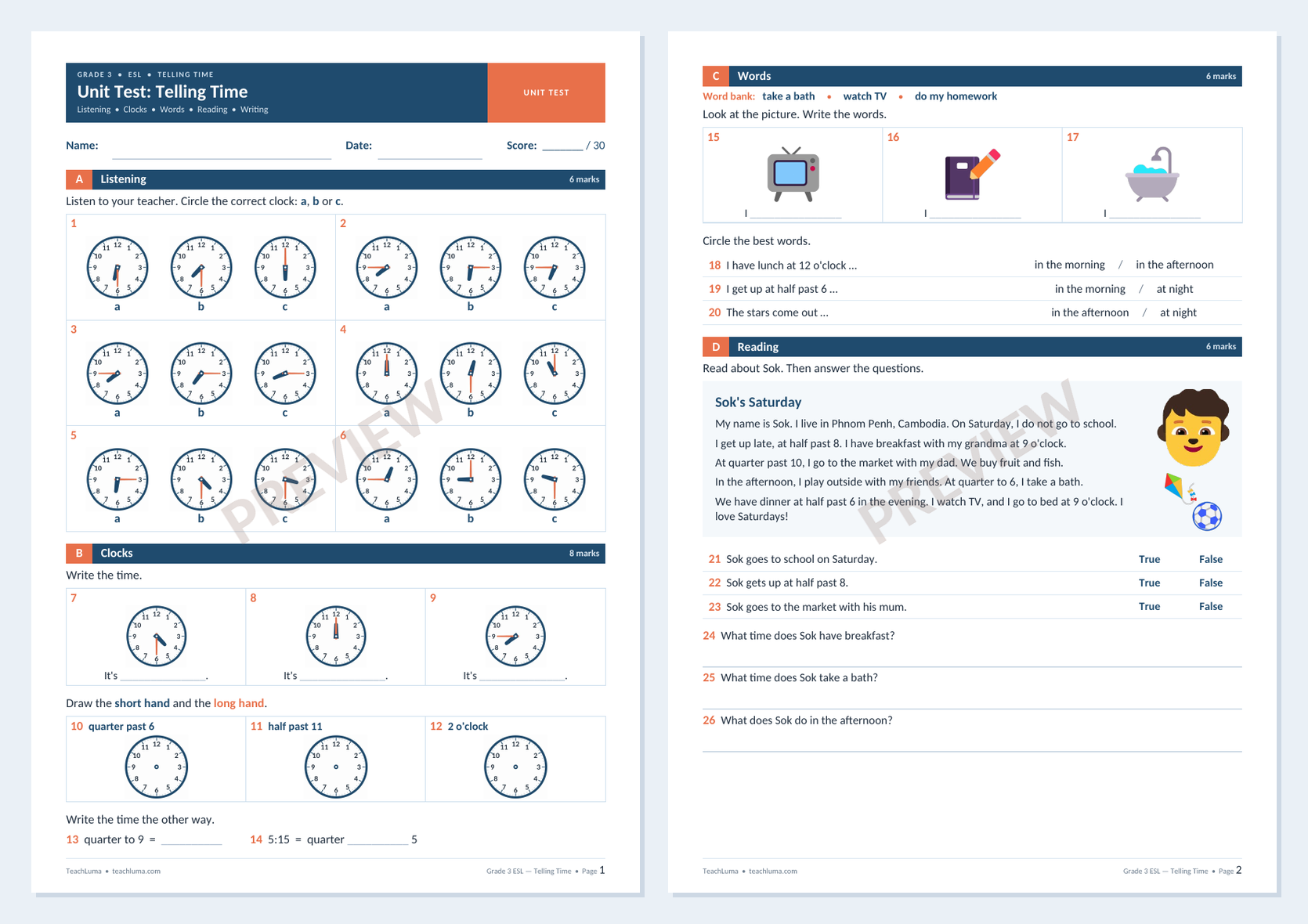
Paper: Listening 6, Clocks 8, Words 6, Reading 6, Writing 4 = 30 marks, with score bands. Speaking check: 10 marks (say 5 times, answer 3 questions, ask 1 question).
Skills Assessed
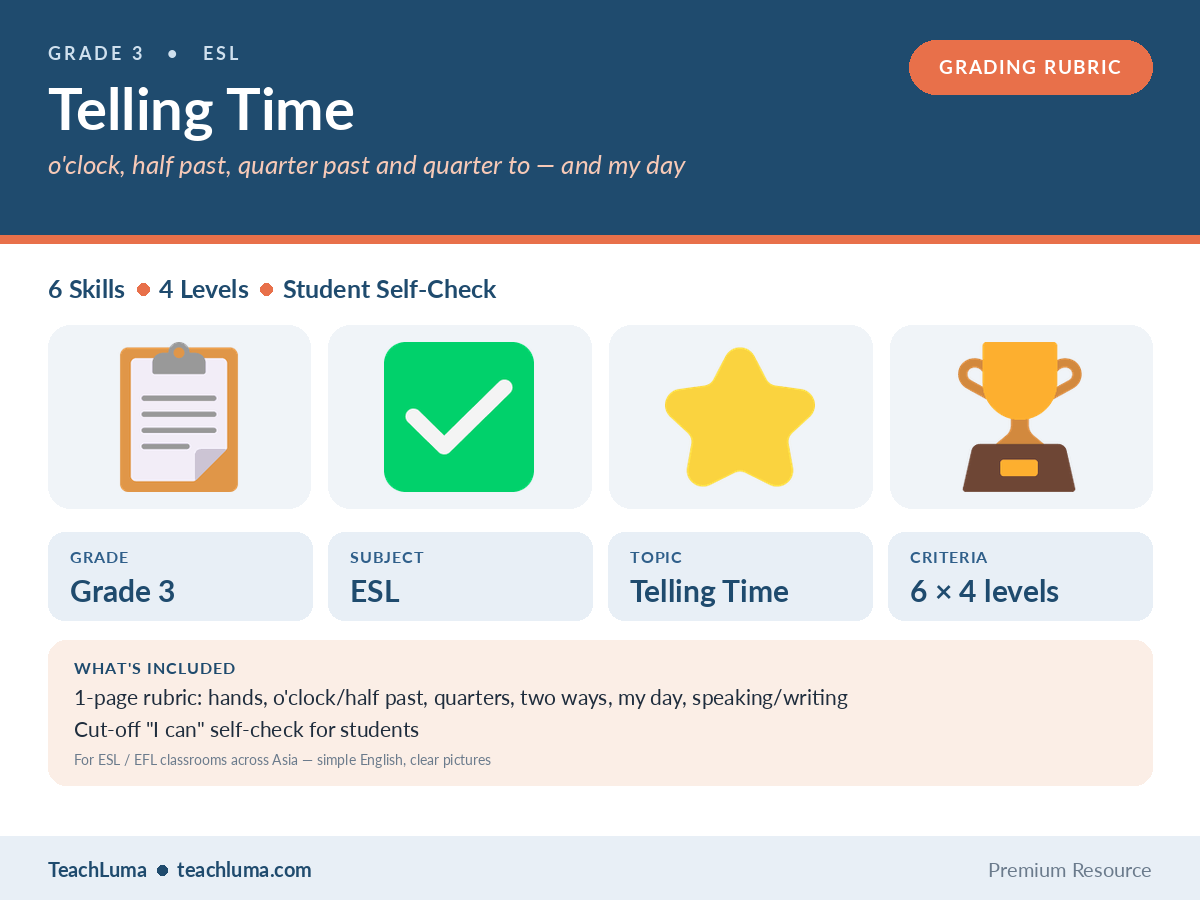
- Name the hour hand (short) and the minute hand (long) and explain what each one shows.
- Read, say and write times on the hour and half hour: It's 4 o'clock. / It's half past 4.
- Read, say and write quarter past and quarter to, and explain why quarter to uses the next hour (quarter to 8 = 7:45).
- Say a time two ways (half past 7 = seven thirty = 7:30) and match clock words to digital times.
- Name 12 daily routines and ask and answer: What time do you get up? – I get up at 6 o'clock.
- Use in the morning / in the afternoon / in the evening / at night, and decide if someone is early, on time or late.
- Read a short text about a child's day and write five sentences about their own day.
How to Administer
- Give the paper test in one lesson (about 35 minutes). Read each listening sentence twice (script in the answer key, page 3). Do the speaking check one child at a time while the class works on something quiet.
Differentiation
Support: Give weaker students the paper clock from the Teacher Resources (page 2) to keep on the desk and let them make every time before they write it. In Parts A–C, let them say the time to a partner first, then write. Give them the "past side / to side" clock (Flashcards page 6) and the routine word cards for Parts G, H and K. For the writing in Part K, they can copy the routine phrase from the word bank and only add the time.
Extension: Stronger students say every clock time in both ways (half past 7 / seven thirty) and add five-minute times the digital way (seven twenty, seven fifty). They write their own "Spot the Mistake" clocks for a partner, explain the mistake in a full sentence ("The short hand has not got to 8 yet."), and write a longer My Day text with First, After that and Then.
Follow-Up Activities
- Use the speaking check cards again as a pair activity: one child is the teacher.
- After marking, put the most common mistake on the board and ask the class to explain it.
Teacher Tips
Build the clock with the class before you teach any time words. Stand at the front with your arms as the two hands: one arm straight up (the long minute hand at 12) and one arm bent short (the hour hand). Move the long arm slowly all the way round while the class counts, "5, 10, 15 … 60", and move the short arm a tiny bit at the same time. Stop half way round and ask, "Where is my short arm now? On the 7 or between 7 and 8?" Children see with their own eyes that the hour hand moves too, so half past 7 cannot have the hour hand on the 7. Use the same "human clock" each lesson for one minute: a student is the clock and the class says the time.
What's Included
- Unit test, 3 pages: paper test (30 marks) + speaking check (10 marks) (DOCX + PDF)
- Answer key with listening script and score bands, 3 pages (DOCX + PDF)
Additional Files
-
Grade 3 ESL Test: Telling Time — Paper and Speaking Check (40 Marks) (DOCX)
-
Answer Key (PDF)