Question Types & Suggested Use
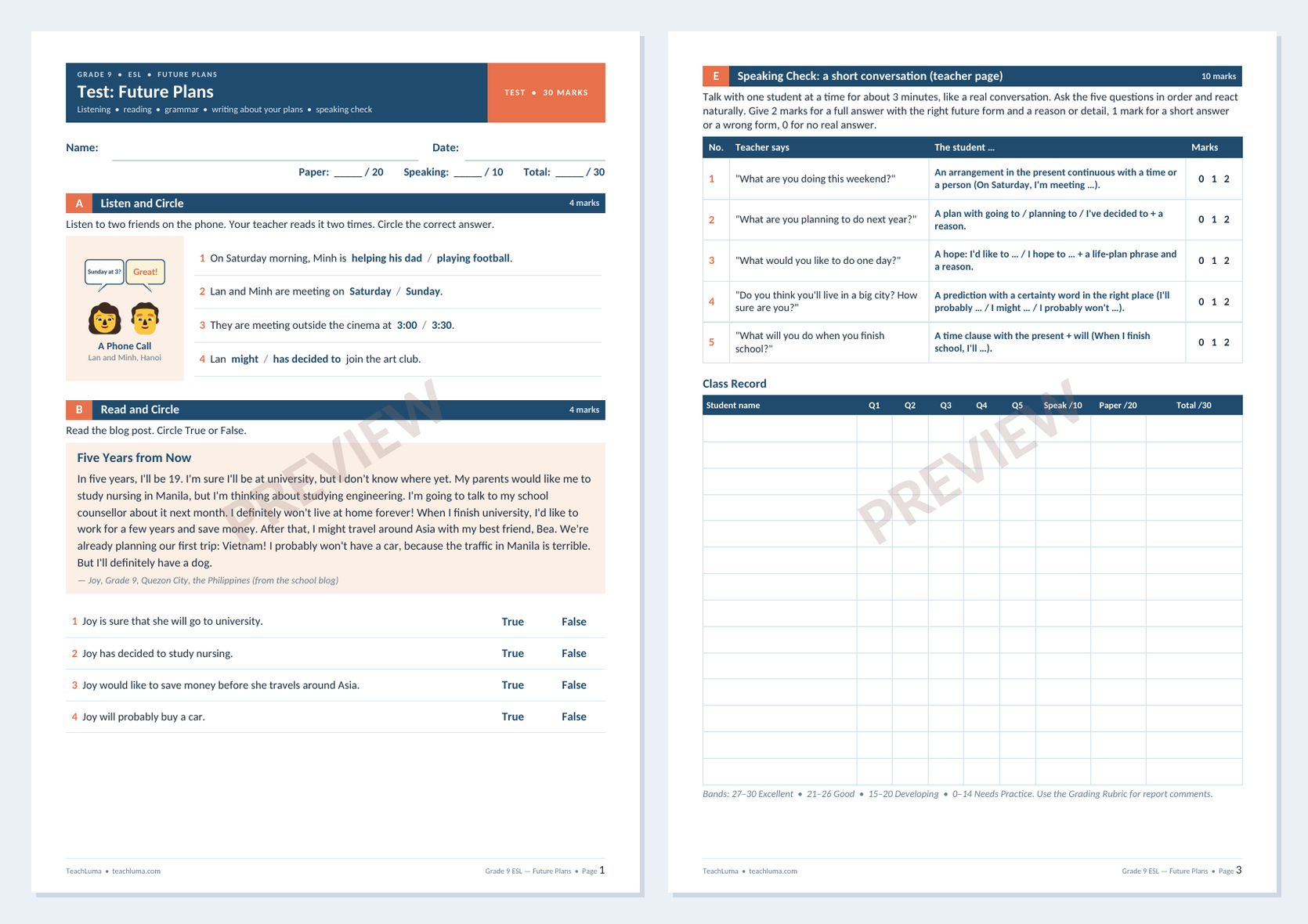
The answer key gives every answer, short reasons for the True / False and grammar items, a 3-part writing guide (content, language, organisation) with a model answer, a 0 / 1 / 2 guide for each speaking question and grade bands (27–30, 21–26, 15–20, 0–14).
Skills Assessed
- Name and use 12 everyday life-plan phrases (pass my exams, get a part-time job, save money, study abroad, live on my own …) with the correct verb.
- Talk about plans and hopes with I'm going to / I'm planning to / I've decided to / I'd like to / I hope to + verb and I'm thinking about + -ing.
- Use the present continuous for fixed arrangements (I'm meeting Kai at 5:30.) and ask and answer questions to find a free time with a friend.
- Make predictions at different levels of certainty (will definitely, will probably, might, probably won't, definitely won't) with the adverb in the right place, and use going to when there is evidence now.
- Use time clauses with when, after, before, as soon as and until + present simple (When I finish school, I'll …).
- Read two letters to a future self and write their own 120–150-word letter to their future self.
How to Administer
- Read the listening script (in the answer key) two times at a natural, slow speed — two voices if you can. While the class does the paper, call students one at a time for the speaking check on page 3 and record scores on the class record sheet.
Differentiation
Support: Give students the phrase cards from the Flashcards (pages 4–6) and the certainty scale (page 7) to keep on the desk for the whole unit. In Part A, let students use the life-plan cards to check the verbs. In Parts B and E, let them underline the trigger word first (planning / thinking about; when / as soon as) before they circle. In Part C, they can point to the diary and answer with He's + -ing. For the letter (Part G), give them the plan table as paragraph starters and ask for 80–100 words.
Extension: Students add more future forms: the future continuous (This time next year, I'll be studying …), be likely to / be unlikely to, and the first conditional (If I save enough money, I'll …). In the Find a Free Time activity, they must also agree on the place and the plan, and they cannot use the same sentence twice. In the letter, they write 160–180 words, include a "Plan B" (If that doesn't work, I might …) and use at least three different time words (when, as soon as, until). Fast finishers run the Class of 2035 survey with another class and write a short report: "Most students think …".
Follow-Up Activities
- Use the five speaking questions as pair practice the lesson before the test.
- Students who finish early add a "Plan B" sentence to their paragraph (If that doesn't work, I might …).
Teacher Tips
Teach the difference between an arrangement and a plan with your own diary. Show your real phone calendar for next week on the projector (hide anything private). Students ask, "What are you doing on Thursday?", and you answer from the calendar: "I'm meeting the head teacher at 3." Then ask them, "What are you going to do in the holidays?" — there is nothing in the calendar, so the answer is a plan: "I'm going to visit my grandparents." Students see at once that the present continuous goes with things that are already in the diary (a time, a place, other people), and going to goes with ideas you have decided on. After that, the "diary test" is quick to use in any lesson: "Is it in your diary? Then use the present continuous."
What's Included
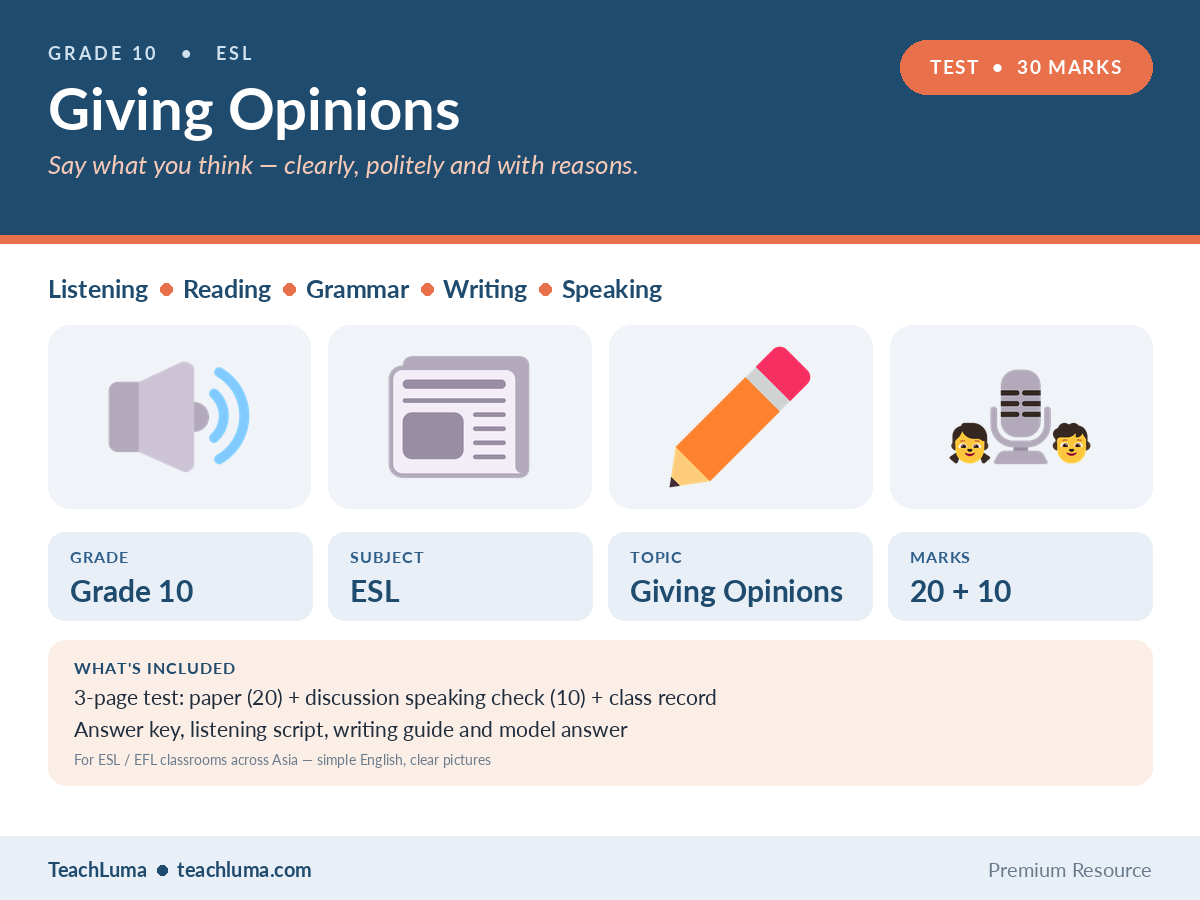
- Test, 3 pages: paper (2 pages), speaking check + class record (DOCX + PDF)
- Answer key with listening script, writing guide and model answer, 1 page (DOCX + PDF)
Additional Files
-
Grade 9 ESL Test: Future Plans — Paper and Speaking Check (30 Marks) (DOCX)
-
Answer Key (DOCX)