Grade 6 Science Lesson Plan: Cells — The Building Blocks of Life
A complete 50–55 minute lesson plan teaching cell theory, the job of each cell part, and p...
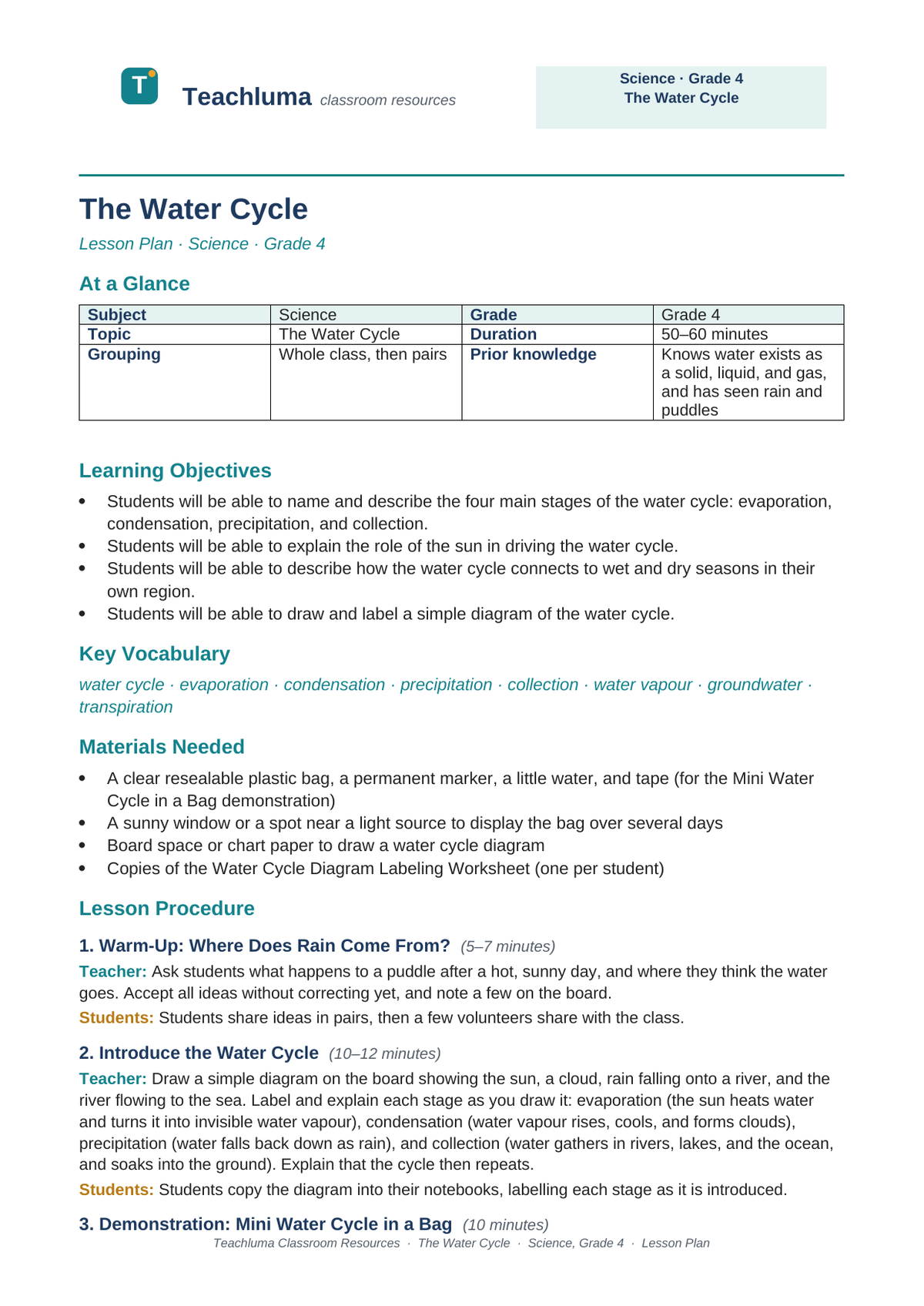
View Resource : Grade 6 Science Lesson Plan: Cells — The Building Blocks of LifeA complete 50–60 minute lesson plan introducing the four stages of the water cycle — evaporation, condensation, precipitation, and collection — through discussion, a simple board diagram, and the classic Mini Water Cycle in a Bag demonstration. Built for Grade 4 classrooms across Southeast Asia, with the water cycle explicitly connected to the region's rainy and dry seasons rather than the four Western seasons.
The lesson opens with a quick warm-up about where puddle water disappears to, then walks students through each stage of the water cycle using a board diagram students copy and label as the teacher explains. A hands-on demonstration — sealing a little water in a clear plastic bag and taping it to a sunny window — gives students something to observe over the following days, tying directly into the separate Mini Water Cycle in a Bag observation activity. Guided and independent practice steps use the Water Cycle Diagram Labeling Worksheet, and the lesson closes with a quick verbal exit check. Differentiation ideas, an extension/homework idea, a regional teaching note, and a movement-based review game are all built in.
Members Only
Upgrade to Teacher Pro (from ฿199/month) to download this resource.
Looking for something different? Request a Resource.
Use the completed Water Cycle Diagram Labeling Worksheet as a formative check during the lesson, and observe students during guided and independent practice using the criteria in the Water Cycle Grading Rubric. The quiz and the Mini Water Cycle in a Bag observation activity can be used later in the week as follow-up checks of understanding.
Support: Provide a picture word bank showing the sun, a cloud, rain, and a river next to the words evaporation, condensation, precipitation, and collection. Offer sentence frames such as "The sun heats the water and it ___." Pair English language learners with a supportive partner and reduce the diagram to the four main stages only.
On-level: Students complete the full worksheet independently, labelling all parts of the diagram and describing each stage in a full sentence.
Challenge: Students add the word transpiration to their diagram and explain where it fits in the cycle, or explain in writing why some places have a rainy season and a dry season using the water cycle to support their answer.
Set up the Mini Water Cycle in a Bag demonstration as early in the lesson as you can manage — even a few extra hours of sun before students check it the next day makes the first observation far more convincing.
No ratings yet
Be the first teacher to review this resource.
A complete 50–55 minute lesson plan teaching cell theory, the job of each cell part, and p...
View Resource : Grade 6 Science Lesson Plan: Cells — The Building Blocks of LifeA detailed, immediately-usable 10-lesson unit plan covering inheritance, Punnett squares, ...
View Resource : Grade 10 Science Lesson Plan: Genetics & Punnett SquaresA complete three-lesson plan that introduces Grade 5 students to ecosystems and habitats, ...
View Resource : Grade 5 Ecosystems and Habitats Lesson PlanA 3-page worksheet with 5 parts: label the animal cell, label the plant cell, match cell p...
View Resource : Grade 6 Science Worksheet: Cells — The Building Blocks of LifeAn 8-question, 10-minute formative quiz covering cell part functions, plant-vs-animal diff...
View Resource : Grade 6 Science Quiz: Cells — The Building Blocks of LifeA 14-slide, classroom-ready presentation introducing cell theory, labeled animal and plant...
View Resource : Grade 6 Science PowerPoint: Cells — The Building Blocks of LifeAdvertisement