Grade 5 Area and Perimeter Lesson Plan
About This Resource
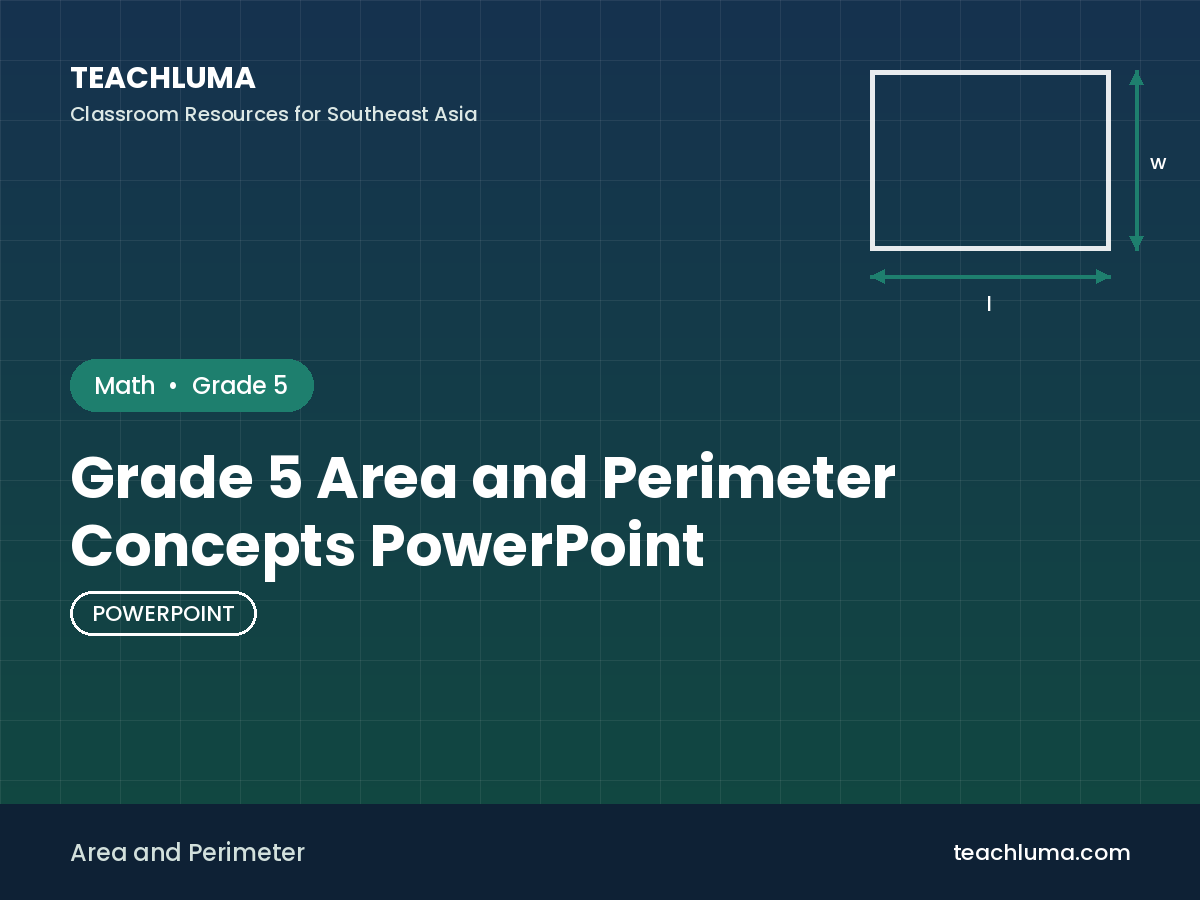
A complete 60-minute lesson plan that introduces Grade 5 students to perimeter and area,
built around the Concepts PowerPoint and Practice Worksheet in this collection. Includes
timing, teacher and student actions for every stage, differentiation, and an exit ticket.
Overview
This lesson plan sequences a full class period from warm-up through closure: an
observation-based warm-up that surfaces students' existing intuition about edges versus
surfaces, direct instruction using the accompanying PowerPoint, guided practice in pairs,
independent practice using the Practice Worksheet, and a two-part exit ticket. Each stage
lists both what the teacher does and what students do, along with the purpose of that
stage, so the plan can be followed closely or adapted to a teacher's own classroom rhythm.
Resource Details
- Subject
- Math
- Topic
- Area and Perimeter
- Category
- Measurement
- File Type
- File Size
- 66.1 KB
- Published
- 05 Sep 2026
- Downloads
- 0
Free download — no account required.
Learning Objectives
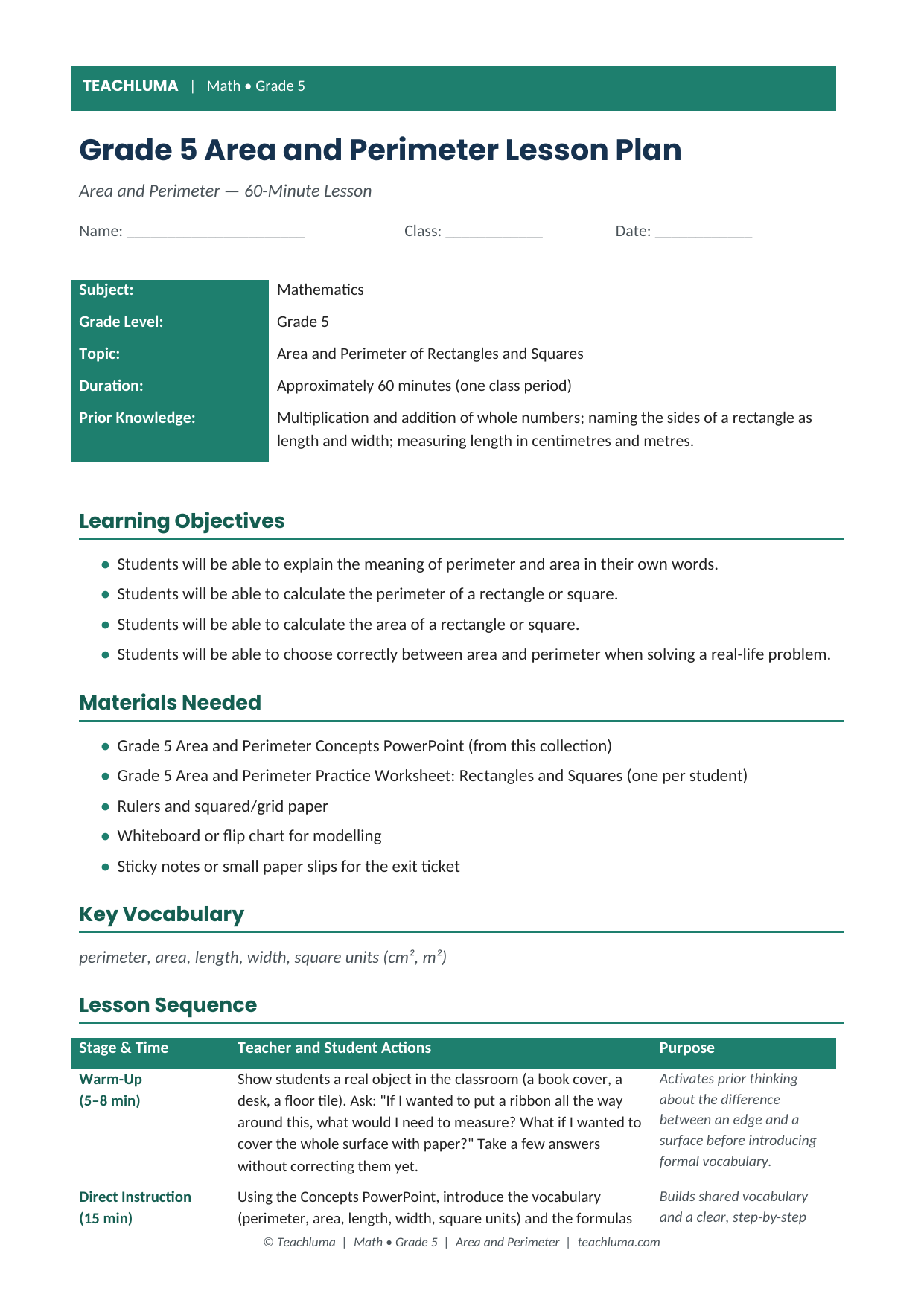
- Students will be able to explain the meaning of perimeter and area in their own words.
- Students will be able to calculate the perimeter of a rectangle or square.
- Students will be able to calculate the area of a rectangle or square.
- Students will be able to choose correctly between area and perimeter when solving a real-life problem.
Lesson Procedure
- Read through the full plan before teaching, and have the Concepts PowerPoint and Practice
- Worksheet ready, since both are referenced directly in the lesson sequence. The timings
- given are approximate for a 60-minute period; if your school uses shorter periods, the
- Independent Practice stage can be split across two days, with the exit ticket moved to
- the end of the second day.
Assessment
Observation during guided practice
The Practice Worksheet, checked against its answer key
The exit ticket response, collected at the end of the less
Differentiation
Support: A printed formula reference card, rulers for tracing shapes before
calculating, fewer independent practice questions, and strategic pairing for English
language support.
On-Level: The guided and independent practice stages as designed.
Challenge: Early finishers move on to the Word Problems Worksheet or the Practice
Worksheet's bonus question.
Classroom Activity Ideas
- Use the guided practice stage as a "think-pair-share": give students thirty seconds of
- silent thinking time before they discuss with a partner, so that quieter students have
- time to form an answer before the conversation starts.
Teacher Tips
Keep the warm-up object simple and visible to the whole class — a book or a floor tile
works better than an abstract drawing, because students can physically point to an edge
versus a surface, which makes the perimeter/area distinction concrete before any
vocabulary is introduced.
Additional Files
Teacher Reviews
No ratings yet
Be the first teacher to review this resource.
Related Resources
Grade 5 Composite Shapes: Area and Perimeter Challenge Worksheet
Worksheet · Composite Shapes
An extension worksheet for Grade 5 students who are confident finding the area and perimet...
View ResourceGrade 5 Area and Perimeter Word Problems Worksheet
Worksheet · Area and Perimeter
A six-question word problem worksheet that asks Grade 5 students to apply perimeter and a...
View ResourceGrade 5 Area and Perimeter Practice Worksheet: Rectangles and Squares
Worksheet · Area and Perimeter
A two-page practice worksheet that gives Grade 5 students focused, structured practice ca...
View ResourceGrade 5 Area and Perimeter Concepts PowerPoint
PowerPoint · Area and Perimeter
A 12-slide teaching PowerPoint that introduces perimeter and area to Grade 5 students, fr...
View ResourceGrade 5 Area and Perimeter Quiz
Assessment · Area and Perimeter
A short, 30-point formal quiz covering everything in this Area and Perimeter unit: key voc...
View ResourceGrade 6 Percentages in Real Life Lesson Plan
Lesson Plan · Percentages in Real Life
A complete 50-60 minute lesson plan introducing Grade 6 students to percentages: what perc...
View Resource