Grade 5 Area and Perimeter Practice Worksheet: Rectangles and Squares
About This Resource
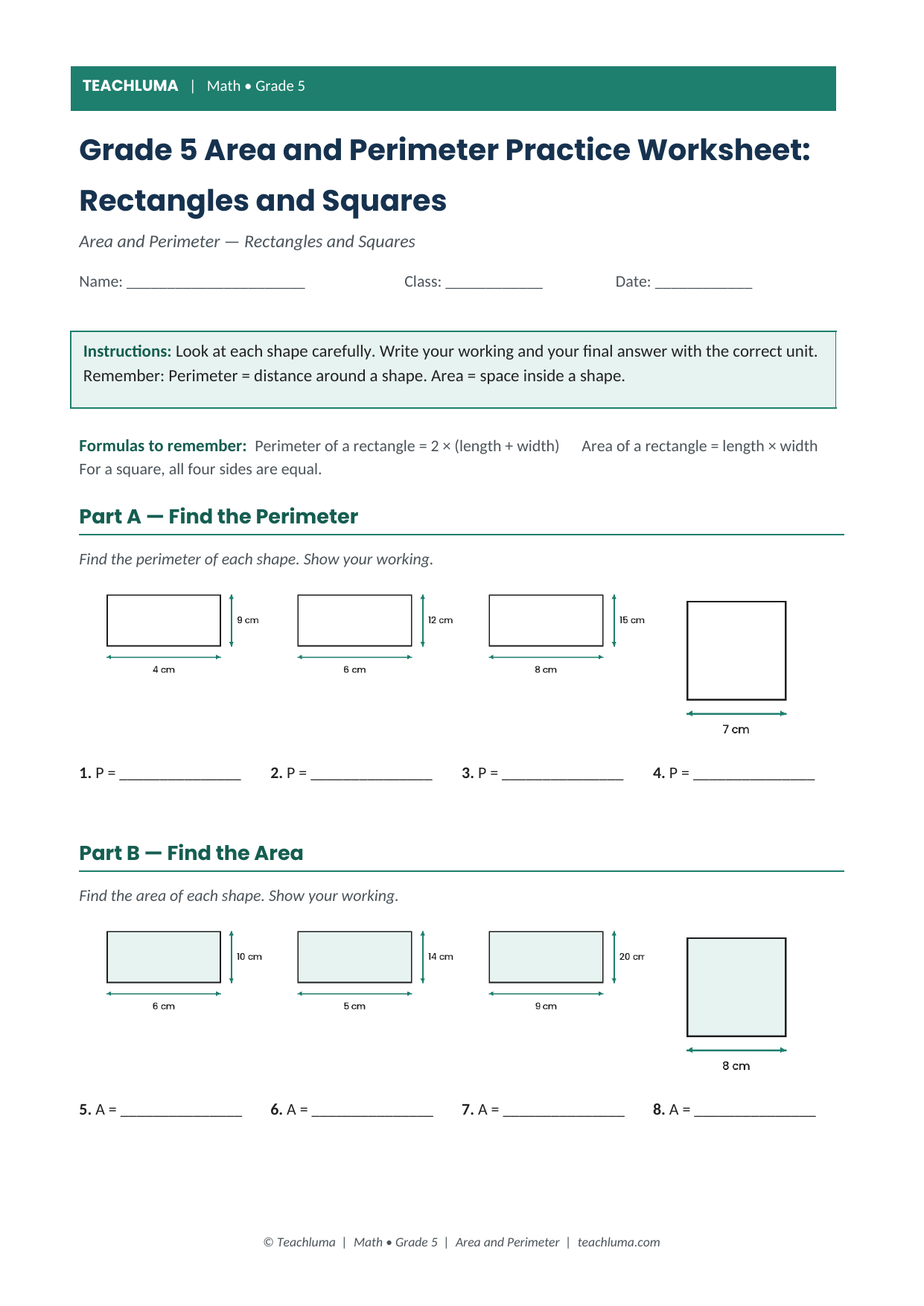
A two-page practice worksheet that gives Grade 5 students focused, structured practice
calculating the perimeter and area of rectangles and squares before they move on to
word problems or composite shapes. Every shape is illustrated with a labelled diagram,
so students who are still building English vocabulary can see exactly which measurement
is the length and which is the width. Includes a "find the missing side" section and a
table-completion task for extra fluency, plus a bonus challenge question.
Overview
This worksheet is designed as the first hands-on practice students complete after being
introduced to perimeter and area. It moves from simple, direct calculation (Parts A and B)
to backward reasoning (Part C, where students are given the perimeter or area and must
find a missing side) and then to a table-based fluency task (Part D). A bonus challenge
question (Part E) asks students to subtract an inner rectangle from an outer one, which
previews the composite-shape thinking they will need later in the unit. Every shape comes
with a clean, labelled diagram rather than numbers alone, which supports English language
learners and visual learners while still being appropriately independent for Grade 5.
Resource Details
- Subject
- Math
- Topic
- Area and Perimeter
- Category
- Measurement
- File Type
- File Size
- 87.9 KB
- Published
- 05 Sep 2026
- Downloads
- 0
Members Only
Upgrade to Teacher Pro (from ฿199/month) to download this resource.
Student Task
- Hand this worksheet out after you have introduced the formulas for perimeter and area of
- a rectangle (2 × (length + width), and length × width) using the accompanying PowerPoint
- or your own instruction. Students can work through Parts A and B independently as guided
- practice, then complete Parts C and D with a partner if they need more support. The bonus
- challenge in Part E works well as an early-finisher task or as a whole-class discussion at
- the end of the lesson. Review answers as a class using the answer key, asking students to
- explain their reasoning for at least one question rather than only stating the final number.
Classroom Use
- Pair Speaking Challenge: In pairs, one student secretly chooses a length and width for a
- rectangle (using whole centimetres between 3 and 15) and tells their partner only the
- perimeter and one side. The partner must calculate the missing side and the area, then
- both students check the shape together by drawing it on grid paper.
Differentiation
Support: Provide a printed word bank (length, width, perimeter, area, square units) and
allow students to use a ruler to trace over each diagram before calculating. Reduce Part D
to the first three rows and allow calculators for students who have already shown they
understand the method but need support with multiplication facts.
On-Level: Students complete all parts as designed, showing their working for every question.
Challenge: Ask students to create their own version of the Part E bonus question using
different measurements, calculate the answer themselves, and swap with a partner to solve.
Answer Key & Assessment
Completed worksheet, checked against the answer key
Observation during paired work on Part C and the Classroom Activity
Exit ticket: ask each student to write one perimeter formula and one area formula from memory
Learning Objectives
- Students will be able to calculate the perimeter of a rectangle or square given its side lengths.
- Students will be able to calculate the area of a rectangle or square given its side lengths.
- Students will be able to work backwards from a given perimeter or area to find a missing side length.
- Students will be able to record measurements with the correct unit, including square units for area.
- Students will be able to apply area and perimeter reasoning to a simple composite (subtracted) shape
Teacher Tips
Before students start Part C, ask a volunteer to explain out loud what "working backwards"
means in their own words. Students who can calculate perimeter and area forwards sometimes
freeze the first time they are asked to reverse the process — a quick verbal check avoids
this and takes less than a minute.
What's Included
- 2-page student worksheet (Parts A–E, 13 questions total)
- Fully worked answer key with matching diagrams
- Editable DOCX version of the worksheet and the answer key
- Print-ready PDF of the worksheet
- Print-ready PDF answer key
Additional Files
- Area and Perimeter.docx
- Answer Key (Printable)
Teacher Reviews
No ratings yet
Be the first teacher to review this resource.
Related Resources
Grade 5 Composite Shapes: Area and Perimeter Challenge Worksheet
Worksheet · Composite Shapes
An extension worksheet for Grade 5 students who are confident finding the area and perimet...
View ResourceGrade 5 Area and Perimeter Word Problems Worksheet
Worksheet · Area and Perimeter
A six-question word problem worksheet that asks Grade 5 students to apply perimeter and a...
View ResourceGrade 5 Area and Perimeter Concepts PowerPoint
PowerPoint · Area and Perimeter
A 12-slide teaching PowerPoint that introduces perimeter and area to Grade 5 students, fr...
View ResourceGrade 5 Area and Perimeter Lesson Plan
Lesson Plan · Area and Perimeter
A complete 60-minute lesson plan that introduces Grade 5 students to perimeter and area, ...
View ResourceGrade 5 Area and Perimeter Quiz
Assessment · Area and Perimeter
A short, 30-point formal quiz covering everything in this Area and Perimeter unit: key voc...
View ResourceGrade 4 Fractions Worksheet: Shade, Name, and Match
Worksheet · Fractions
A three-page worksheet that has students name fractions from shaded shapes, shade shapes t...
View Resource