Grade 5 Composite Shapes: Area and Perimeter Challenge Worksheet
About This Resource
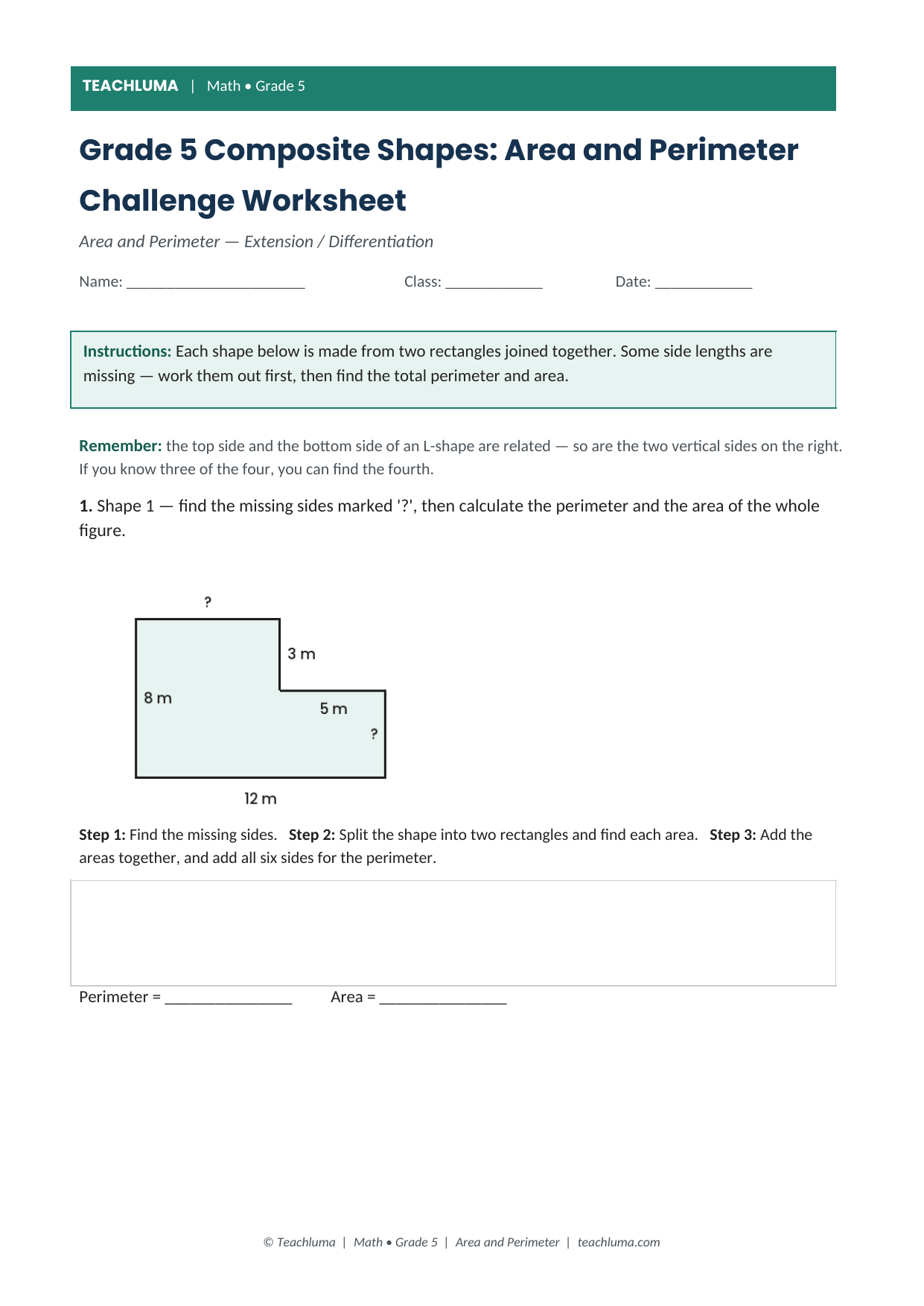
An extension worksheet for Grade 5 students who are confident finding the area and perimeter of simple rectangles and are ready for composite (compound) shapes. Students work out missing side lengths on L-shaped figures, split each shape into two rectangles, and calculate total area and perimeter — finishing with a bonus challenge and a design-your-own task.
Overview
Composite shapes are where area and perimeter work becomes genuinely problem-solving rather than direct calculation, and this worksheet is built to make that jump manageable. Each L-shaped figure gives four known side lengths and leaves two missing, so students must first reason about how the sides of a compound shape relate to each other before they can calculate anything. Once the missing sides are found, students split the shape into two rectangles — a strategy explicitly modelled in the instructions — find each rectangle's area, and add them together. A worked bonus shape and an open "design your own" task extend the thinking further for early finishers or a full extension group.
Resource Details
- Subject
- Math
- Topic
- Composite Shapes
- Category
- Measurement
- File Type
- File Size
- 67.3 KB
- Published
- 05 Sep 2026
- Downloads
- 0
Members Only
Upgrade to Teacher Pro (from ฿199/month) to download this resource.
Student Task
- This worksheet is intended as an extension activity, not a first introduction to area and
- perimeter — students should already be confident with simple rectangles (see the Practice
- Worksheet and Word Problems Worksheet in this collection) before attempting it. Model the
- first shape together on the board, thinking aloud about how the top side relates to the
- bottom side and the notch. Let students work through the remaining shapes independently
- or in pairs, and treat the "Design Your Own" task as an open extension for students who
- finish early rather than a requirement for the whole class.
Classroom Use
- Build It: Using square tiles, cubes, or grid paper, have small groups physically build one
- of the L-shaped figures from the worksheet at a small scale. Groups count the tiles to
- confirm their calculated area, which gives immediate, concrete feedback before they move
- on to the next shape.
Differentiation
Support: Complete Shape 1 as a whole-class or small-group activity before students
attempt Shapes 2 and 3 independently. Provide grid paper so students can count squares to
check their area calculations, and allow a partner to check the missing-side reasoning
before calculating area and perimeter.
On-Level: Students complete all three shapes and the bonus challenge independently, showing their working.
Challenge: Students complete the "Design Your Own" task, and can be asked to create a
composite shape from three rectangles instead of two.
Answer Key & Assessment
Completed worksheet, checked against the answer key, with particular attention to the missing-side reasoning
Observation during the "Build It" activity or paired work
The "Design Your Own" task can be collected as a short extension assessment for early finishers
Learning Objectives
- Students will be able to find a missing side length on a composite rectilinear shape using the lengths of the other sides.
- Students will be able to split a composite shape into two rectangles.
- Students will be able to calculate the total area of a composite shape by adding the areas of its parts.
- Students will be able to calculate the perimeter of a composite shape by adding all of its outer sides.
- Students will be able to create their own composite shape problem with consistent, correct measurements.
Teacher Tips
Give students squared or grid paper alongside this worksheet. Being able to sketch the
dividing line between the two rectangles directly onto (or over) the figure makes the
"split into two rectangles" step far more concrete than working from the printed diagram alone.
What's Included
- 3-page student worksheet (3 composite shapes plus a bonus challenge shape and a design task)
- Fully worked answer key showing the missing-side reasoning and the rectangle split for every shape
- Editable DOCX version of the worksheet and the answer key
- Print-ready PDF of the worksheet
- Print-ready PDF answer key
Additional Files
- Composite Shapes.docx
- Answer Key (Printable)
Teacher Reviews
No ratings yet
Be the first teacher to review this resource.
Related Resources
Grade 5 Area and Perimeter Word Problems Worksheet
Worksheet · Area and Perimeter
A six-question word problem worksheet that asks Grade 5 students to apply perimeter and a...
View ResourceGrade 5 Area and Perimeter Practice Worksheet: Rectangles and Squares
Worksheet · Area and Perimeter
A two-page practice worksheet that gives Grade 5 students focused, structured practice ca...
View ResourceGrade 5 Area and Perimeter Concepts PowerPoint
PowerPoint · Area and Perimeter
A 12-slide teaching PowerPoint that introduces perimeter and area to Grade 5 students, fr...
View ResourceGrade 5 Area and Perimeter Lesson Plan
Lesson Plan · Area and Perimeter
A complete 60-minute lesson plan that introduces Grade 5 students to perimeter and area, ...
View ResourceGrade 6 Percentages Practice Worksheet: Converting and Finding Percentages
Worksheet · Percentages
A skills-practice worksheet for Grade 6 that gives students focused practice converting be...
View ResourceGrade 6 Percentage Increase and Decrease Worksheet
Worksheet · Percentage Increase and Decrease
A six-problem worksheet focused specifically on percentage increase and decrease for Grade...
View Resource