Skip to content
Preview
Members Only ESL Assessment Grade 6
No ratings yet

Grade 6 ESL Test: Health & Fitness — Paper and Speaking Check (30 Marks)

About This Resource

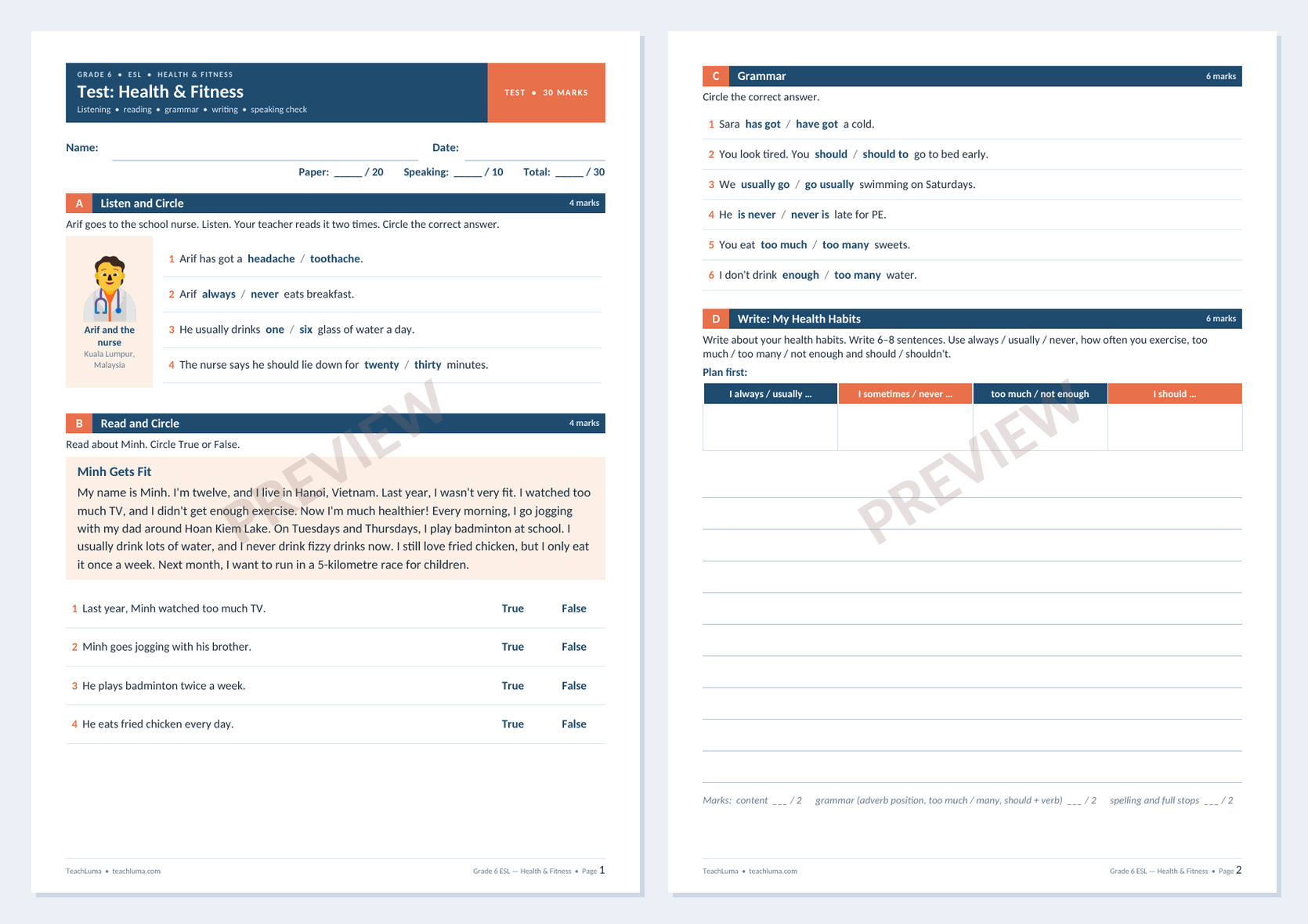
A 30-mark unit test: listening (Arif at the school nurse, Kuala Lumpur), reading (Minh Gets Fit, Hanoi), grammar and a short writing task (20 marks), plus a 10-mark one-to-one speaking check with a class record sheet and a full answer key with the listening scrip

Overview

This pack teaches Grade 6 learners the English they need to talk about their health and fitness — and the grammar that goes with it. Students learn 8 common health problems (a headache, a toothache, an earache, a fever, a cold, a cut, feel sick, feel tired) and ask "What's the matter?" with I've got a … / I feel … / My … hurts, including he / she. They give advice with should / shouldn't + verb (You should see a dentist. You shouldn't eat sweets.), learn 12 healthy and unhealthy habits (go jogging, do yoga, drink water, get enough sleep, eat junk food, stay up late), say how often they do things with always, usually, often, sometimes, rarely and never, and use too much, too many and not enough with countable and uncountable nouns. The reading "Ask Dr Lin" has letters from Bayu (Surabaya, Indonesia), Noy (Vientiane, Laos) and Wei (Shenzhen, China) with the doctor's replies, and students finish by writing about their own health habits. Students keep a 5-day Health Diary for homework. A2 level; it prepares students for the Grade 8 Health and Healthy Habits resources. This listing covers the Test only.

Resource Details

Subject
ESL
Topic
Health & Fitness
Category
Assessments
File Type
PDF
File Size
66.5 KB
Published
06 Oct 2026
Downloads
0

Members Only

Upgrade to Teacher Pro (from ฿199/month) to download this resource.

Share:

Looking for something different? Request a Resource.

Question Types & Suggested Use

The answer key gives every answer, short reasons for the False items, a 3-part writing guide (content, grammar, spelling) with a model answer, a 0 / 1 / 2 guide for each speaking item and grade bands (27–30, 21–26, 15–20, 0–14).

Skills Assessed

  • Name 8 common health problems and 12 healthy and unhealthy habits (a headache, a fever, feel sick, drink water, get enough sleep, eat junk food).
  • Ask and answer "What's the matter?" with I've got a … / I feel … / My … hurts, including he / she ("Nam has got an earache.").
  • Give and understand advice with should / shouldn't + verb ("You should see a dentist. You shouldn't eat sweets.").
  • Use always, usually, often, sometimes, rarely and never in the right place and answer "How often do you …?"
  • Use too much, too many and not enough with countable and uncountable nouns ("You eat too many sweets. I don't get enough sleep.").
  • Read three short health letters and replies for detail and write about their own health habits in 8–10 sentences.

How to Administer

  • Read the listening script (in the answer key) two times at a natural, slow speed — two voices if you can. While the class does the paper, call students one at a time for the speaking check on page 3 and record scores on the class record sheet.

Differentiation

Support: Teach the 8 health problems first and add the habits in Lesson 3. Keep the pictures and the word cards (should / shouldn't, always … never, too much / too many / enough) on the desk for Worksheet Parts C, F and G. Give sentence frames: "What's the matter? – I've got a ___. / I feel ___." "You should ___. You shouldn't ___." and for writing: "I always ___. I usually ___. I never ___. I eat too many ___. I don't get enough ___. I should ___." Accept short answers in speaking, then model the full sentence. Pair a stronger student with a weaker one for the information gap.
Extension: Students add a reason with because to every piece of advice ("You should drink water because sugary drinks are bad for your teeth."), use more health words (a sore throat, a cough, a stomachache, a backache) and more frequency words (once a week, twice a day, every evening). They write a letter to Dr Lin about a real or invented problem and swap it with a partner, who writes the reply. Strong readers write three new "Who …?" questions about the Ask Dr Lin page, or make a class bar chart from the health survey and write four sentences about it

Follow-Up Activities

  • Use the speaking prompts as a pair practice the lesson before the test.
  • Students who finish early play Doctor, Doctor! quietly in pairs.

Teacher Tips

Two mistakes come up again and again in this unit: "You should to go …" and "I eat always …". Fix both with chants and the board, not long explanations. Write SHOULD + VERB (no to!) at the top of the board in Lesson 2 and clap the rhythm: "You should REST. You should SLEEP. You shouldn't EAT too many SWEETS." For frequency adverbs, use the "sandwich" picture: the adverb goes between I / he / she and the main verb (I always brush …) but after am / is / are (I'm never late). Then keep it real: on the first day, ask students to keep a 3-day "health diary" (sleep, water, exercise, screens). Students care much more about too much / not enough when the numbers are their own — and they love to tell you that the teacher drinks too much coffee!

What's Included

  • Test, 3 pages: paper (2 pages), speaking check + class record (DOCX + PDF)
  • Answer key with listening script and writing guide, 1 page (DOCX + PDF)

Additional Files

  • Grade 6 ESL Test: Health & Fitness (DOCX)
  • Answer Key (PDF)

Teacher Reviews

No ratings yet

Be the first teacher to review this resource.

Sign in to review this resource.

Related Resources

Advertisement