Question Types & Suggested Use
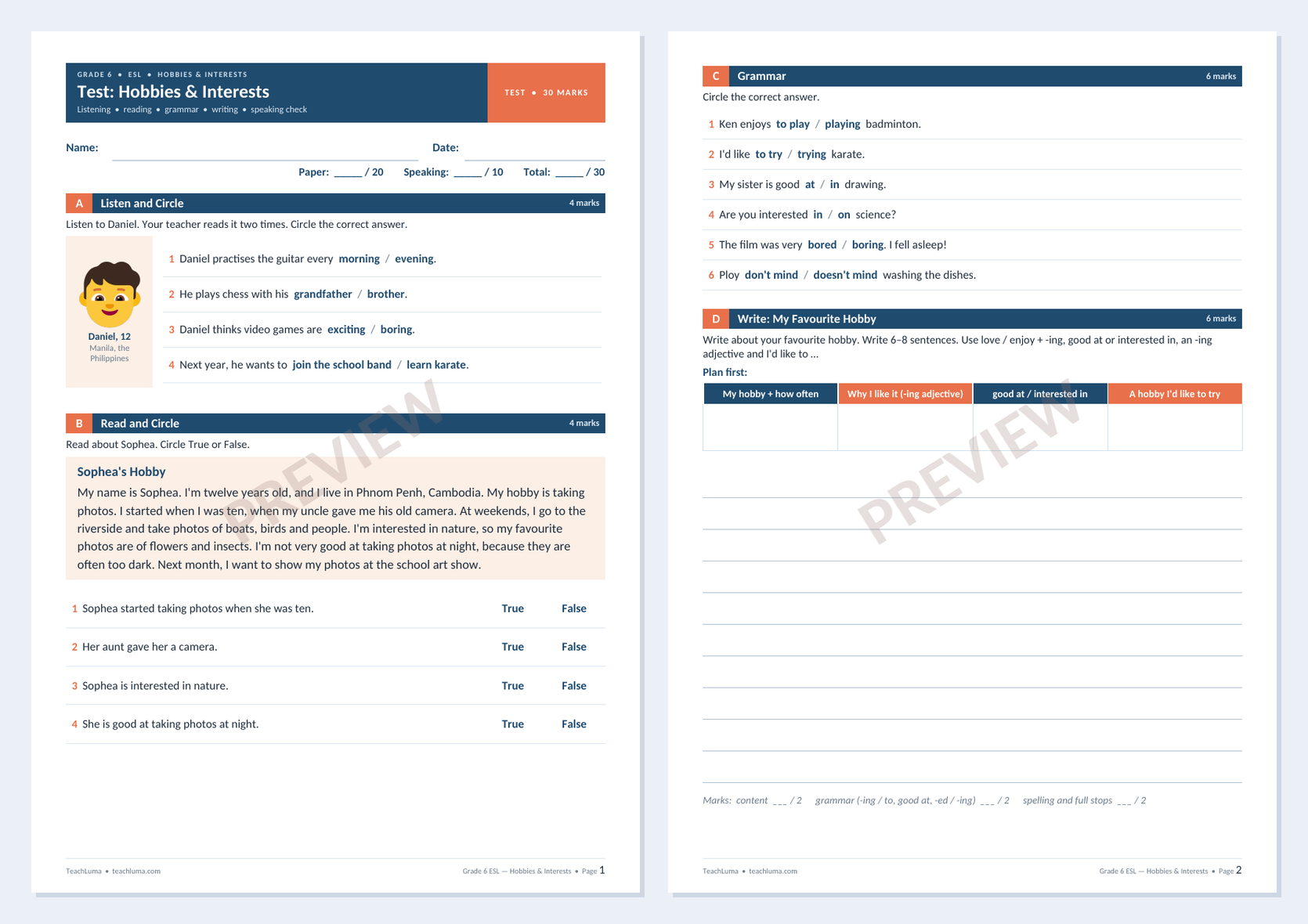
The answer key gives every answer, short reasons for the False items, a 3-part writing guide (content, grammar, spelling) with a model answer, a 0 / 1 / 2 guide for each speaking item and grade bands (27–30, 21–26, 15–20, 0–14).
Skills Assessed
- Name 16 hobbies and use the right verb with each one (play chess, go hiking, do karate, take photos, fly kites).
- Ask and answer "What do you do in your free time?" and "How often do you …?"
- Talk about likes and dislikes with love / enjoy / don't mind / don't like / hate + -ing, including he / she + -s ("Mai enjoys painting pictures.").
- Use want / would like / hope / decide + to + verb to talk about plans ("I'd like to try karate.").
- Use good at, bad at, interested in and keen on + -ing or a noun ("I'm good at drawing.").
- Choose -ed or -ing adjectives correctly ("I'm bored." / "This film is boring.").
- Read three short hobby profiles for detail and write their own hobby profile of 8–10 sentences.
How to Administer
- Read the listening script (in the answer key) two times at a natural, slow speed. While the class does the paper, call students one at a time for the speaking check on page 3 and record scores on the class record sheet.
Differentiation
Support: Teach 8 hobbies in Lesson 1 (one slide) and add the other 8 in Lesson 2. Keep the word cards (+ -ING / + TO, at / in / on) on the desk for Worksheet Parts D–F. Give sentence frames: "I love ___ing. I don't mind ___ing. I'd like to ___." and for writing: "My hobby is ___. I do it ___. I enjoy it because it's ___. I'm good at ___. One day, I'd like to ___." Accept short answers in speaking, then model the full sentence. Pair a stronger student with a weaker one for the information gap.
Extension: Students add frequency (once a week, twice a month, every evening) and a reason with because to every answer, and use more verbs with -ing or to (can't stand, keep, plan, learn). They write a second profile about a family member using he / she + -s, compare two hobbies ("Hiking is more tiring than fishing, but it's more exciting."), or interview a teacher and report back. Strong readers write three new "Who …?" questions about the Hobby Club Profiles for a partner.
Follow-Up Activities
- Use the speaking prompts as a pair practice the lesson before the test.
- Students who finish early play Guess My Hobby quietly in pairs.
Teacher Tips
The biggest problem in this unit is "I enjoy to play" and "I'm boring". Fix both with the board, not with explanations. At the start of Lesson 2, draw two columns, + -ING and + TO + VERB, and stick the verb cards under them; leave them up for the whole unit. When a student says "I enjoy to play", just point at the columns — students self-correct within a few days. For -ed / -ing, act it out once (yawn with a boring book: "This book is boring. I'm bored.") and add two headings to the board: PEOPLE feel … -ed and THINGS are … -ing. Then make it personal: students tell a partner one boring thing and one exciting thing from their week. Real hobbies make the grammar stick, so add students' own hobbies (badminton, mobile games, K-pop dance, helping in the family shop) to the word wall in Lesson 1.
What's Included
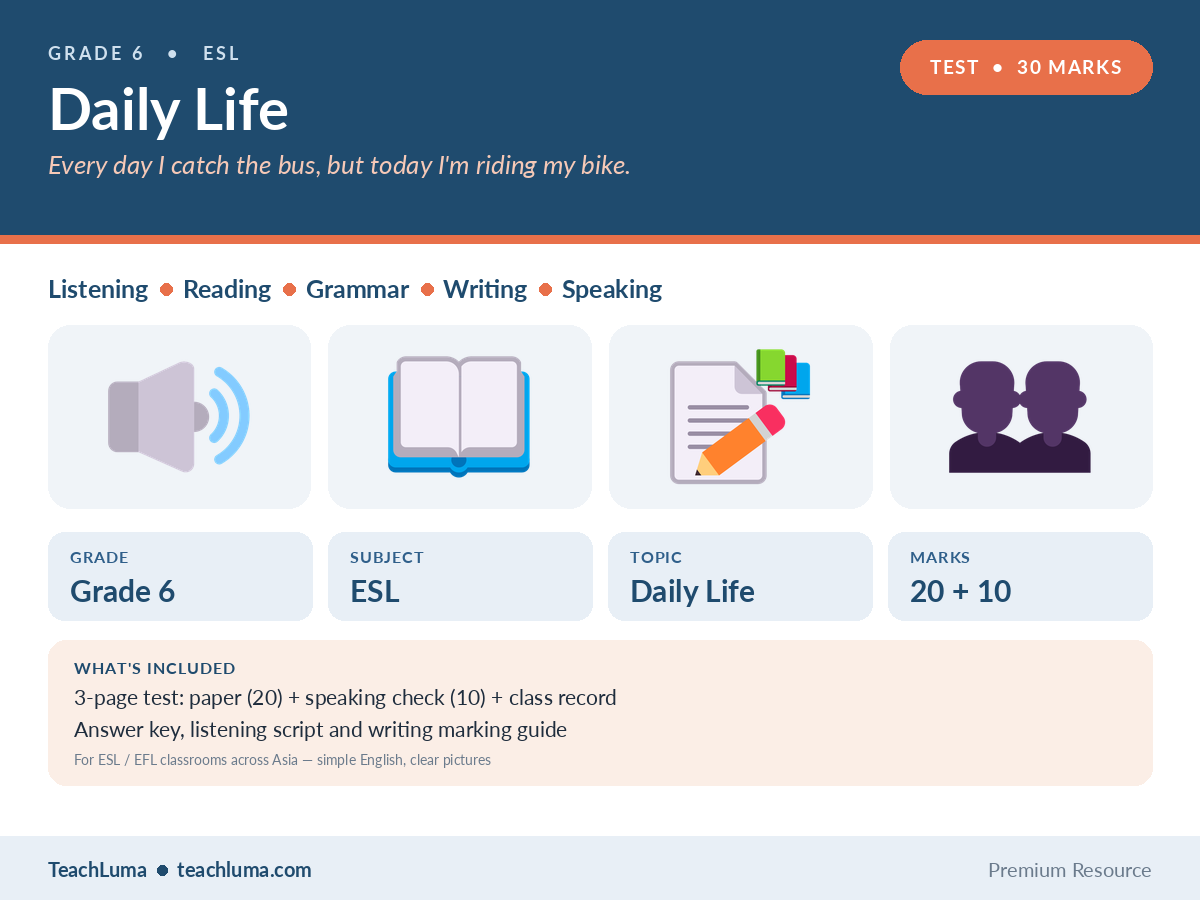
- Test, 3 pages: paper (2 pages), speaking check + class record (DOCX + PDF)
- Answer key with listening script and writing guide, 1 page (DOCX + PDF)
Additional Files
-
Grade 6 ESL Test: Hobbies & Interests — Paper and Speaking Check (30 Marks) (DOCX)
-
Answer Key (PDF)