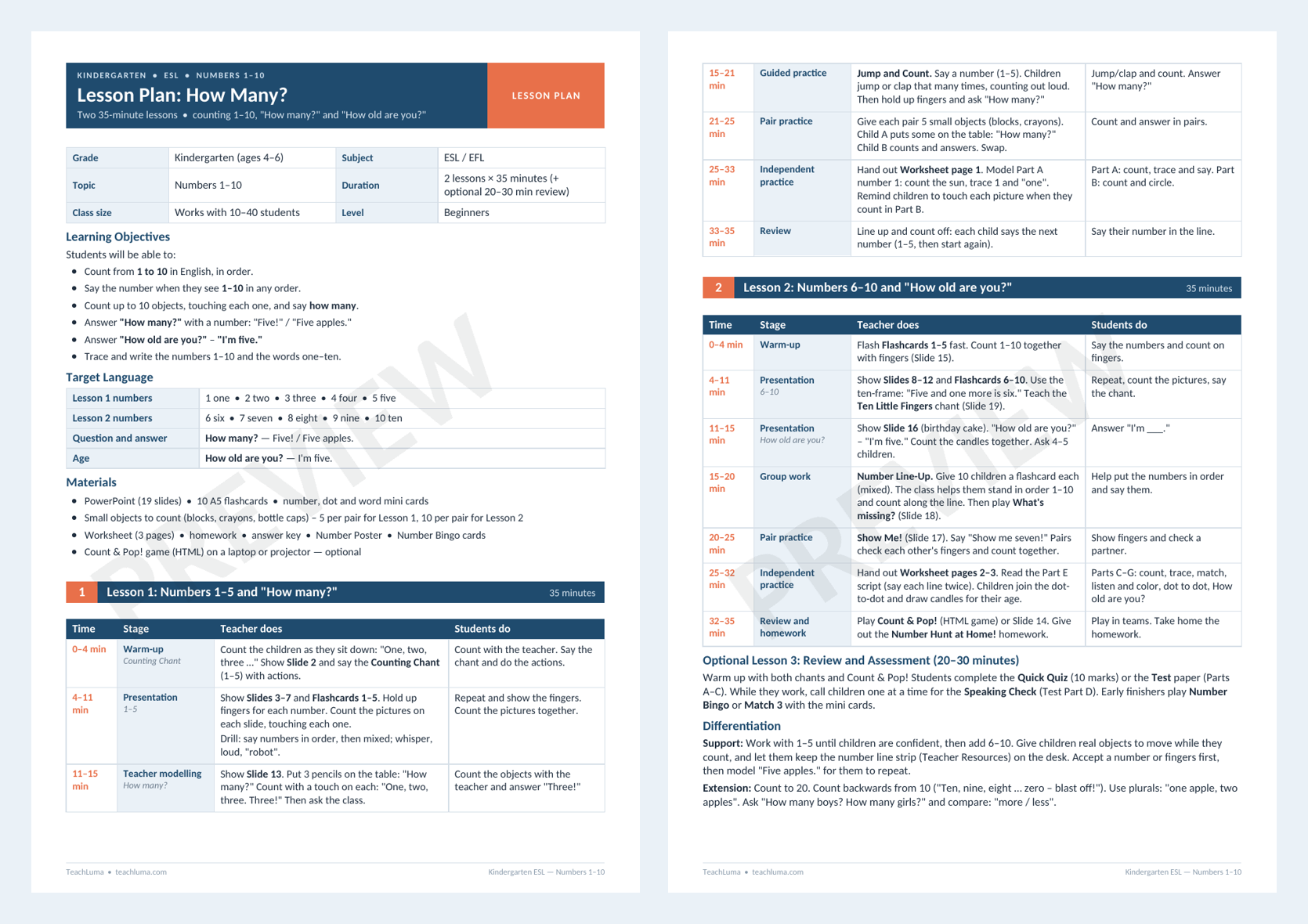
Kindergarten ESL Lesson Plan: Numbers 1–10 — How Many?
About This Resource
A minute-by-minute plan for two 35-minute Kindergarten ESL lessons on counting 1–10, "How many?" and "How old are you? – I'm five." — with games, differentiation, a board plan and a prep checklist.
Resource Details
- Subject
- ESL
- Topic
- Numbers 1-10
- Category
- Lesson Plans
- File Type
- File Size
- 104 KB
- Published
- 24 Sep 2026
- Downloads
- 0
Free download — no account required.
Teaching this in class? Try our free Random Name Picker & Timer.
Looking for something different? Request a Resource.
Learning Objectives
- Count from 1 to 10 in English, in order.
- Say the number when they see 1–10 in any order.
- Count up to 10 objects, touching each one, and say how many.
- Answer "How many?" with a number: "Five!" / "Five apples."
- Answer "How old are you?" – "I'm five."
- Trace and write the numbers 1–10 and the words one–ten.
Lesson Procedure
- Read both lessons before class and use the prep checklist. Each stage has a time, what the teacher does and what the children do. Lesson 1 teaches 1–5 and "How many?"; Lesson 2 teaches 6–10 with ten-frames and "How old are you?". Slide and flashcard numbers match the PowerPoint and Flashcards in this series.
Assessment
Watch and listen during Jump and Count, pair counting and Line-Up and score with the Grading Rubric. The plan also shows where to use the Quick Quiz and the Test.
Differentiation
Support: Work with 1–5 until children are confident, then add 6–10. Give children real objects to move while they count, and let them keep a desk number line. Accept a number or fingers first, then model "Five apples." for them to repeat.
Extension: Count to 20. Count backwards from 10 ("Ten, nine, eight … zero – blast off!"). Use plurals: "one apple, two apples". Ask "How many boys? How many girls?" and compare with more / less.
Classroom Activity Ideas
- Jump and Count: children jump or clap the number you say.
- Number Line-Up: children with flashcards stand in order 1–10.
Teacher Tips
Listen for three, five, seven and six. Many children in Thailand, Vietnam, Laos and Cambodia say "tree" for three (no "th"), "fife" for five, "sewen" for seven and "sick" for six (the "ks" end is lost). Show the tongue between the teeth for "th" and the top teeth on the bottom lip for "v" – make it a silly-face game, and children will soon correct each other.
What's Included
- 3-page lesson plan: objectives, target language, materials, 2 timed lessons, optional review lesson, differentiation, assessment, teacher tips, board plan, prep checklist, counting ideas and homework (DOCX + PDF)
Additional Files
Teacher Reviews
No ratings yet
Be the first teacher to review this resource.
Related Resources
Kindergarten ESL Lesson Plan: Greetings and Introductions — Hello! What's Your Name?
Lesson Plan · Greetings and Introductions
A minute-by-minute plan for two 35-minute Kindergarten ESL lessons on greetings: hello and...
View Resource
Kindergarten ESL Lesson Plan: Colors — What Color Is It?
Lesson Plan · Colors
A minute-by-minute plan for two 35-minute Kindergarten ESL lessons on 10 colors, "What col...
View Resource
Kindergarten ESL Lesson Plan: All About Me (Family, Feelings and Body Parts)
Lesson Plan · All About Me
A complete two-session lesson plan for introducing "All About Me" vocabulary to Kindergart...
View Resource
Grade 4 ESL Lesson Plan: Hobbies and Free Time — What Do You Like Doing?
Lesson Plan · Hobbies and Free Time
This resource is one part of the Grade 4 ESL "Hobbies and Free Time" series. Students lear...
View Resource
Grade 2 Weather and Seasons Unit Lesson Plan (5-Day Sequence)
Lesson Plan · Weather and Seasons
A ready-to-teach 5-day lesson plan that sequences all 13 resources in the Weather and Seas...
View Resource
Grade 4 Daily Routines Unit Lesson Plan
Lesson Plan · Daily Routine
A 2-page teacher lesson plan tying the whole Grade 4 Daily Routines topic together into on...
View ResourceAdvertisement