Skip to content
Preview
Members Only Science Complete Lesson Pack Grade 5 (Year 6)
No ratings yet

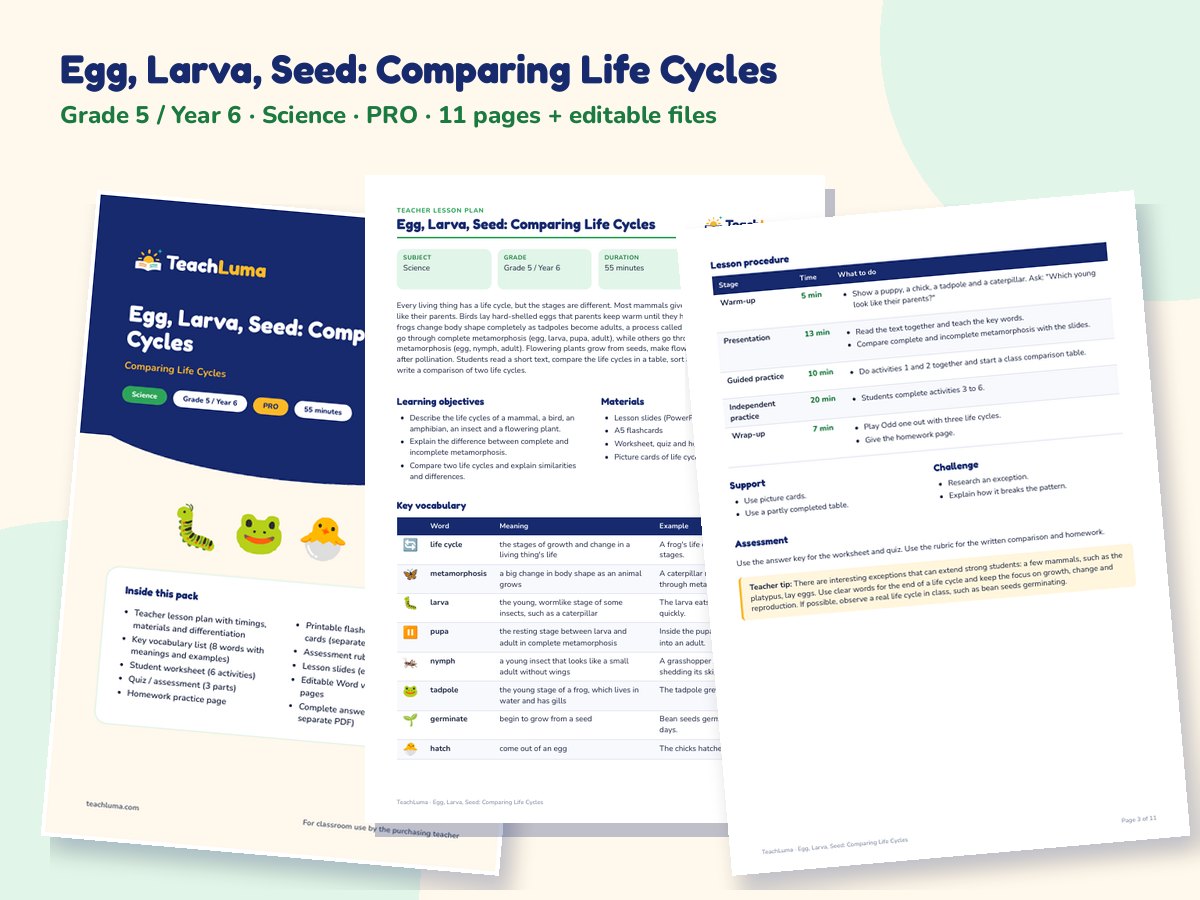
Egg, Larva, Seed: Comparing Life Cycles

About This Resource

A complete Grade 5 science pack comparing the life cycles of mammals, birds, amphibians, insects and flowering plants. Students read about each life cycle, match young stages to their animals, sort insects by complete and incomplete metamorphosis, order the stages of a flowering plant and explain similarities and differences. Includes slides, a lesson plan, worksheet, quiz, homework, flashcards, a rubric and answer keys.

Overview

Every living thing has a life cycle, but the stages are different. Most mammals give birth to live young that look like their parents. Birds lay hard-shelled eggs that parents keep warm until they hatch. Amphibians such as frogs change body shape completely as tadpoles become adults, a process called metamorphosis. Some insects go through complete metamorphosis (egg, larva, pupa, adult), while others go through incomplete metamorphosis (egg, nymph, adult). Flowering plants grow from seeds, make flowers and produce new seeds after pollination. Students read a short text, compare the life cycles in a table, sort and sequence stages and write a comparison of two life cycles.

Resource Details

Subject
Science
Topic
Comparing Life Cycles
Category
Living Things
File Type
PDF
File Size
308.8 KB
Published
12 Nov 2026
Downloads
0

Members Only

Upgrade to Teacher Pro (from ฿199/month) to download this resource.

Share:

Looking for something different? Request a Resource.

Grade 5 science (ages 10–11) 55 minutes Life science comparing classifying sequencing scientific explanation

Learning Objectives

  • Describe the life cycles of a mammal, a bird, an amphibian, an insect and a flowering plant.
  • Explain the difference between complete and incomplete metamorphosis.
  • Compare two life cycles and explain similarities and differences.

How to Use This Resource

  • Show the slides: photos of a puppy, a chick, a tadpole and a caterpillar. Ask: "Which young look like their parents?"
  • Read the text and do worksheet activities 1 and 2 together.
  • Students complete activities 3 to 6, then use the quiz and send the homework page home.

Classroom Activity Ideas

  • Life cycle wheels: groups make a spinning wheel for one life cycle and present it to the class.
  • Compare table: students complete a table with columns for how the young begin, number of stages and whether there is metamorphosis.
  • Odd one out: show three life cycles and ask which one is different and why.

Differentiation

Support: give picture cards for each stage and a partly completed comparison table. Challenge: students research one exception (an egg-laying mammal or a live-bearing reptile) and explain how it fits or breaks the pattern.

Assessment

Use the worksheet and quiz to check knowledge of stages and metamorphosis. Use the rubric to assess the written comparison and homework.

Teacher Tips

There are interesting exceptions that can extend strong students: a few mammals, such as the platypus, lay eggs. Use clear words for the end of a life cycle and keep the focus on growth, change and reproduction. If possible, observe a real life cycle in class, such as bean seeds germinating.

What's Included

  • 11-page printable PDF lesson pack: teacher lesson plan with timings, materials and differentiation
  • Key vocabulary list (8 words with meanings and examples)
  • Student worksheet (6 activities)
  • Quiz / assessment (3 parts)
  • Homework practice page
  • Printable flashcards: 8 A5 picture cards (separate PDF)
  • Assessment rubric (4 levels)
  • Lesson slides (editable PowerPoint)
  • Editable Word version of all student pages
  • Complete answer key (also as a separate PDF)

Additional Files

  • Lesson Slides (PPTX)
  • Editable Student Pages and Lesson Plan (DOCX)
  • A5 Flashcards (PDF)
  • Answer Key (PDF)

Teacher Reviews

No ratings yet

Be the first teacher to review this resource.

Sign in to review this resource.

Related Resources

Advertisement