Members Only
Science
Complete Lesson Pack
Grade 6 (Year 7)
No ratings yet
Sorting Life: The Five Kingdoms
About This Resource
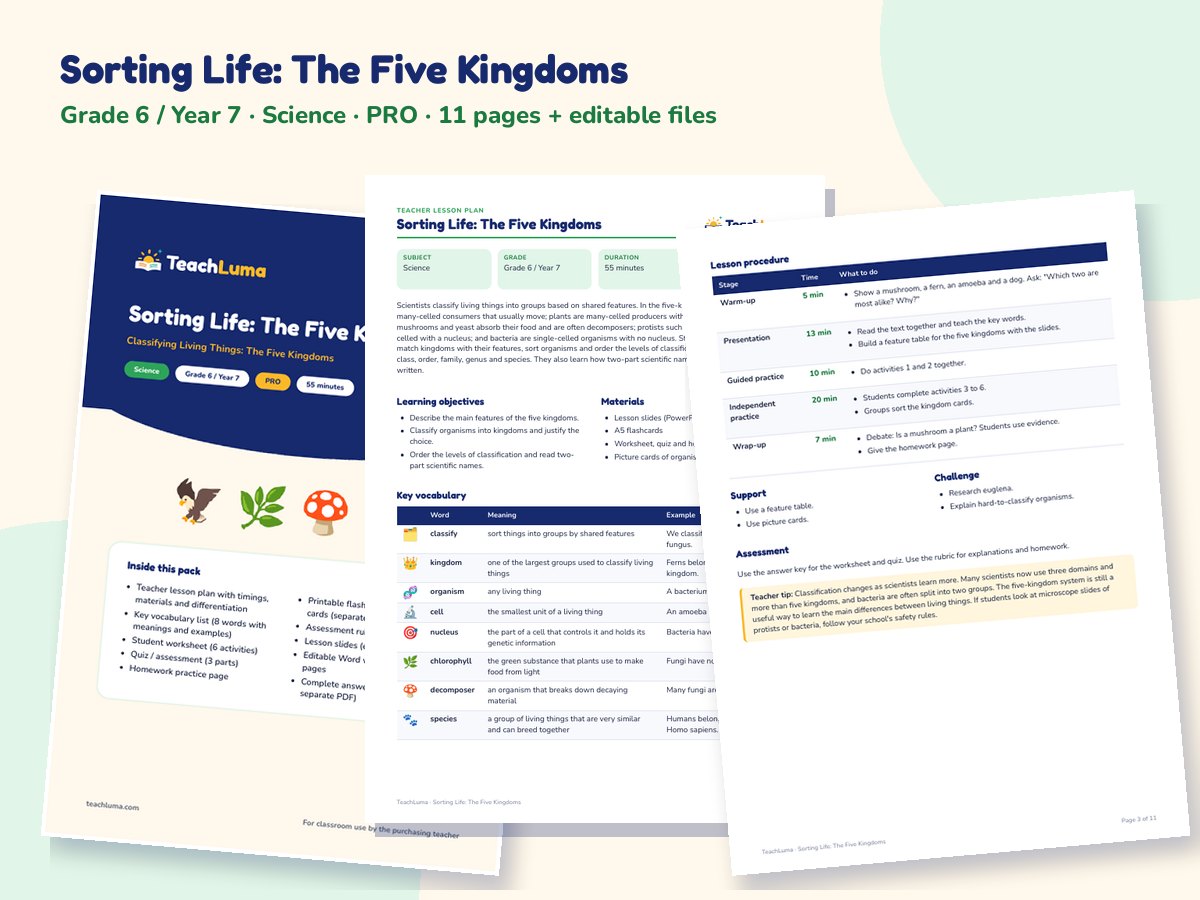
A complete Grade 6 science pack on classifying living things into five kingdoms: animals, plants, fungi, protists and bacteria (monera). Students read about the features of each kingdom, sort organisms, explain why a mushroom is not a plant, order the levels of classification from kingdom to species and read scientific names. Includes slides, a lesson plan, worksheet, quiz, homework, flashcards, a rubric and answer keys.
Overview
Scientists classify living things into groups based on shared features. In the five-kingdom system, animals are many-celled consumers that usually move; plants are many-celled producers with chlorophyll; fungi such as mushrooms and yeast absorb their food and are often decomposers; protists such as amoebas are mostly single-celled with a nucleus; and bacteria are single-celled organisms with no nucleus. Students read a short text, match kingdoms with their features, sort organisms and order the levels of classification: kingdom, phylum, class, order, family, genus and species. They also learn how two-part scientific names such as Homo sapiens are written.
Resource Details
- Subject
- Science
- Topic
- Classifying Living Things: The Five Kingdoms
- Category
- Living Things
- File Type
- PDF
- File Size
- 333.5 KB
- Published
- 12 Nov 2026
- Downloads
- 0
Members Only
Upgrade to Teacher Pro (from ฿199/month) to download this resource.
Looking for something different? Request a Resource.