Skip to content
Preview
Members Only ESL Complete Lesson Pack Grade 5 (Year 6)
No ratings yet

Pause or Introduce? Semicolons and Colons

About This Resource

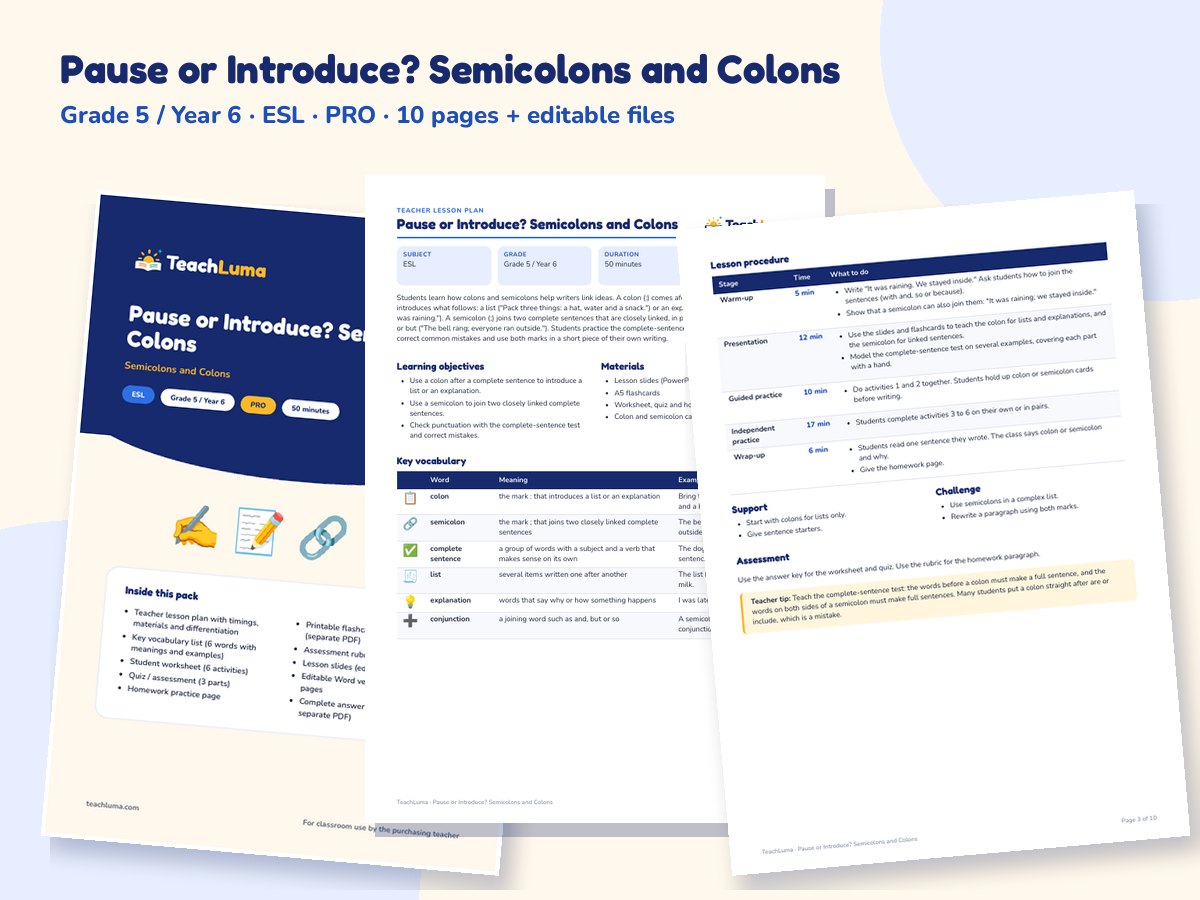
A complete Grade 5 ESL writing pack on two useful punctuation marks: the colon, which introduces a list or an explanation after a complete sentence, and the semicolon, which joins two closely linked complete sentences without a conjunction. Students learn the complete-sentence test, choose between colons, semicolons and full stops, correct mistakes and write their own sentences. Includes slides with notes, a lesson plan, worksheet, quiz, homework, flashcards, a rubric and answer keys.

Overview

Students learn how colons and semicolons help writers link ideas. A colon (:) comes after a complete sentence and introduces what follows: a list ("Pack three things: a hat, water and a snack.") or an explanation ("We stayed inside: it was raining."). A semicolon (;) joins two complete sentences that are closely linked, in place of a conjunction such as and or but ("The bell rang; everyone ran outside."). Students practice the complete-sentence test, choose the right mark, correct common mistakes and use both marks in a short piece of their own writing.

Resource Details

Subject
ESL
Topic
Semicolons and Colons
Category
Writing
File Type
PDF
File Size
312.1 KB
Published
08 Nov 2026
Downloads
0

Members Only

Upgrade to Teacher Pro (from ฿199/month) to download this resource.

Share:

Looking for something different? Request a Resource.

Grade 5 ESL (ages 10–11), A2–B1 50 minutes Punctuation sentence structure editing writing

Learning Objectives

  • Use a colon after a complete sentence to introduce a list or an explanation.
  • Use a semicolon to join two closely linked complete sentences.
  • Check punctuation with the complete-sentence test and correct mistakes.

How to Use This Resource

  • Start with the slides: show the same idea written with a full stop, a semicolon and a colon and ask how they feel different.
  • Teach the rules with the slides and flashcards, then do worksheet activities 1 and 2 together using the complete-sentence test.
  • Students complete activities 3 to 6, then use the quiz and send the homework page home.

Classroom Activity Ideas

  • Human sentences: two students hold complete sentences; a third holds a semicolon card and stands between them.
  • Colon or semicolon? Read out sentence pairs; students hold up a colon or semicolon card.
  • Packing list: students write a colon sentence listing what they would take on a trip to the mountains.

Differentiation

Support: focus on colons for lists first and give sentence starters such as "I need three things:". Challenge: students use semicolons in a list of items that already contain commas, such as cities and their countries.

Assessment

Use the worksheet and quiz to check choosing and placing colons and semicolons. Use the rubric to assess the homework paragraph.

Teacher Tips

Teach the complete-sentence test: the words before a colon must make a full sentence, and the words on both sides of a semicolon must make full sentences. Many students put a colon straight after are or include, which is a mistake.

What's Included

  • 10-page printable PDF lesson pack: teacher lesson plan with timings, materials and differentiation
  • Key vocabulary list (6 words with meanings and examples)
  • Student worksheet (6 activities)
  • Quiz / assessment (3 parts)
  • Homework practice page
  • Printable flashcards: 6 A5 picture cards (separate PDF)
  • Assessment rubric (4 levels)
  • Lesson slides (editable PowerPoint)
  • Editable Word version of all student pages
  • Complete answer key (also as a separate PDF)

Additional Files

  • Lesson Slides (PPTX)
  • Editable Student Pages and Lesson Plan (DOCX)
  • A5 Flashcards (PDF)
  • Answer Key (PDF)

Teacher Reviews

No ratings yet

Be the first teacher to review this resource.

Sign in to review this resource.

Related Resources

Advertisement