Skip to content
Preview
Members Only Science Complete Lesson Pack Grade 5 (Year 6)
No ratings yet

Shadows in Space: Solar and Lunar Eclipses

About This Resource

A complete Grade 5 science pack on solar and lunar eclipses. Students model the positions of the Sun, Earth and Moon, explain how shadows cause each eclipse, compare solar and lunar eclipses, learn why eclipses do not happen every month and review eye safety for viewing the Sun. Includes slides, a lesson plan, worksheet, quiz, homework, flashcards, a rubric and answer keys.

Overview

An eclipse happens when one object in space moves into the shadow of another. In a solar eclipse, the Moon passes between the Sun and Earth, and the Moon's shadow falls on part of Earth, blocking the Sun for a few minutes in those places. In a lunar eclipse, Earth passes between the Sun and the Moon, and Earth's shadow falls on the Moon, which can look dark red because some sunlight bends through Earth's atmosphere. Eclipses do not happen every month because the Moon's orbit is slightly tilted. Students model eclipses with a lamp and balls, order the positions, compare the two types and learn why we must never look directly at the Sun, even during an eclipse.

Resource Details

Subject
Science
Topic
Solar and Lunar Eclipses
Category
Earth & Space
File Type
PDF
File Size
288.5 KB
Published
13 Nov 2026
Downloads
0

Members Only

Create a free account to download this resource with one of your 3 Free Pro Previews, or upgrade to Teacher Pro (from ฿199/month) for the whole library.

Share:

Looking for something different? Request a Resource.

Grade 5 science (ages 10–11) 55 minutes Earth and space science modeling comparing explaining

Learning Objectives

  • Explain how the positions of the Sun, Earth and Moon cause solar and lunar eclipses.
  • Compare solar and lunar eclipses.
  • Describe safe ways to observe a solar eclipse.

How to Use This Resource

  • Show the slides: photos of a solar eclipse and a red Moon. Ask: "What do you think is happening?"
  • Model both eclipses with a lamp (Sun), a large ball (Earth) and a small ball (Moon), then do worksheet activities 1 and 2 together.
  • Students complete activities 3 to 6, then use the quiz and send the homework page home.

Classroom Activity Ideas

  • Lamp model: groups use a lamp and two balls to make both kinds of eclipse.
  • Human orrery: three students act as the Sun, Earth and Moon and move into eclipse positions.
  • Pinhole viewer: students make a pinhole projector from card, the safe way to see the Sun's shape.

Differentiation

Support: give labeled diagrams to color and the key sentence frames. Challenge: students explain the difference between total and partial eclipses and research when the next eclipse will be visible in their region.

Assessment

Use the worksheet and quiz to check positions and comparisons. Use the rubric for the model demonstration and explanations.

Teacher Tips

Stress eye safety: never look at the Sun directly or through binoculars, cameras or ordinary sunglasses. A lunar eclipse is safe to watch with the naked eye. Real sizes and distances are very different from a classroom model; mention this so students do not form misconceptions.

What's Included

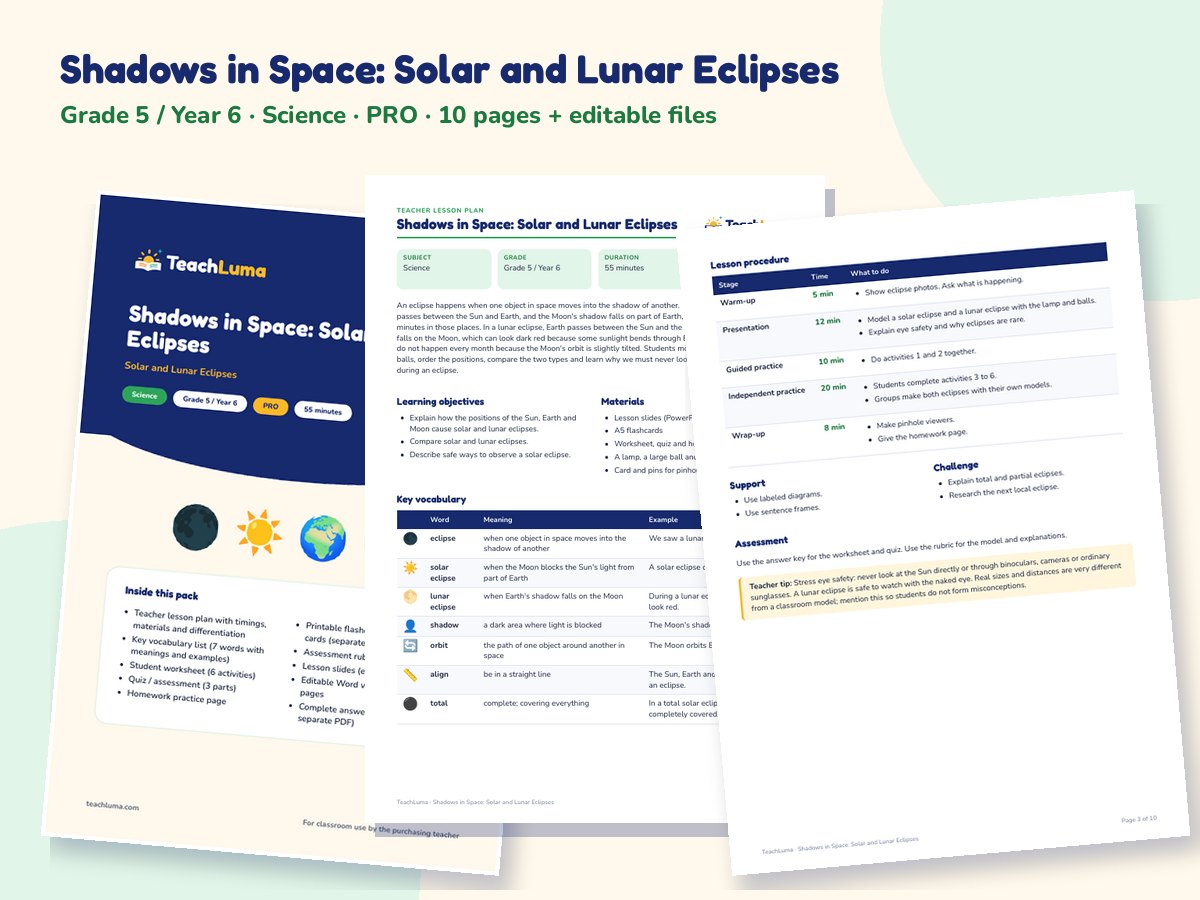
  • 10-page printable PDF lesson pack: teacher lesson plan with timings, materials and differentiation
  • Key vocabulary list (7 words with meanings and examples)
  • Student worksheet (6 activities)
  • Quiz / assessment (3 parts)
  • Homework practice page
  • Printable flashcards: 7 A5 picture cards (separate PDF)
  • Assessment rubric (4 levels)
  • Lesson slides (editable PowerPoint)
  • Editable Word version of all student pages
  • Complete answer key (also as a separate PDF)

Additional Files

  • Lesson Slides (PPTX)
  • Editable Student Pages and Lesson Plan (DOCX)
  • A5 Flashcards (PDF)
  • Answer Key (PDF)

Teacher Reviews

No ratings yet

Be the first teacher to review this resource.

Sign in to review this resource.

Related Resources

Advertisement