Skip to content
Preview
Members Only Science Complete Lesson Pack Grade 6 (Year 7)
No ratings yet

Sour, Slippery or Neutral? Acids and Bases

About This Resource

A complete Grade 6 science pack on acids, bases and the pH scale. Students learn the properties of acids and bases, read pH values, use indicators such as litmus and red cabbage juice safely, and explore neutralization in everyday life. Includes slides, a lesson plan, worksheet, quiz, homework, flashcards, a rubric and answer keys.

Overview

Students meet acids and bases through everyday substances: lemon juice, vinegar, soap and baking soda. They learn the pH scale from 0 to 14, with 7 as neutral, and practice classifying substances from their pH values. Students find out why scientists use indicators instead of tasting or touching, read litmus and red cabbage indicator results, and learn how neutralization is used in antacids and farming. The pack includes a safe red cabbage indicator investigation for the teacher to lead.

Resource Details

Subject
Science
Topic
Acids and Bases
Category
Materials & Matter
File Type
PDF
File Size
322.1 KB
Published
13 Nov 2026
Downloads
0

Members Only

Create a free account to download this resource with one of your 3 Free Pro Previews, or upgrade to Teacher Pro (from ฿199/month) for the whole library.

Share:

Looking for something different? Request a Resource.

Grade 6 science (ages 11–12) 55 minutes Physical science classifying interpreting data safe investigation

Learning Objectives

  • Describe the properties of acids and bases.
  • Use the pH scale to classify substances as acidic, neutral or basic.
  • Explain how indicators work and what neutralization is.

How to Use This Resource

  • Show the slides: a lemon and a bar of soap. Ask: "How are these different?"
  • Read the text and do worksheet activities 1 and 2 together.
  • Lead the red cabbage indicator demonstration, then students complete activities 3 to 6 and the quiz.

Classroom Activity Ideas

  • Red cabbage indicator: the teacher prepares cabbage juice and adds it to vinegar, water and baking soda solution while students record the colors.
  • pH number line: students place picture cards of everyday substances on a giant 0 to 14 line.
  • Neutralization demo: add baking soda solution to vinegar with indicator and watch the color change.

Differentiation

Support: give a colored pH scale with example pictures. Challenge: students research acid rain or how pH affects ocean animals with shells.

Assessment

Use the worksheet and quiz to check classification and pH reading. Use the rubric for explanations and the homework investigation.

Teacher Tips

Model safe practice throughout: goggles on, no tasting and no touching unknown liquids. Use only weak household substances for demonstrations. Stress that both strong acids and strong bases can be dangerous.

What's Included

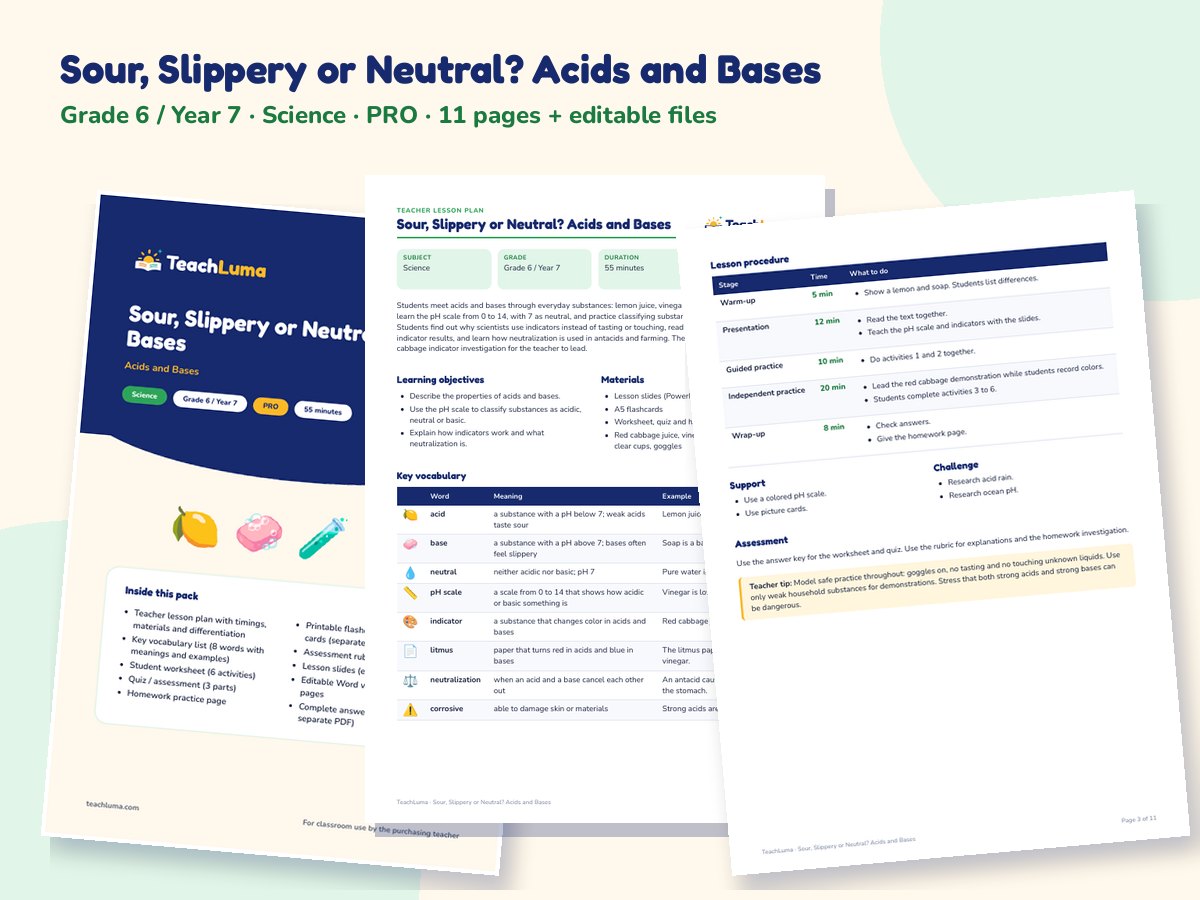
  • 11-page printable PDF lesson pack: teacher lesson plan with timings, materials and differentiation
  • Key vocabulary list (8 words with meanings and examples)
  • Student worksheet (6 activities)
  • Quiz / assessment (3 parts)
  • Homework practice page
  • Printable flashcards: 8 A5 picture cards (separate PDF)
  • Assessment rubric (4 levels)
  • Lesson slides (editable PowerPoint)
  • Editable Word version of all student pages
  • Complete answer key (also as a separate PDF)

Additional Files

  • Lesson Slides (PPTX)
  • Editable Student Pages and Lesson Plan (DOCX)
  • A5 Flashcards (PDF)
  • Answer Key (PDF)

Teacher Reviews

No ratings yet

Be the first teacher to review this resource.

Sign in to review this resource.

Related Resources

Advertisement