Skip to content
Preview
Members Only Science Complete Lesson Pack Grade 2 (Year 3)
No ratings yet

From Nature or Made by People? Natural and Human-Made Materials

About This Resource

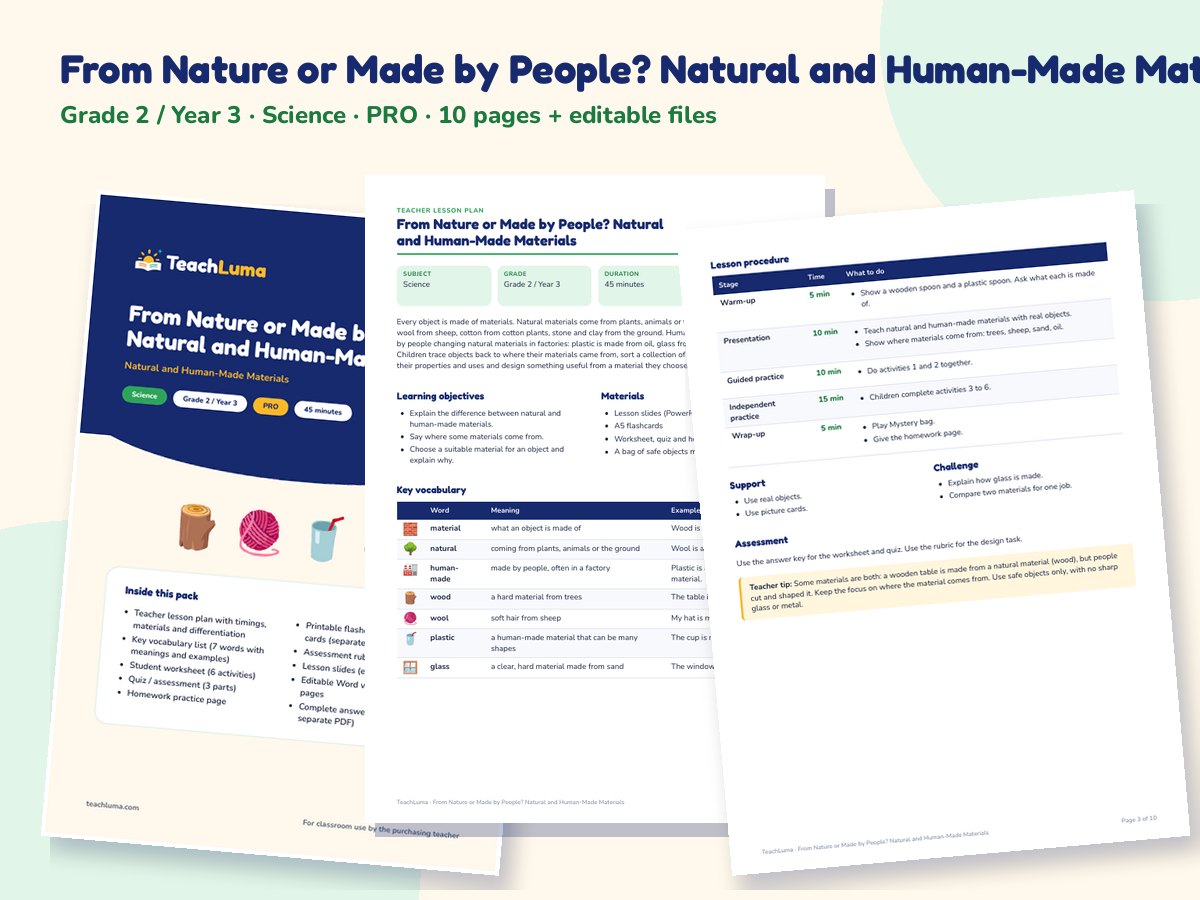
A complete Grade 2 science pack on natural and human-made materials. Children learn that wood, wool, cotton, stone and clay come from nature, while plastic, glass, paper and metal objects are made or changed by people. They trace materials back to their source, sort objects, match materials to uses and design a product from a material of their choice. Includes slides, a lesson plan, worksheet, quiz, homework, flashcards, a rubric and answer keys.

Overview

Every object is made of materials. Natural materials come from plants, animals or the ground: wood from trees, wool from sheep, cotton from cotton plants, stone and clay from the ground. Human-made materials are made by people changing natural materials in factories: plastic is made from oil, glass from sand and paper from wood. Children trace objects back to where their materials came from, sort a collection of objects, match materials with their properties and uses and design something useful from a material they choose.

Resource Details

Subject
Science
Topic
Natural and Human-Made Materials
Category
Materials & Matter
File Type
PDF
File Size
315.2 KB
Published
13 Nov 2026
Downloads
0

Members Only

Create a free account to download this resource with one of your 3 Free Pro Previews, or upgrade to Teacher Pro (from ฿199/month) for the whole library.

Share:

Looking for something different? Request a Resource.

Grade 2 science (ages 7–8) 45 minutes Physical science sorting observing explaining designing

Learning Objectives

  • Explain the difference between natural and human-made materials.
  • Say where some materials come from.
  • Choose a suitable material for an object and explain why.

How to Use This Resource

  • Show a wooden spoon and a plastic spoon. Ask: "What is each made of? Where did it come from?"
  • Teach natural and human-made with real objects, then do worksheet activities 1 and 2 together.
  • Children complete activities 3 to 6, then use the quiz and take home the homework page.

Classroom Activity Ideas

  • Mystery bag: children feel an object, guess the material and say if it is natural or human-made.
  • Where does it come from? Children match objects to their sources (a T-shirt to a cotton plant).
  • Material walk: children find natural and human-made materials around the school.

Differentiation

Support: use real objects and picture cards for sources. Challenge: children explain how one human-made material is made from a natural one (sand to glass).

Assessment

Use the worksheet and quiz to check sorting and sources. Use the rubric to assess the design task and explanations.

Teacher Tips

Some materials are both: a wooden table is made from a natural material (wood), but people cut and shaped it. Keep the focus on where the material comes from. Use safe objects only, with no sharp glass or metal.

What's Included

  • 10-page printable PDF lesson pack: teacher lesson plan with timings, materials and differentiation
  • Key vocabulary list (7 words with meanings and examples)
  • Student worksheet (6 activities)
  • Quiz / assessment (3 parts)
  • Homework practice page
  • Printable flashcards: 7 A5 picture cards (separate PDF)
  • Assessment rubric (4 levels)
  • Lesson slides (editable PowerPoint)
  • Editable Word version of all student pages
  • Complete answer key (also as a separate PDF)

Additional Files

  • Lesson Slides (PPTX)
  • Editable Student Pages and Lesson Plan (DOCX)
  • A5 Flashcards (PDF)
  • Answer Key (PDF)

Teacher Reviews

No ratings yet

Be the first teacher to review this resource.

Sign in to review this resource.

Related Resources

Advertisement