Skip to content
Preview
Members Only Math Complete Lesson Pack Grade 4 (Year 5)
No ratings yet

Special Numbers: Prime and Square Numbers

About This Resource

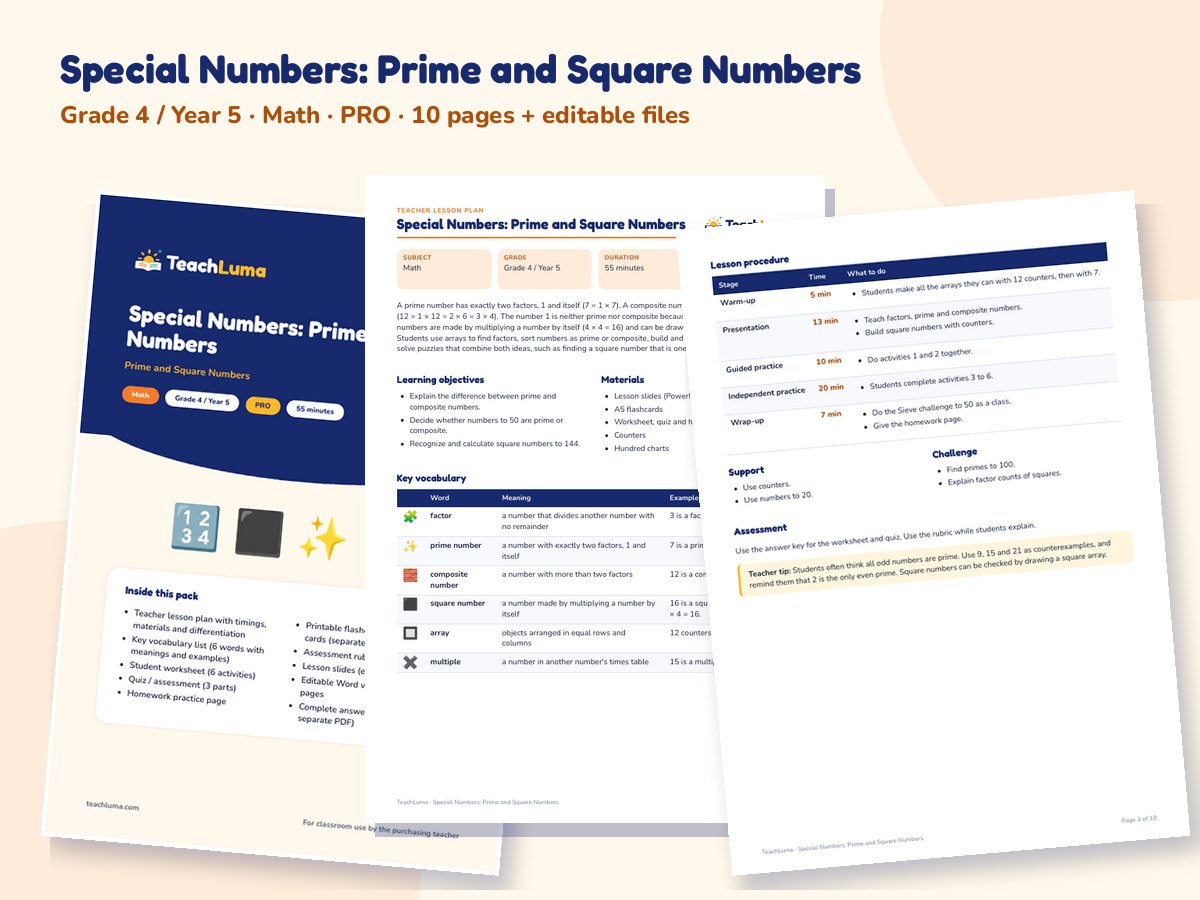
A complete Grade 4 math pack on prime, composite and square numbers. Students find factors with arrays, decide whether numbers to 50 are prime or composite, learn why 1 is neither, build square numbers with dot patterns, calculate squares to 12 × 12 and solve number puzzles. Includes slides with worked examples, a lesson plan, worksheet, quiz, homework, flashcards, a rubric and answer keys.

Overview

A prime number has exactly two factors, 1 and itself (7 = 1 × 7). A composite number has more than two factors (12 = 1 × 12 = 2 × 6 = 3 × 4). The number 1 is neither prime nor composite because it has only one factor. Square numbers are made by multiplying a number by itself (4 × 4 = 16) and can be drawn as square arrays of dots. Students use arrays to find factors, sort numbers as prime or composite, build and calculate square numbers and solve puzzles that combine both ideas, such as finding a square number that is one more than a prime.

Resource Details

Subject
Math
Topic
Prime and Square Numbers
Category
Number Sense
File Type
PDF
File Size
258.1 KB
Published
13 Nov 2026
Downloads
0

Members Only

Create a free account to download this resource with one of your 3 Free Pro Previews, or upgrade to Teacher Pro (from ฿199/month) for the whole library.

Share:

Looking for something different? Request a Resource.

Grade 4 math (ages 9–10) 55 minutes Factors multiplication facts number properties reasoning

Learning Objectives

  • Explain the difference between prime and composite numbers.
  • Decide whether numbers to 50 are prime or composite.
  • Recognize and calculate square numbers to 144.

How to Use This Resource

  • Start with the slides: give students 12 counters and ask how many different rectangles (arrays) they can make. Then try 7 counters.
  • Teach prime, composite and square numbers with the worked examples, then do worksheet activities 1 and 2 together.
  • Students complete activities 3 to 6, then use the quiz and send the homework page home.

Classroom Activity Ideas

  • Array hunt: students find all the arrays for numbers 1 to 20 and record which make only one row.
  • Sieve challenge: students cross out multiples on a hundred chart to find the primes to 50.
  • Square patterns: students build square numbers with counters and spot the odd-number pattern between them (1, 3, 5, 7…).

Differentiation

Support: give counters, a multiplication grid and numbers to 20. Challenge: students find all primes to 100 and explain why every square number has an odd number of factors.

Assessment

Use the worksheet and quiz to check prime, composite and square numbers. Use the rubric while students explain their reasoning.

Teacher Tips

Students often think all odd numbers are prime. Use 9, 15 and 21 as counterexamples, and remind them that 2 is the only even prime. Square numbers can be checked by drawing a square array.

What's Included

  • 10-page printable PDF lesson pack: teacher lesson plan with timings, materials and differentiation
  • Key vocabulary list (6 words with meanings and examples)
  • Student worksheet (6 activities)
  • Quiz / assessment (3 parts)
  • Homework practice page
  • Printable flashcards: 6 A5 picture cards (separate PDF)
  • Assessment rubric (4 levels)
  • Lesson slides (editable PowerPoint)
  • Editable Word version of all student pages
  • Complete answer key (also as a separate PDF)

Additional Files

  • Lesson Slides (PPTX)
  • Editable Student Pages and Lesson Plan (DOCX)
  • A5 Flashcards (PDF)
  • Answer Key (PDF)

Teacher Reviews

No ratings yet

Be the first teacher to review this resource.

Sign in to review this resource.

Related Resources

Advertisement