Skip to content
Preview
Free ESL Worksheet Grade 4 (Year 5)
No ratings yet

Story or Facts? Fiction and Nonfiction

About This Resource

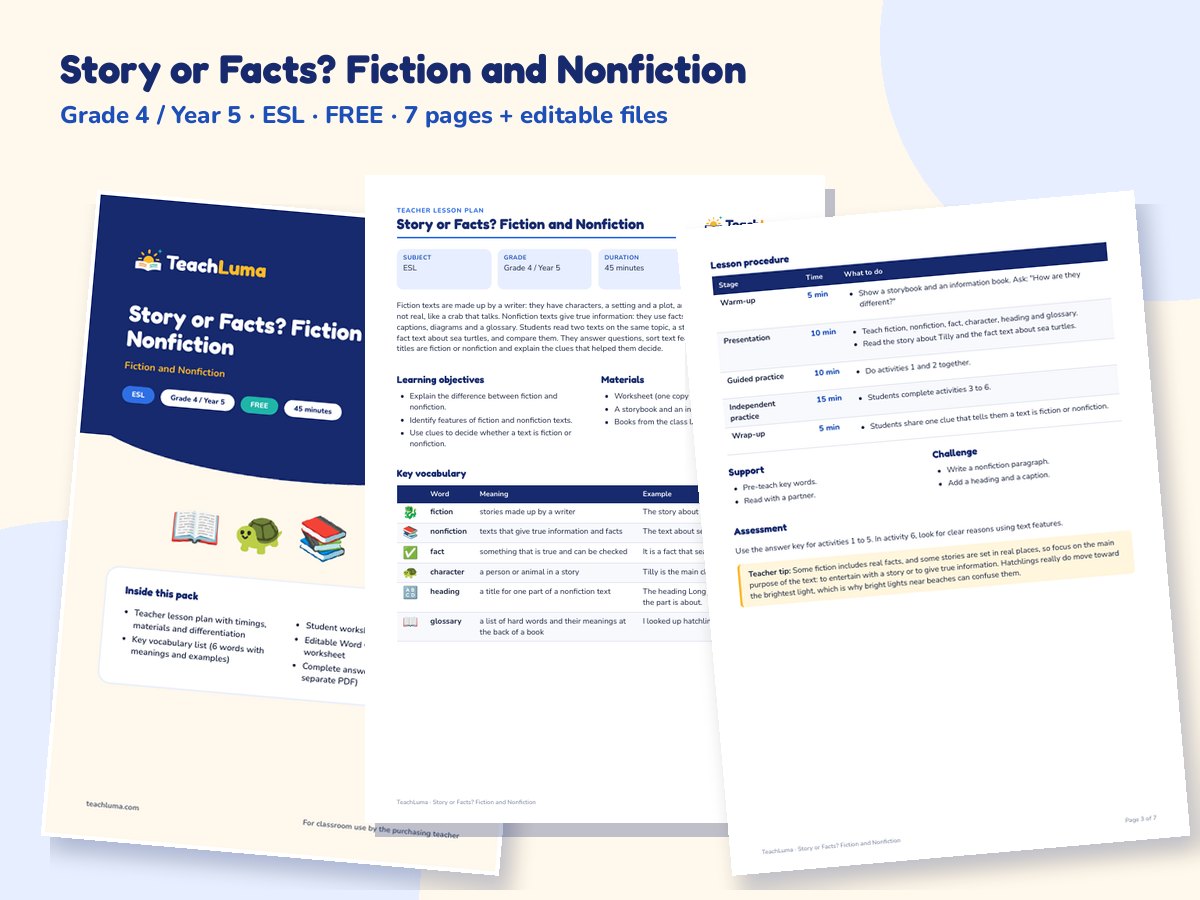
A free Grade 4 ESL reading worksheet on the difference between fiction and nonfiction. Students read a short story about a baby turtle and a fact text about sea turtles, answer questions on each, sort the features of fiction and nonfiction texts, decide whether book titles are fiction or nonfiction and explain how they know. Includes a timed lesson plan, a six-activity worksheet, an editable Word version and answer key.

Overview

Fiction texts are made up by a writer: they have characters, a setting and a plot, and things can happen that are not real, like a crab that talks. Nonfiction texts give true information: they use facts, headings, photos with captions, diagrams and a glossary. Students read two texts on the same topic, a story about Tilly the turtle and a fact text about sea turtles, and compare them. They answer questions, sort text features, decide whether book titles are fiction or nonfiction and explain the clues that helped them decide.

Resource Details

Subject
ESL
Topic
Fiction and Nonfiction
Category
Reading
File Type
PDF
File Size
230.1 KB
Published
12 Nov 2026
Downloads
0
Download

Free download — no account required.

Teaching this in class? Try our free Random Name Picker & Timer.

Share:

Looking for something different? Request a Resource.

Grade 4 ESL (ages 9–10), A2 45 minutes Reading comprehension text features comparing texts explaining

Student Task

  • Hold up a storybook and an information book. Ask: "How are these books different?"
  • Read the two turtle texts and do activities 1 and 2 together.
  • Students complete activities 3 to 6. Answers are in the answer key.

Classroom Use

  • Library sort: groups sort a pile of books from the class library into fiction and nonfiction and explain their choices.
  • Feature hunt: students find a heading, a caption and a glossary in an information book.
  • Turn it around: students write two fact sentences about an animal from a story they know.

Differentiation

Support: pre-teach reptile, hatchling and surface, and let students read the texts with a partner. Challenge: students write a short nonfiction paragraph about another animal using a heading and a caption.

Answer Key & Assessment

Activities 1 to 5 check comprehension and text features (answer key included). Activity 6 shows whether students can explain their reasoning.

Learning Objectives

  • Explain the difference between fiction and nonfiction.
  • Identify features of fiction and nonfiction texts.
  • Use clues to decide whether a text is fiction or nonfiction.

Teacher Tips

Some fiction includes real facts, and some stories are set in real places, so focus on the main purpose of the text: to entertain with a story or to give true information. Hatchlings really do move toward the brightest light, which is why bright lights near beaches can confuse them.

What's Included

  • 7-page printable PDF lesson pack: teacher lesson plan with timings, materials and differentiation
  • Key vocabulary list (6 words with meanings and examples)
  • Student worksheet (6 activities)
  • Editable Word version of the worksheet
  • Complete answer key (also as a separate PDF)

Additional Files


Teacher Reviews

No ratings yet

Be the first teacher to review this resource.

Sign in to review this resource.

Related Resources

Advertisement