Skip to content
Preview
Members Only Science Complete Lesson Pack Grade 5
No ratings yet

Tiny Building Blocks: Plant and Animal Cells

About This Resource

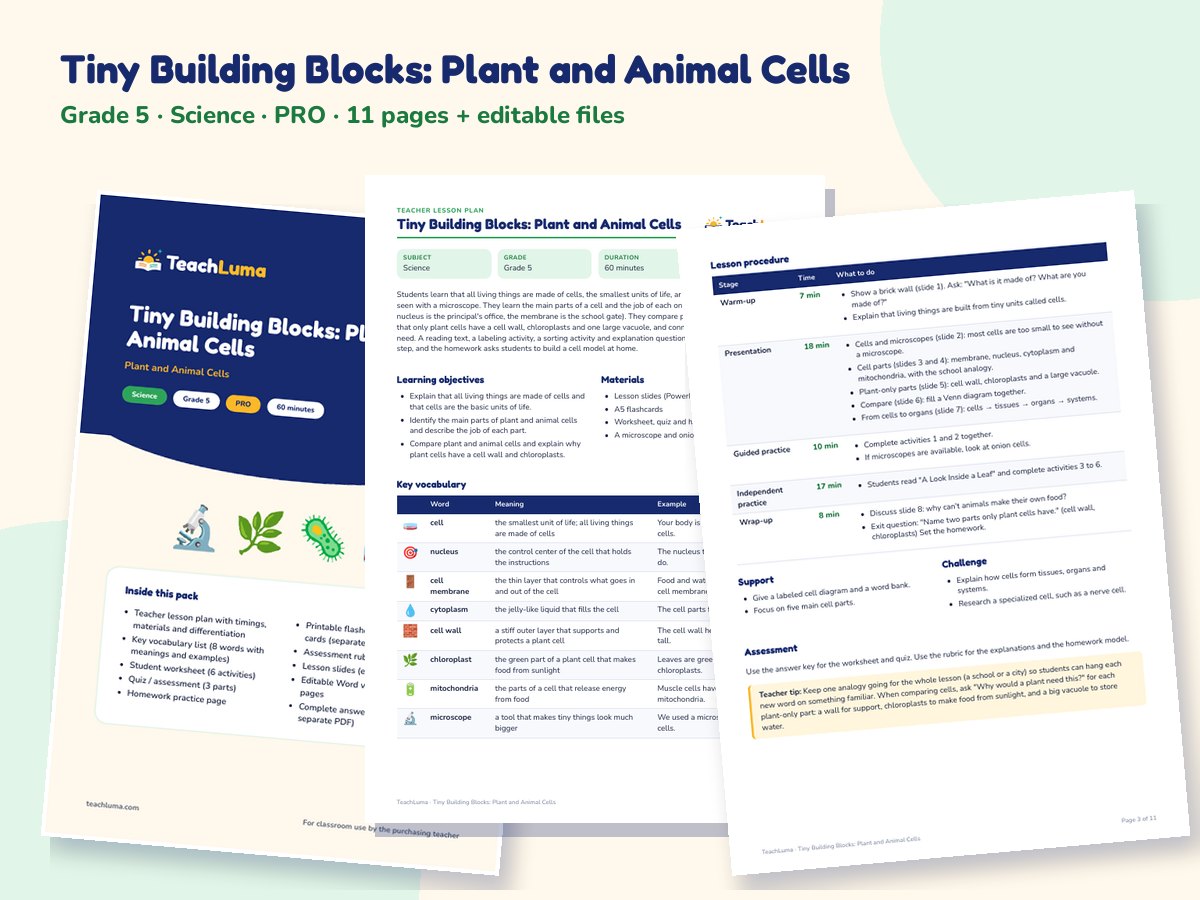
A complete Grade 5 science lesson pack on plant and animal cells: cells as the building blocks of living things, using a microscope, the jobs of the cell membrane, nucleus, cytoplasm, mitochondria, cell wall, chloroplasts and vacuole, comparing plant and animal cells in a Venn diagram, and how cells form tissues and organs. Includes slides, a timed lesson plan, flashcards, worksheet, quiz, homework, rubric and answer key.

Overview

Students learn that all living things are made of cells, the smallest units of life, and that most cells can only be seen with a microscope. They learn the main parts of a cell and the job of each one, using a school analogy (the nucleus is the principal's office, the membrane is the school gate). They compare plant and animal cells, finding that only plant cells have a cell wall, chloroplasts and one large vacuole, and connect these parts to what plants need. A reading text, a labeling activity, a sorting activity and explanation questions build understanding step by step, and the homework asks students to build a cell model at home.

Resource Details

Subject
Science
Topic
Plant and Animal Cells
Category
Living Things
File Type
PDF
File Size
372 KB
Published
01 Nov 2026
Downloads
0

Members Only

Upgrade to Teacher Pro (from ฿199/month) to download this resource.

Share:

Looking for something different? Request a Resource.

Grade 5 (ages 10–11) 60 minutes Life science comparing labeling reading comprehension explaining modeling

Learning Objectives

  • Explain that all living things are made of cells and that cells are the basic units of life.
  • Identify the main parts of plant and animal cells and describe the job of each part.
  • Compare plant and animal cells and explain why plant cells have a cell wall and chloroplasts.

How to Use This Resource

  • Start with slide 1: show a brick wall and ask what it is made of. Link bricks to cells as building blocks.
  • Teach the cell parts with the school analogy on the slides, then compare plant and animal cells using the Venn diagram slide.
  • Students complete the worksheet, then use the quiz to check and the homework model project for practice. Answers are in the answer key.

Classroom Activity Ideas

  • Onion skin cells: if microscopes are available, students look at a thin layer of onion skin stained with iodine and draw what they see.
  • Cell in a bag: fill a zip bag with gelatin (cytoplasm), a grape (nucleus) and small beans (mitochondria); put it in a box for a plant cell wall.
  • Cell city: groups compare a cell to a city and make a poster that matches each cell part to a city job.

Differentiation

Support: give a labeled cell diagram and a word bank, and focus on five parts (membrane, nucleus, cytoplasm, cell wall, chloroplast). Challenge: add mitochondria and the vacuole, explain how cells form tissues, organs and systems, and research one specialized cell such as a red blood cell or a nerve cell.

Assessment

Worksheet activities and the quiz check cell parts, their jobs and the differences between plant and animal cells (answer key included). The explanation questions, homework model and rubric assess understanding.

Teacher Tips

Keep one analogy going for the whole lesson (a school or a city) so students can hang each new word on something familiar. When comparing cells, ask "Why would a plant need this?" for each plant-only part: a wall for support, chloroplasts to make food from sunlight, and a big vacuole to store water.

What's Included

  • 11-page printable PDF lesson pack: teacher lesson plan with timings, materials and differentiation
  • Key vocabulary list (8 words with meanings and examples)
  • Student worksheet (6 activities)
  • Quiz / assessment (3 parts)
  • Homework practice page
  • Printable flashcards: 8 A5 picture cards (separate PDF)
  • Assessment rubric (4 levels)
  • Lesson slides (editable PowerPoint)
  • Editable Word version of all student pages
  • Complete answer key (also as a separate PDF)

Additional Files

  • Lesson Slides (PPTX)
  • Editable Student Pages and Lesson Plan (DOCX)
  • A5 Flashcards (PDF)
  • Answer Key (PDF)

Teacher Reviews

No ratings yet

Be the first teacher to review this resource.

Sign in to review this resource.

Related Resources

Advertisement